Most Data Agent demos end at the same impressive moment:
A user asks a question, the Agent connects to a database, writes SQL, and returns a table with a few conclusions.
That is useful. But if the result lives only in a chat transcript, it is not yet a production data asset. The next BI report, scheduled job, or downstream Agent still needs someone to translate the chat logic back into ETL, a target schema, and validation scripts.
The hard part is not getting a model to produce an answer. It is making that answer satisfy four conditions:
- Verifiable: dirty data or an incorrect metric definition cannot quietly cross a boundary.
- Materialized: the result can be written to an explicit data target instead of remaining in a chat window.
- Reloadable: the state that was actually written can be read back and checked.
- Reusable: BI, schedulers, and later Agents can consume it like an ordinary data asset.
Over the past few days, we independently verified two important mechanisms in an Infinity SQL test environment:
!assert: a deterministic quality gate raises an error when it finds dirty data and stops later statements.save: an analytical result can be written in the form of a MySQL production table and then reloaded withloadfor verification.
Put them into the same production design and a Data Agent begins to move from “a chat tool that answers questions” toward “an execution system that delivers verifiable data assets.”
A Trustworthy Analysis Pipeline Has to Close Four Loops
The ideal execution flow can be compressed into six actions:
load → select → !assert → save → reload → verify
read     compute     gate      write    reread     check
Two boundaries matter most:
!assertdecides whether a result may affect the outside world.reload + verifydetermines whether the outside world actually reached the intended state.
The model proposes the computation. The runtime executes it. Deterministic rules decide whether it may proceed. A fresh read from the target system supplies the acceptance evidence. Probabilistic capability and deterministic constraints each do the job they are good at, producing an auditable Agent workflow.
Gate One: Do Not Let a Probabilistic System Audit Probability with More Probability
Suppose the Agent receives four order events and one row has a null user_id:
set events='''
{"id":1,"user_id":"u1","amount":120}
{"id":2,"user_id":"u2","amount":80}
{"id":3,"user_id":null,"amount":56}
{"id":4,"user_id":"u4","amount":230}
''';

load jsonStr.`events` as events_table;

select count(*) as null_users
from events_table
where user_id is null
as null_check;

!assert null_check ''' :null_users == 0 '''
"user_id contains null; block downstream write";

select "quality gate passed" as message as output;
In the test environment, the engine raised the equivalent of:
java.lang.RuntimeException: user_id contains null; block downstream write
The natural-language error text above is translated for the English edition; the original test emitted the same message in Chinese.
More importantly, the following quality gate passed statement did not execute.
That is fundamentally different from asking the model to “check whether the result looks reasonable.” The latter is another probabilistic judgment. !assert turns a business rule into a deterministic condition that the runtime must satisfy. If the condition is false, the pipeline stops.
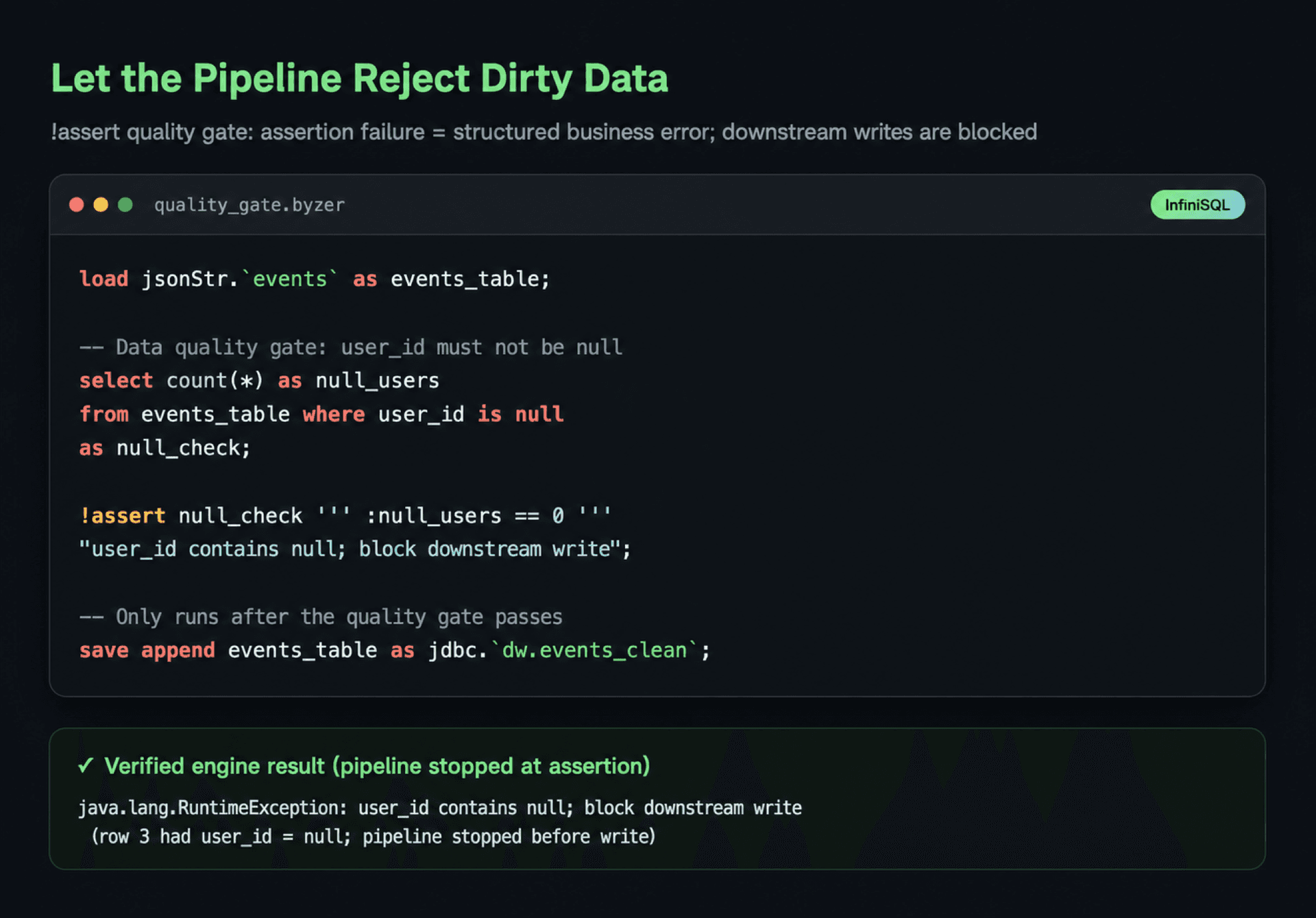
!assert has another practical design property: it asserts over a table.
To verify something, first use select to calculate the evidence into a small table, then assert on fields in that table. The Agent does not need to learn a second testing language. The query capability it already uses can become a quality gate:
- row count must be greater than zero;
- primary keys must not be null;
- unique keys must not be duplicated;
- old and new metric definitions must reconcile;
- amount variance must stay inside a business threshold;
- the target partition must match the intended scope before a write.
Quality validation is no longer an analyst’s note appended after the work. It becomes part of the pipeline itself.
Gate Two: Put the Quality Gate Before Every Irreversible Action
The most valuable place for a quality gate is not before all exploration. It is immediately before each irreversible action:
free exploration zone                    external impact zone

load → clean → aggregate → reconcile → !assert → save / send report / trigger downstream work
Inside the free exploration zone, the Agent can try different queries, correct syntax, and compare interpretations. Mistakes are cheap.
The risk changes completely when the next step writes to a database, sends a report, or triggers another system. At that boundary, a deterministic rule should decide whether the workflow may proceed—not the model approving itself with “this looks fine.”
The pattern resembles CI in software engineering:
- developers can change code freely;
- failing tests prevent a merge;
- a Data Agent can explore freely;
- a failing quality gate prevents a write to a production target.
The goal is not to make the Agent infallible. The goal is to keep an error from quietly expanding its blast radius.
Gate Three: save Turns an Exploratory Result Directly into a Table
Once the quality gate passes, the analysis still needs an explicit production outlet.
In a separate test, one InfiniSQL pipeline loaded MySQL orders, calculated a regional report, wrote it to region_report_daily, and then reloaded it for verification:
load jdbc.`biz_mysql.orders` as orders;

select
  region,
  count(*) as order_cnt,
  sum(amount) as gmv
from orders
where status = 'paid'
group by region
as region_report;

save overwrite region_report
as jdbc.`biz_mysql.region_report_daily`;

load jdbc.`biz_mysql.region_report_daily`
as verify_report;

select *
from verify_report
order by gmv desc
as output;
The actual values returned by the test environment were:
| Region | Paid orders | GMV |
|---|---|---|
| East China | 8 | 274,600 |
| North China | 2 | 14,000 |
| South China | 1 | 12,000 |
| Southwest | 2 | 7,200 |
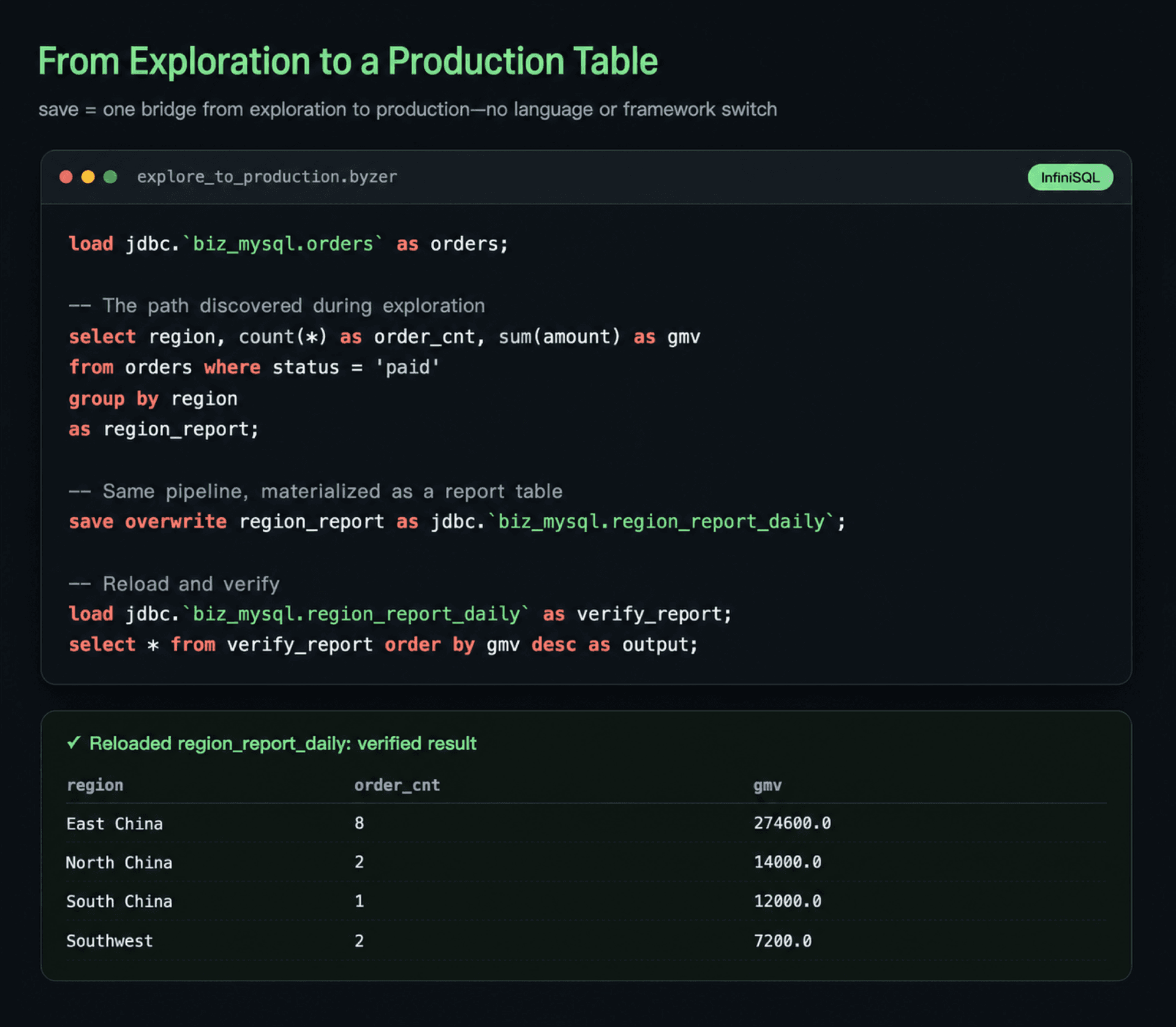
The important point is not merely that this removes some ETL code. It is that analysis and delivery do not require a language switch:
- read data with
load; - define the metric with
select ... as; - write the target with
save; - verify the result with
loadandselectagain.
Logic confirmed during exploration does not have to be translated manually into another framework, another language, or another team’s implementation. Every translation removed also removes one possible source of metric drift.
Gate Four: Why a Successful Write Still Has to Be Reloaded
Many automation systems treat “the write command did not throw an error” as success. For a production system, that evidence is not enough.
A successful write request only says that the request completed. Reloading answers the more important questions:
- Does the target table actually exist?
- Do its fields and values match expectations?
- Is the row count correct?
- Did an overwrite affect only the intended target?
- Can the next consumer read the result through the standard interface?
reload is not redundant repetition. It is a state confirmation.
A safer production template looks like this:
compute a candidate result
  ↓
pre-write assertions: quality, metric definition, target scope
  ↓
save: execute an explicit write mode
  ↓
load: read the target system again
  ↓
post-write assertions: row count, key metrics, idempotency keys, partition scope
  ↓
deliver to BI, a scheduler, or another Agent
The pre-write assertion constrains what is about to be written. The post-write assertion verifies what was actually written. They solve different problems.
The Four save Modes Are Four Different Risk Choices
save supports four explicit modes:
| Mode | Semantics | Suitable use | Primary risk |
|---|---|---|---|
overwrite | replace the target | full report refresh | a wrong target can be overwritten |
append | add rows | incremental flows and event logs | retries can create duplicates |
ignore | skip if the target exists | idempotent initialization | stale state can remain |
errorIfExists | fail if the target exists | prevent accidental replacement | conflicts require explicit handling |
This table makes one point clear: save is not a vague instruction to “store this.” Every write must declare its semantics, which means consciously selecting a risk model.
An Agent should default to conservative behavior:
- Before the target is confirmed, prefer
errorIfExists. - Before using
overwrite, assert the target name, partition, and critical metrics. - When using
append, design a business key or another idempotency rule. - After every write, reload and verify.
- High-risk targets still need permissions, auditing, and human approval.
The language can provide deterministic primitives. It cannot replace all production governance for the team.
From a One-Off Answer to an Asset Other Systems Can Keep Consuming
Once the loop is closed, the same analytical result gets a completely different lifecycle.
If it exists only in a chat transcript:
- it is hard to reuse after the user leaves the page;
- its metric definition and sources are difficult to trace;
- another Agent has to reconstruct the context;
- BI and scheduling systems cannot consume it directly;
- after a failure, it is hard to tell how far execution progressed.
If the result passes a quality gate, is written into a table, and is verified by reloading:
- the table name becomes a stable reference;
- the metric definition can be audited with the pipeline;
- BI can read it directly;
- a scheduler can refresh it periodically;
- a later Agent can continue analysis from that table;
- failures can be localized to reading, computation, gating, writing, or verification.
That is what it means for an analytical result to become an asset. It is not the answer being stored as text. It is the answer becoming a named, structured, verified data object that other systems can keep consuming.
InfiniSynapse Has to Provide More Than a Chat Experience
Users can still ask questions in natural language. Natural language is not the problem. The underlying execution cannot depend on natural language alone.
A trustworthy product layer should progressively map the user’s intent to inspectable execution objects:
user goal
  → Agent generates an InfiniSQL pipeline
  → runtime executes and retains intermediate results
  → deterministic quality gates decide whether the workflow may proceed
  → explicit write semantics materialize the result in a target system
  → reload and assertions produce acceptance evidence
  → the result enters BI, a scheduler, or the next Agent run
In this architecture, the language model interprets an ambiguous goal, proposes steps, and explains the result. InfiniSQL brings data operations, state, validation, and delivery into one execution language.
That is closer to what enterprises need than simply making an Agent produce a smarter first answer. They do not need one confident sentence. They need a pipeline that can be traced, rerun, stopped, and accepted.
The Evidence Boundaries Must Stay Explicit
This article combines two tests that were executed separately. They should not be exaggerated into a single end-to-end production acceptance test:
- The
!asserttest verified that a null value raises a runtime error and stops later statements. That script did not connect to a real target database and perform a write. - The
savetest verified that a regional report written to the MySQL tableregion_report_dailycould be reloaded withload, returning the four regional results shown above. - The current evidence does not prove a production SLA, concurrent throughput, transaction rollback behavior, the permission model, or recovery time.
- A real production deployment still needs access control, credential isolation, audit logs, target allowlists, idempotency strategy, transaction boundaries, monitoring, alerting, and human approval.
Keeping those boundaries honest does not weaken the design. It shows that this is an architecture that can be validated further—not a piece of marketing magic.
Conclusion: Do Not Ask Only “What Is the Answer?”
Ask better questions:
- Which data supports this answer?
- Which rules decide that it may be delivered?
- Where was it written?
- Was the written state reloaded and verified?
- How will another system or Agent consume it next?
- If it fails, can we identify the exact stage where it stopped?
When load → select → !assert → save → reload → verify becomes one coherent flow, a Data Agent is no longer limited to answering questions.
It begins to deliver data assets.
The !assert interception and the save write/reload values in this article come from real executions in an Infinity SQL test environment. InfiniSQL is the execution engine underneath the InfiniSynapse data analysis Agent.