Memory Must Be SaaS, and Agents Must Follow Through
Why Agent memory needs SaaS, and how Personal Agents take responsibility for ongoing work through goals, KPIs, constraints, reports, and feedback.
Writing archive
Thoughts on AI coding, developer tools, and building software that works for everyone.

Why Agent memory needs SaaS, and how Personal Agents take responsibility for ongoing work through goals, KPIs, constraints, reports, and feedback.

A year of social media operations, an Apple developer task spanning two weeks, and three months of website performance work: goals, KPIs, and constraints guide ongoing follow-up.

From Dots, Muse, and Devin to Sparse Agent: goals, KPIs, ongoing responsibility, three work scenarios, a cloud computer in your account, and cloud Memory.

Why Sparse Agent uses DHH’s Omarchy on a cloud computer in your own DigitalOcean account, with a complete working environment, SSH access, and control over when to keep or delete the machine.

A year of social media operations, an Apple developer account task spanning two weeks, and three months of website performance work: how goals, KPIs, and human participation guide each responsibility.
Save working preferences, project conventions and reusable lessons as cloud memory. Learn how to connect, save, recall, update and manage memory across agent sessions.

Sparse Agent works on your own accounts: the model key decides what it thinks with, the DigitalOcean token decides where its cloud machine lives, the cloud environment is the computer it works on, and cloud memory is how it remembers your preferences. Here is how to set up each of the four, what each one does, and why we chose DigitalOcean + Omarchy.

We ran Jev head-to-head against the recall-judgment LLM we use in production on ten years of Apple 10-K filings: 79 samples, accuracy tied at 92.2%, average latency 1.0s vs 11.3s, about $0.00018 per judgment.

Same Apple 10-K corpus, same 79 samples, six recall judges instead of two: official Jev ties production Flash at 92.2% accuracy, while open-source reproductions openjev/semif reach only 75.9%/79.7%, and vector search tops out at 64.6%.

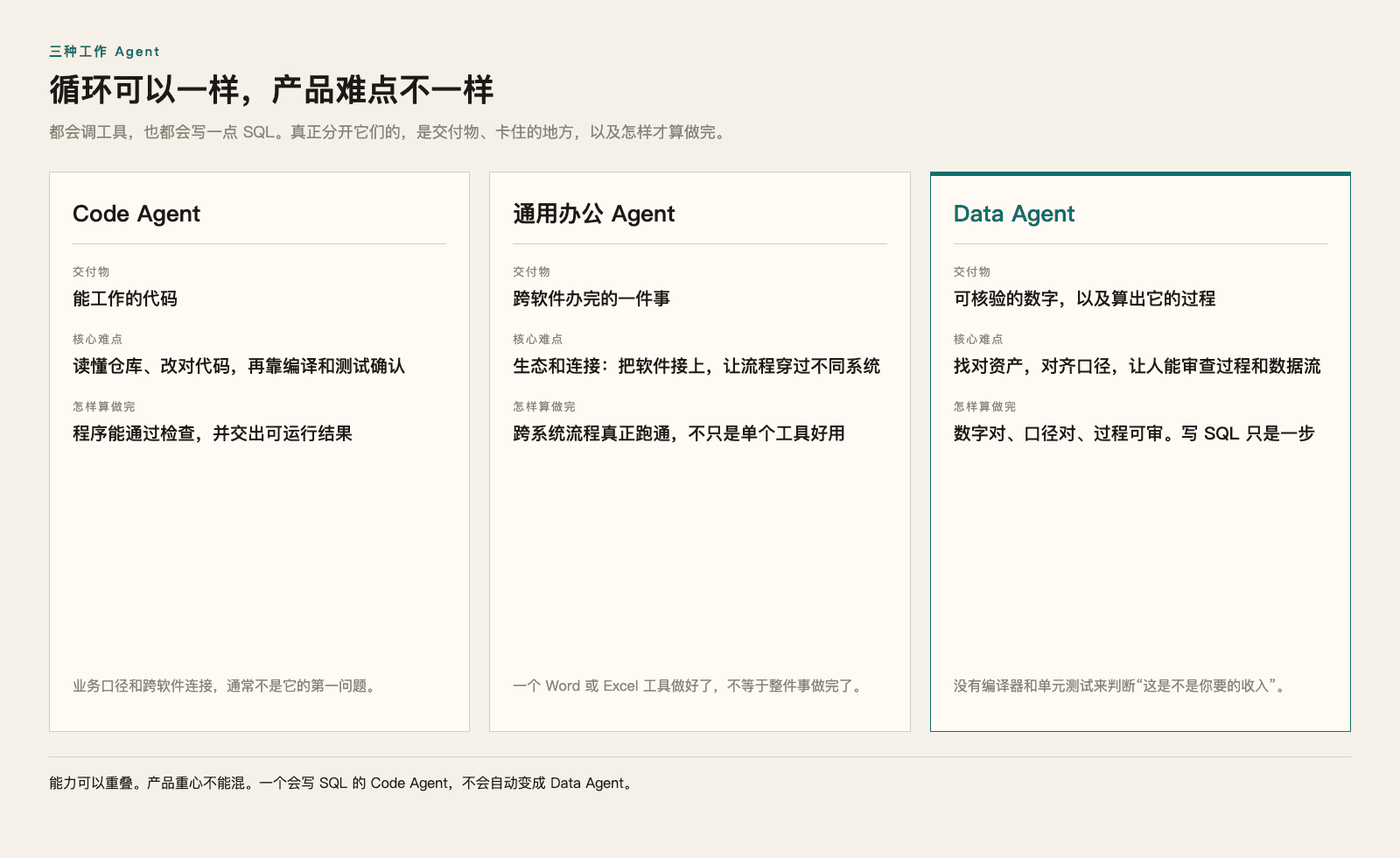
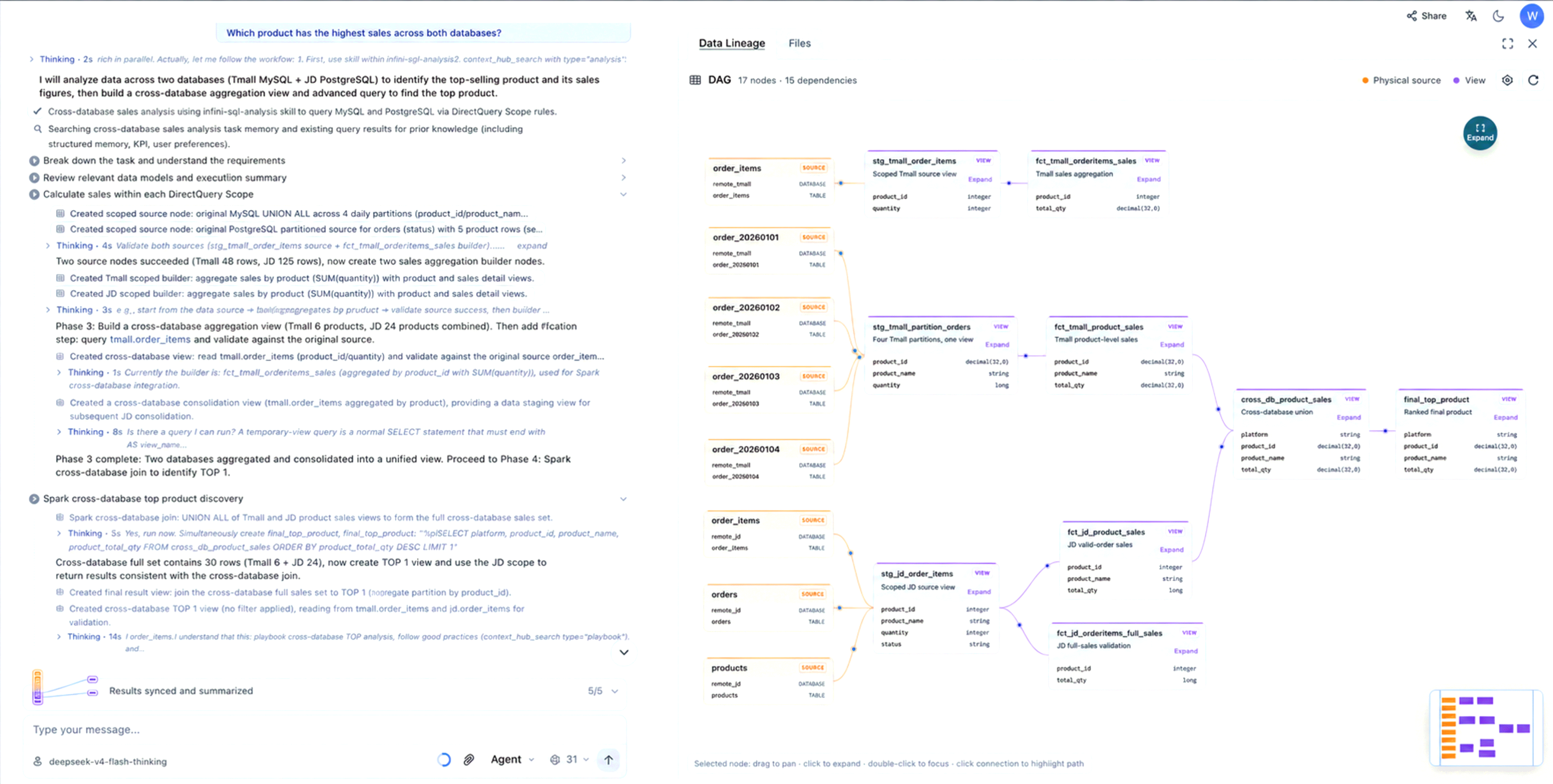
Code Agents, office Agents, and Data Agents share the same loop. Being able to write SQL still does not mean you have built a Data Agent. Asset search, definition alignment, and inspectable results, plus InfiniSQL and Context Hub, are what make a product enterprises can use.

If the model determines whether an agent feels human, the harness determines what kind of person it becomes. InfiniSynapse behaves like a data analyst: layered reasoning, metric definitions before answers, and inspectable pipelines that can enter real business.

A task-executing AI Agent walks through InfiniSynapse's personal and enterprise dev editions, verifying how embeddability, connect-and-ask, and organizational alignment combine into an Agentic Data Engine.
A fourteen-day macOS signing and notarization journey: how William and an AI collaborator worked through support escalations, permission boundaries, and a changing release baseline until the job was truly complete.

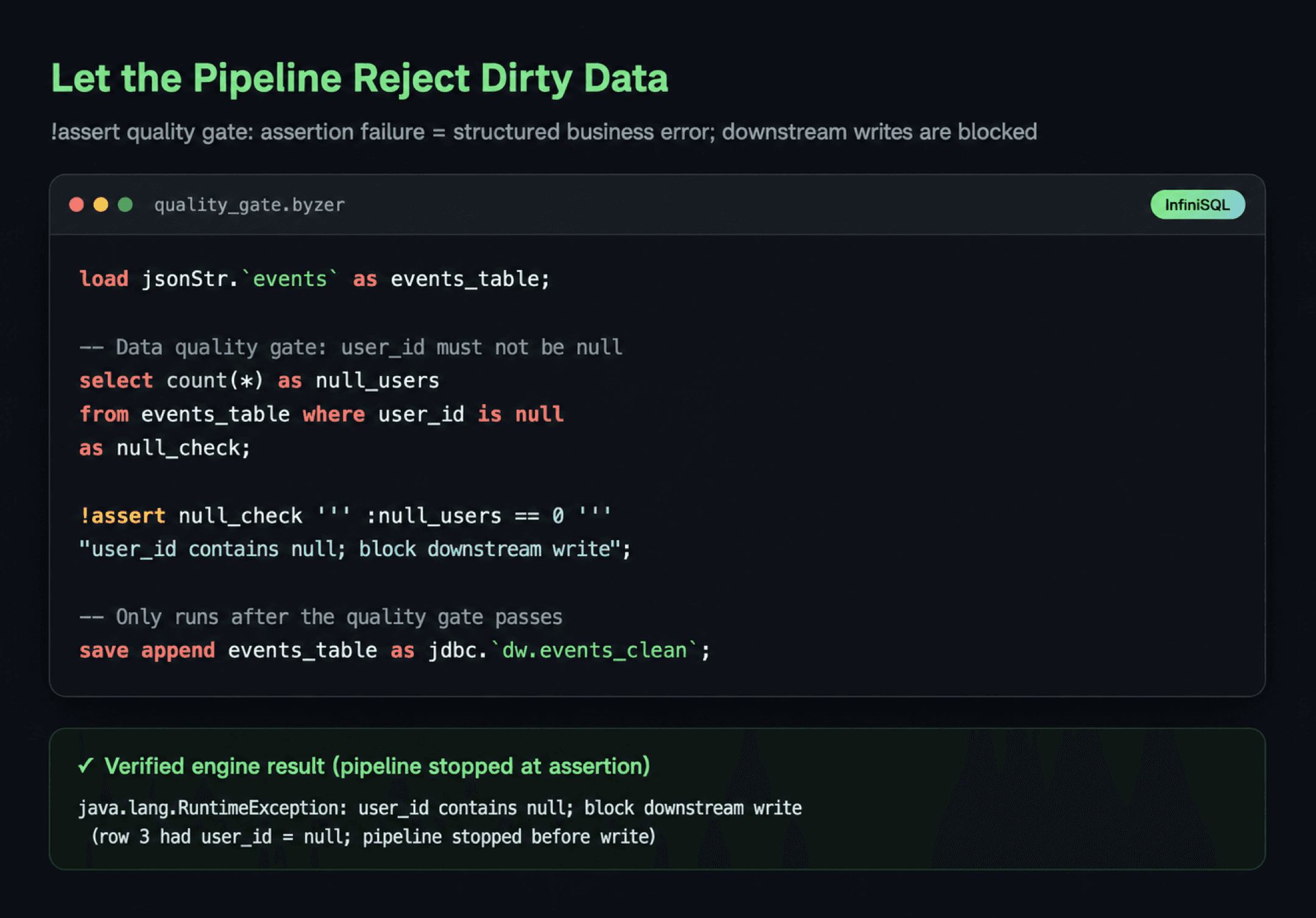
How deterministic !assert quality gates, explicit save semantics, and reload verification turn an analytical answer into a production data asset other systems can trust and reuse.

After reviewing 30 Vibe Coding projects, scarcity shifts from app shells to Decision Job lifecycles. From ForgeX and Yanshu to DataForNGO, a field note on where InfiniSynapse sits as Data Infra.

William Zhu on InfiniSynapse: why a single Agent is not enough, and what storage neutrality, InfiniSQL compression, and federated compute mean after the shift from subscription users to app developers.
University applications, shopping, investing, sales, and consulting look different on the surface, but underneath they all turn scattered information into executable decisions. InfiniSynapse is built as infrastructure for this new class of general data analysis applications.

How much context window one request consumes reveals whether you still use AI as a Q&A tool or have started delegating real complex work to it.

AI shifts programming from single-threaded coding toward parallel orchestration, goal writing, communication, review, and long-term engineering judgment.

Fable 5 is challenging OpenAI's old o-series intelligence advantage, DeepSeek is compressing the low and middle market on price, and enterprises are moving from tokenmaxxing to token budgeting. OpenAI now has to defend intelligence, cost, and routing at the same time.

InfiniSQL is not Agent-friendly because an Agent magically memorizes a new SQL dialect. It is Agent-friendly because the runtime can explain its data sources, data-processing ETs, algorithms, parameters, examples, and model explanations as queryable tables.
When AI can copy general-purpose software in a week, the durable opportunities are personal tools, domains AI cannot access, and systems beneath the AI layer that compound through years of user feedback.

A hands-on InfiniSynapse ML walkthrough showing how InfiniSQL turns data into features, Agent Teams run continuous experiments, and traditional ML becomes reproducible, explainable, and auditable again.
Why Code Agents can analyze Excel but still cannot solve enterprise data analysis. Starting from Databricks Genie's three challenges, this article explains why Data Agents need InfiniSQL, InfiniRAG, and auditable workflows.
Agentic Data Agents can already decompose questions, choose tools, and produce reports. Truly trustworthy business analysis still requires databases bound to a high-precision knowledge base.

AI has made information cheaper to produce, but trustworthy information harder to find. This InfiniSynapse demo shows how a Data Agent ranks sources and cross-validates a risky medical marketing claim.
Databricks Genie extracts semantics from the Lakehouse. InfiniSynapse goes further by binding data sources to high-accuracy knowledge bases and giving Agents an Agentic-friendly SQL language.
OpenAI shows the mature shape of an internal data agent. InfiniSynapse productizes the same class of capability for more complex enterprise data environments.
Auto-Coder introduces /bg background session capability in terminal chat mode, enabling AI tasks to run in parallel, recover at any time, and complement Warp's multi-pane workflow.
auto-coder.chat's Organization Kanban is the first time three forms of collaboration land on the same board at once — humans bound by roles and a permission matrix, humans and Agents bound by acceptance criteria and a shared instance pool, and Agents bound by lanes, auto-relay and Subagent layering. Paired with WinClaw + accchat as the one-sentence writing entry, the last missing piece of the software industrial pipeline is finally in place.
auto-coder.chat's Kanban is excellent at giving you a one-glance view of an entire AI engineering pipeline. But filing requirements is a different story — especially on a phone, where filling forms is hell. We built accchat so WinClaw can query boards, create issues and triage bugs in a single line of natural language. Reading stays on the web, writing goes to WinClaw, and the two complement each other.
Between errands on a random afternoon, a user dropped a bug screenshot in our WeChat group. I didn't go home, didn't touch my laptop — I just opened the auto-coder.chat Kanban on my phone and filed one card. 8 minutes later the bug was fixed, self-verified by the Agent, and sitting in 'To Review' waiting for my nod. This is what the 'cloud Kanban + local instance' architecture makes possible.
In April 2026, I spent half a day using app.infinisynapse.cn end-to-end — opening an account, connecting real data sources, asking real questions, waiting for results, inspecting the deliverables, clicking through live dashboards. This is a hands-on observation from a deep trialer, with 12 screenshots.
Vibe Kanban and auto-coder.chat's Kanban look similar on the surface, but architecturally they walk two completely different paths: local orchestration vs cloud control + local execution, agent orchestrator vs self-contained end-to-end pipeline. An honest side-by-side.
Most Data Agents have LLMs generate Python code for data analysis, but this path grows increasingly narrow. InfiniSQL's language design is structurally isomorphic to the Agentic tool-calling paradigm — select ... as newTable naturally maps to state accumulation, load syntax enables cross-source fusion, and minimal keywords push per-step error rates to near zero.
The essence of the Agentic paradigm is multi-step tool calling and progressive exploration. InfiniSQL's pipeline design achieves precise structural alignment with this paradigm.
How big can the experience gap be when doing AI coding in a terminal? Warp is the best companion for auto-coder.chat, turning a traditional terminal into a complete AI coding workstation.
Instead of making the main Agent stronger, we made it more restrained. Multi-agent collaboration is shifting from an optional technique to a default architecture — achieving near-top-tier quality with minimal premium inference, higher throughput, and dramatically lower costs.
AI coding is slow and expensive? auto-coder.chat's SubAgent multi-model collaboration and /fast mode cut complex task costs by over 10x — clear requirements done in a minute for just a few cents.
As AI-driven projects grow complex, the bottleneck shifts from writing code to understanding it. It's time to embrace vibe reading — using AI to re-read, untangle, and pay down tech debt.