The application shell is the first compilation. Whether an answer can stand is the second. Once code becomes cheap, someone still has to catch data, long-running work, evidence chains, and failure recovery.
On July 24, 2026, I went through all 30 projects in the InfiniSynapse × CSDN Vibe Coding contest gallery one by one—28 contest entries and 2 official examples.
The topics were all over the place: personal expense analysis, 3D printing factory diagnostics, offer due diligence, employment assessment, number checking, renovation contract review, open-source project health checks, NGO project governance, early-retirement research, everyday decision-making, plus lighter tools for personality tests and content generation. Interfaces, users, and business contexts differed widely.
I did not stop at the project pages. For representative works, I actually opened and used them: I launched a real production-fault analysis in ForgeX; watched how "Yanshu" recalculates report numbers and binds them to evidence; walked through ProjectValueLab's adversarial research sample; in DataForNGO I deliberately revoked consent authorization to see whether the publish gate would truly block the result; I also opened the public demos for Early Retirement Institute, Analyx, and Offer Radar and checked them.
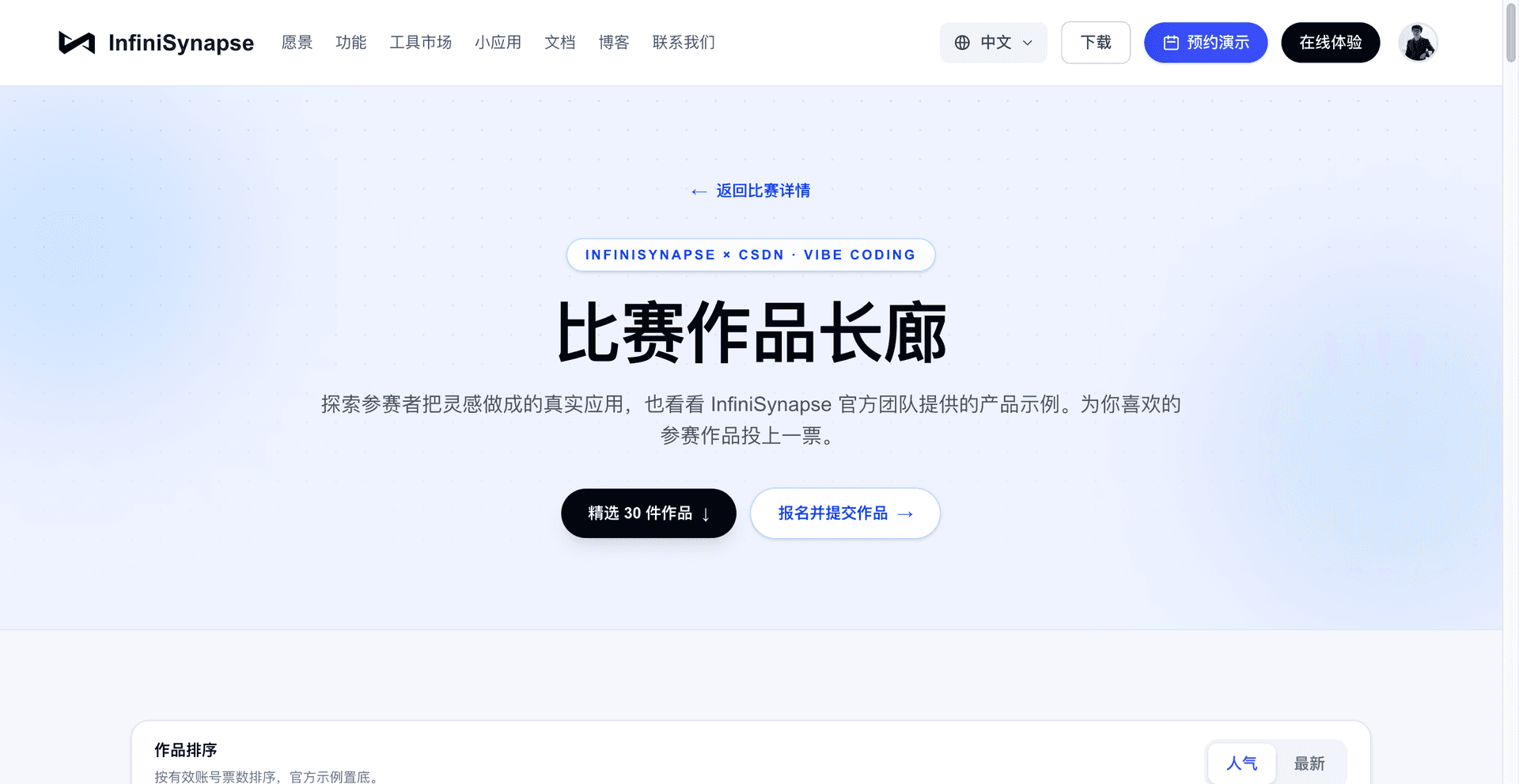
After that pass, the conclusion worth remembering was not "Vibe Coding can already ship 30 applications"—people already believed that. Something else was more interesting: code generation is turning application shells into a low-priced commodity, and once the shell gets cheap, scarcity moves underneath it—to a decision pipeline that can keep running, stay traceable, and still refuse when it should.
I had guessed that the deepest integrations would be the ones that "used the most AI." What I saw was the opposite: the most mature products were actively taking away the model's power to judge errors, publish, or execute final actions.
Follow that observation, and why InfiniSynapse counts as Data Infra becomes easier to see.
1. Whether something is infrastructure depends on who absorbs the complexity
"Data Infra" easily calls to mind databases, warehouses, ETL, and BI dashboards. That is its traditional shape.
When I judge whether something is infrastructure, I usually look for three conditions:
- It can be reused by unrelated upper-layer applications;
- It takes on state, failure, and recovery for developers, rather than returning a one-off text response;
- It draws a boundary between a messy underlying world and a stable application interface.
By that standard, InfiniSynapse covers far more than a chatbot wrapped as an API:
- Agent Runtime: planning, exploration, tool calls, and multi-step execution;
- InfiniSQL: an analysis language designed for agents;
- Cross-source execution engine: connecting databases, files, data lakes, search, and document sources;
- InfiniRAG: recalling knowledge and context for analysis tasks;
- Business memory: enabled on demand only after a task selects data sources; memories proposed by the agent default to
draft, and enter later context only after human review turns them intoverified; - Long-running tasks and workspaces: continuous progress push, retention of intermediate process and artifacts such as Markdown, charts, and data files; apps can also export PDF and Word via the corresponding skills;
- Application-facing Server API: letting external products start tasks through a BFF, read artifacts, and manage user isolation.
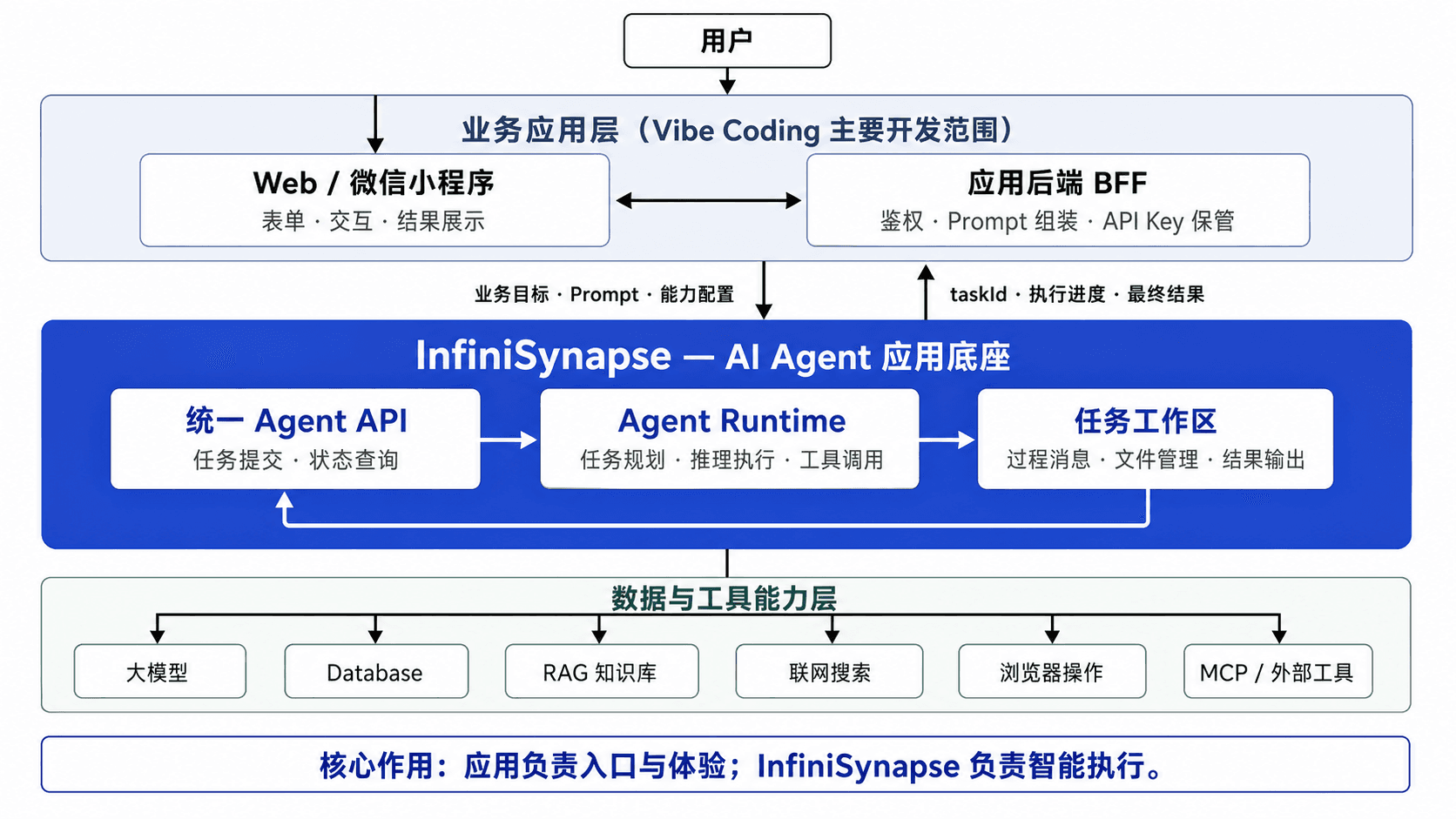
Abstract one analysis into a chain and it looks roughly like this:
User input
  → App BFF: auth, quotas, business parameters, prompt assembly
  → task: a long-running job with identity and isolation
  → SSE events: progress, messages, completion status
  → Agent: plan, retrieve, analyze, call tools
  → InfiniSQL: raw tables, named intermediate views, cross-source compute
  → workspace: reports, charts, data files, and process records
  → the app's own quality gates
  → share, export, or business action
This is the officially recommended SSE integration path; real projects may also poll task status according to their own engineering choices.
What is worth pausing on is the basic unit in this chain. It is no longer a table or a single SQL statement, but a Decision Job.
A Decision Job is also not just a renamed async task. It is a lifecycle object jointly maintained by the application and the foundation, tying together inputs, data sources, intermediate views, evidence, gate status, and final artifacts. InfiniSynapse hosts the analysis kernel among these—task identity, execution, intermediate state, and workspace artifacts; the upper application still owns domain definitions, quality gates, veto power, and final actions.
Traditional Data Infra manages storing, moving, and querying data. In the agent era, it also has to let upper applications track how a decision was proposed, executed, reviewed, and delivered. That is probably InfiniSynapse's most important new positioning: it hosts the analysis lifecycle of decision jobs and leaves stable hook points for each application's own adjudication protocol. "Saying something clever for the app" is only the surface use of that stack.
2. Vibe Coding and InfiniSynapse are really two compilers
What Vibe Coding does is compile natural-language intent into an application:
"I want a factory fault analysis tool"
  → pages, forms, APIs, state, deployment
But a page that runs is not the same as an analysis conclusion that holds. There is still a second compilation:
"Which machine has the highest failure rate, and why?"
  + CSV / database / documents / web pages
  + business definitions and constraints
  → a verifiable analysis process
  → a deliverable decision artifact
The first compiler answers "how the application comes into being"; the second answers "why the answer can stand." InfiniSynapse sits on the second layer.
InfiniSQL's design follows the same logic. Its language docs continue a simple Byzer-Lang principle: Everything is a table. Files, databases, data lakes, even REST API responses can be abstracted as tables; select ... as view_name saves each step's result as a named view for the next step to reuse; sources that support DirectQuery can push native queries down to the underlying system and register the results back.
That design changes the shape of agent mistakes. Writing hundreds of lines of complex SQL in one shot makes it hard to know where things went wrong; splitting into ten named intermediate views lets you inspect each step, keep citing results, and review them alone. Complex analysis thus shifts from one-shot generation to inspectable stepwise construction. Put simply, InfiniSQL gives the AI a stateful analysis scratchpad; being able to write SQL is only the ticket into that pad.
3. What ForgeX showed me was much more than a chat box
ForgeX is a production analytics app for 3D printing factories, putting machines, slicing, calibration, quality, and insights into one product experience.
In the public demo I submitted a question:
Which machine has the highest failure rate, and what are the main faults? Please give data evidence and actionable maintenance recommendations.
The result was not hard-coded in advance. The app created a real InfiniSynapse task and, after multi-step analysis, returned:
FX-256-03: 25 jobs total, 6 failures, 24% failure rate;- 5 of the 6 failures were nozzle clogs, 83.3%;
- Clogs appeared across PLA, PETG, TPU, and ABS, so they looked more like nozzle, extrusion, or cooling-system issues than a single material problem;
- Recommendations: clean or replace the nozzle, run PID calibration, check feed gears and heat-break cooling, and schedule a maintenance window.
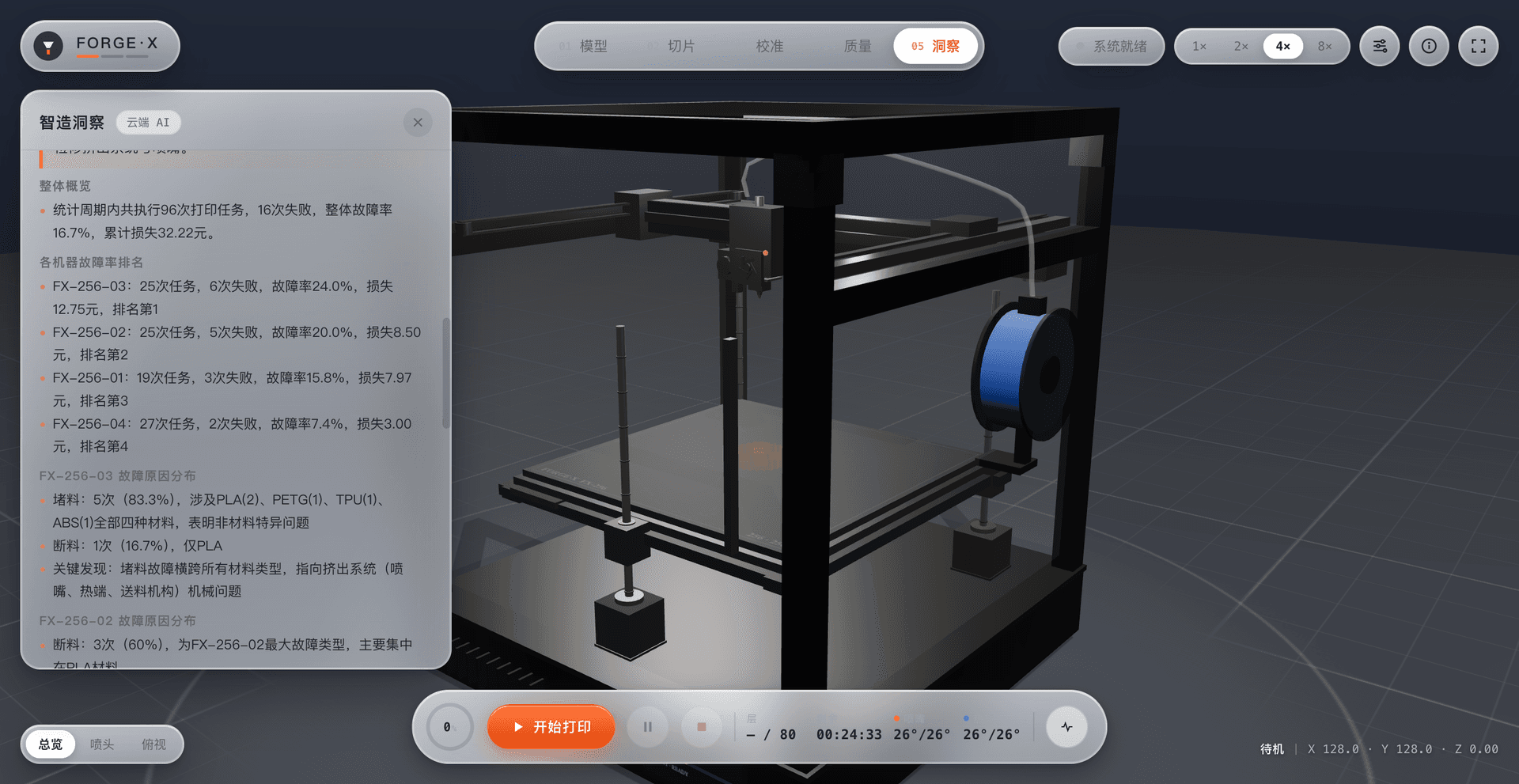
More importantly, the task workspace retained multi-step InfiniSQL artifacts—not just a blob of copy you cannot follow up on.
This example shows a sensible split between Vibe Coding and Data Infra: ForgeX owns the 3D factory product language—machines, jobs, materials, yield, losses, maintenance actions; InfiniSynapse owns long-running tasks, analysis execution, intermediate results, and report delivery; how repairs are scheduled and whether a line can stop still belong to the factory and its business systems.
Infrastructure does not define the domain for the product, but it keeps the product from reinventing an analysis runtime.
4. Infrastructure value hides in the failure path
Many AI API demos feel smooth: send a request, wait for a string.
Production does not. Connections drop, tasks run for minutes, users open multiple tabs, data sources may be disabled, completion events may arrive before the frontend listens, file downloads may be misread as JSON, and API keys may accidentally land in the browser.
InfiniSynapse's integration FAQ and engineering guidance spell these out clearly:
- Establish SSE first, then create the task with the same
connId; - Finish data-source and RAG configuration before starting the task;
- Keep API keys on the server only;
- After receiving
completion_result, read final artifacts from the workspace; - The frontend must clearly express running, completed, failed, and download states.
These items do not read like "AI magic"—they even feel tedious. But the real value of infrastructure is turning the tedious into a stable engineering protocol. A database's worth was never only that it can store a row; it was concurrency, transactions, recovery, and isolation. Likewise, Agentic Data Infra's worth is not only that it can give one good answer, but task identity, streaming events, user isolation, workspaces, and artifact protocols. Those primitives let apps resume and recover after disconnects; keeping API keys server-side remains credential discipline the app must follow.
Do this long enough and you see that infrastructure is, at bottom, the layer that absorbs responsibility for failure. Vibe Coding speeds up application creation, but that responsibility does not disappear—it just surfaces faster.
5. The most mature works actively constrain the AI
The biggest surprise while using these projects: the deepest ones were precisely the ones putting shackles on the model.
1. Yanshu: the model has no power to judge something "wrong"
"Yanshu" is a number-checking product. It takes numeric claims from weekly reports or decks and recalculates them against database and Excel source of truth.
When I opened its public demo workspace, the system checked 12 claims and returned 9 consistent, 2 doubtful, and 1 inconsistent. One report claimed GMV of 42 million; recalculation produced 37.5 million. The page can expand definitions, queries, and evidence further.
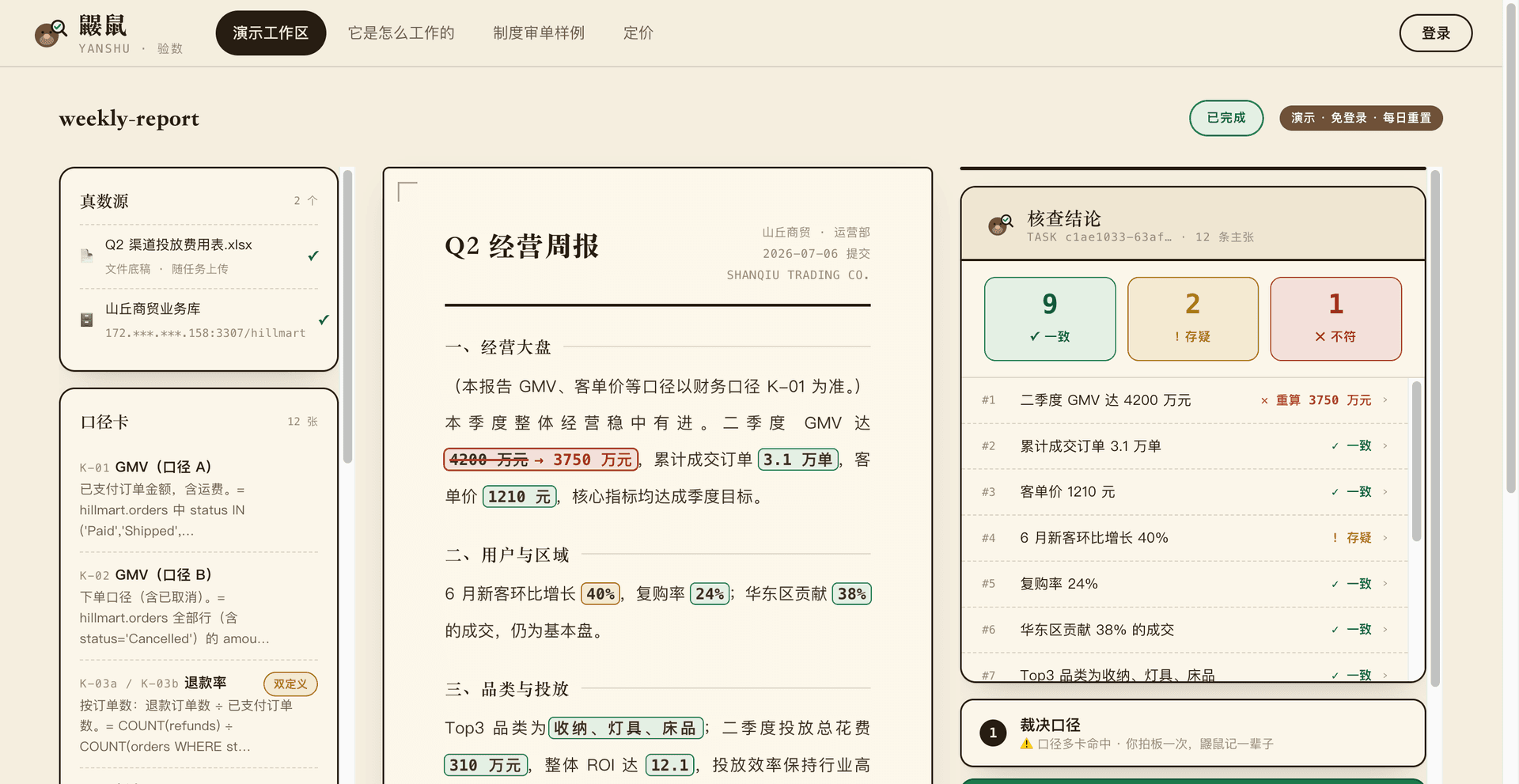
Its smartest design is not scoring each number "87% confidence," but a hard rule: only when a deterministic recalculation exceeds tolerance may code mark "inconsistent"; the model has no authority to judge a number wrong. The model may explain; computation may adjudicate; definition conflicts go to humans.
Generation, computation, and adjudication are split into three permission domains. That is solid product discipline.
2. ProjectValueLab: InfiniSynapse does the research; the app owns the gates
ProjectValueLab's public sample uses a three-stage flow: build a research pack, run opposing review, then synthesize evidence and revise the conclusion.
In the vector-infrastructure sample I reviewed, the initial recommendation leaned toward "buy directly"; after counter-evidence on cost and vendor lock-in, it was revised to "buy + thin abstraction layer." The page shows facts, inferences, contradictions, assumptions, evidence coverage, and hard thresholds side by side.
Notably, its DLP, schema validation, and evidence-coverage gates belong to ProjectValueLab's own ArtifactService—InfiniSynapse did not define them. That can look like a missing capability; it is actually healthy architecture: InfiniSynapse owns research and long-task runtime; what counts as a "qualified project decision" is for the vertical app to decide.
3. DataForNGO: a compliance gate can veto a seemingly good answer
In DataForNGO's public sample, I deliberately checked "revoke consent authorization," then ran insights.
The system could still compute project completion rates and improvement levers, but publish was blocked by the PDPA governance gate: k-anonymity and PII redaction passed; the consent manifest was missing, so publishing was not allowed.
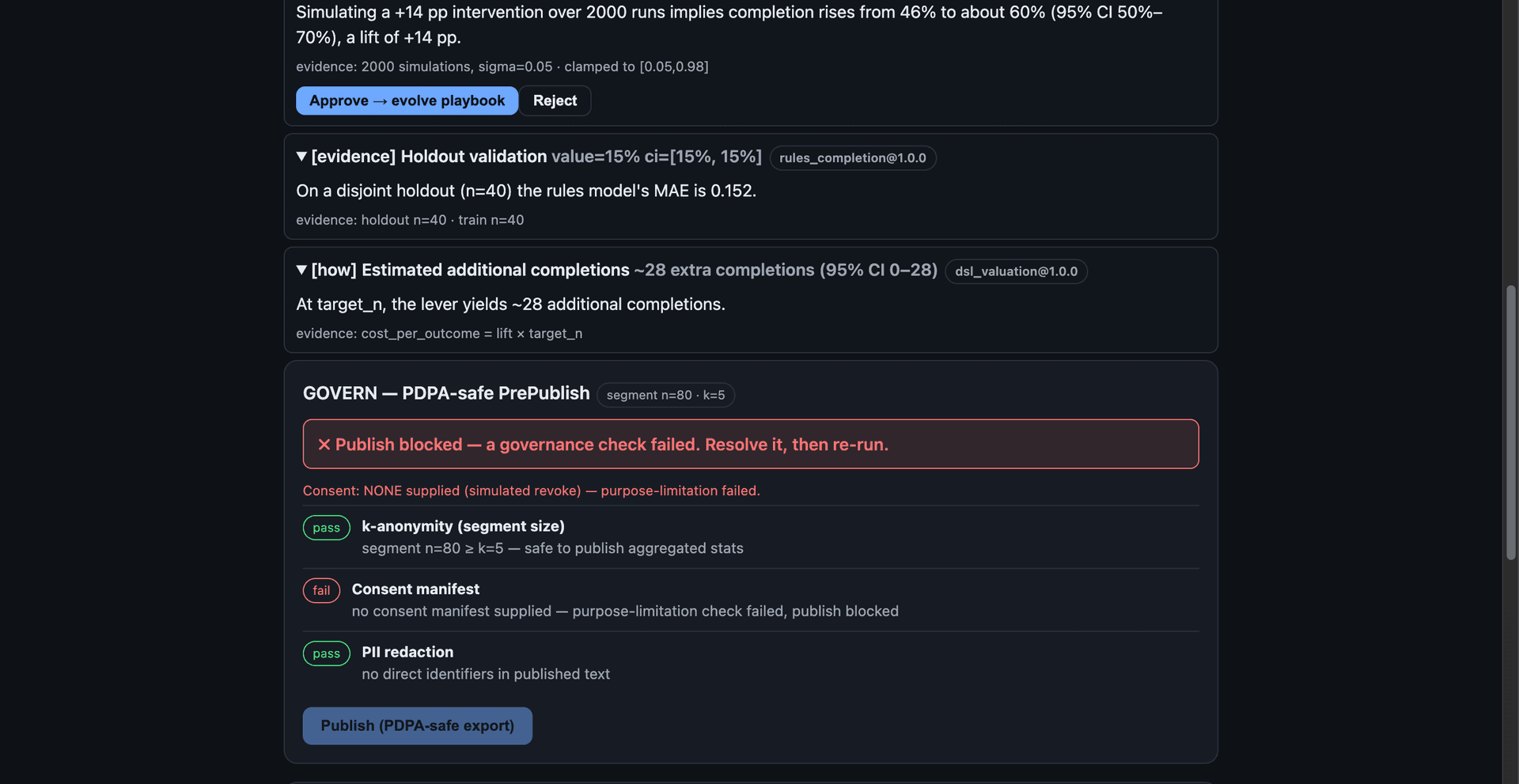
The project is also frank: rigorous math runs in a local Rust/WASM engine; InfiniSynapse only handles external research, industry reference, and narration for non-technical users. You could say it "does not use the stack deeply"; I would rather call it correct boundary design.
Put the three together and they point to the same conclusion: mature Data Infra should let upper applications refuse the model, not require every truth to come out of one model.
6. What the 30 works prove—and what they do not
These 30 projects span manufacturing, finance, hiring, audit, policy, nonprofit, research, and life decisions. At minimum they show infrastructural plasticity: the same task, analysis, and workspace capabilities can be reused by very different products. Coverage is not integration depth, of course—there are also generative, lightly integrated works and 2 official examples—and it is certainly not product–market fit.
On integration depth I saw three clear layers. Layer one is generation: feed a little structured input to AI and get personalized copy. Layer two is analysis: connect files, databases, web pages, or knowledge bases, run multi-step analysis, and deliver reports. Layer three is decision: beyond analysis, there is deterministic computation, evidence ledgers, governance gates, human adjudication, and recoverable workflows. The closer to layer three, the more visible Data Infra's value; stay at layer one and InfiniSynapse is easily treated as an ordinary generation API.
I also ran a plain public GET availability check against the gallery-registered app_urls. As of July 24, 2026, 4 of 30 entries clearly returned 401, 404, or 502. Some apps require login; some need users to bring their own InfiniSynapse quota.
That negative evidence is valuable too. It reminds us: Data Infra does not host apps or keep domains stable for them, does not automatically create good products, and does not define business truth for developers; Vibe Coding can ship something quickly, but long-term operations do not get staffed automatically.
Sample bias must also be admitted: this is a contest built on InfiniSynapse, so the sample is not 30 AI apps randomly drawn from the market. It can show that this foundation can be consumed across many scenarios; it cannot alone prove superiority over every alternative architecture, still less commercial success.
So a more accurate reading of these 30 works is this: they let us see, in one place, what application diversity looks like when the same Agentic Data Infra is consumed by different products—and they also expose the responsibilities the application layer must still carry itself.
7. As code gets cheaper, the moat moves elsewhere
If pages, forms, login, CRUD, and API wrappers can all be generated quickly by a Code Agent, "how much code I wrote" stops being an advantage.
Where does advantage move? From this set of works, roughly five places: input contracts, decision protocols, quality gates, action boundaries, and recovery capability.
ForgeX organizes input around machines, materials, faults, and cost; Yanshu organizes checking around "numeric claim—definition—ground truth"; ProjectValueLab hardens "research—counter-review—synthesis" into a protocol; DataForNGO lets missing consent veto publish. Their value comes from writing domain judgment into product structure; code volume is only a small part of that.
A lucky Demo can succeed once; a repeatedly usable product needs state and protocol. All five of these are harder to copy than "which frontend framework the homepage used."
8. Two compressions happen at once
Vibe Coding alone most easily produces Demo inflation: app counts rise fast, while data access, state management, trustworthy computation, and failure recovery keep accruing debt behind each one.
Data Infra alone tends toward another trap: strong capabilities, but too far from concrete users, ending as architecture diagrams and API docs.
Together they form a loop. Vibe Coding lowers the cost of trying vertical scenarios; InfiniSynapse lowers the cost of rebuilding a data-analysis runtime; vertical developers concentrate on input contracts, domain definitions, quality gates, and UX; each real app in turn exposes protocols, connectors, and recovery capabilities the Infra still lacks.
So the substance of the combination is two compressions at once: Code Agents compress the cost of producing application shells; Data Infra compresses the cognitive and engineering cost of trustworthy decisions. The former lets more people build apps; the latter means those apps need not invent a data-analysis team from scratch.
Of course developers can stitch alternatives from LangGraph, queues, warehouses, object storage, and homemade workspaces. Data Infra's value was never "only I can do this," but that each vertical app need not maintain, validate, and upgrade the same analysis runtime alone. Code Agents will also make connectors and wrapper code cheaper, but they will not automatically make cross-source semantics, task isolation, evidence protocols, human review, and long-horizon recovery correct—they lower implementation cost; responsibility cost stays put.
9. Five questions I ask to see whether a Vibe Coding app has left Demo territory
The next time I look at an AI data app, I will not ask which model it uses first. I will ask:
- Where does the conclusion come from? Can it point to data sources, queries, web pages, or document evidence?
- Can the process be recovered? Is it a one-shot request, or a task with a taskId, state, and workspace?
- What can the model decide? What does the model generate, what does deterministic code compute, and what must humans adjudicate?
- Who can say "no"? When evidence is thin, consent is missing, or definitions conflict, will the system refuse to deliver?
- Can results keep flowing? Can you follow up, reuse, share, export, audit, and carry them into the next piece of work?
If none of the five can be answered, it is probably a pretty Prompt Demo. If they can, it starts to look like a product. And when a foundation system lets many different products answer these questions together, it starts to look like Data Infra.
Closing: the provenance of an answer is harder to produce than the answer itself
In the past we used databases to store facts, BI to show facts, and documents to explain facts.
Now agents join the whole path from question to conclusion, and new risks arrive with them: conclusions may appear fast but have no provenance; interfaces may look beautiful but cannot be recovered; models may sound confident while no one holds veto power.
So data infrastructure in the agent era, beyond answering "where data lives and how to query it," must also answer a new series: who initiated this decision, which data and definitions were used, what transformations happened in between, which parts are fact, inference, or recommendation, which gate allowed it to become a deliverable, and how to locate and recover when something goes wrong.
In that sense, InfiniSynapse qualifies as Data Infra not by how many database nouns it stacks, but because it begins to host Decision Job analysis-kernel state, execution, intermediate views, and artifacts, while letting applications attach their own evidence rules, quality gates, and veto power on top.
Vibe Coding's value is similar: putting more web pages into the world is only its surface effect. What it may truly change is this—vertical data apps that once only large teams could carry can now be built quickly by someone who knows the business; the analysis foundation every team used to rebuild can be provided by infrastructure like InfiniSynapse.
After code becomes cheap, products still have moats. The moat just moves from "how much code I wrote" to harder questions: what decision protocol I defined, what evidence I left behind, and who still has the right to say no when the model is most confident.
Try it & resources
- InfiniSynapse × CSDN Vibe Coding Contest
- Contest gallery
- ForgeX
- Yanshu
- ProjectValueLab
- DataForNGO Lab
- InfiniSynapse Server API Reference
Note: The experience and availability observations in this article were recorded on July 24, 2026. Project status, public entry points, and page content may continue to change during the contest; observations here do not constitute formal judging or ranking of contest entries.