Machine learning is a natural proving ground for InfiniSynapse.
Unlike many analytical tasks where success can be subjective, traditional machine learning has hard feedback loops: AUC, Gini, KS, decile lift, feature IV, PSI, train-test gaps, and model audit rules. That makes it especially well matched with a Data Agent. The Agent can try a feature set, run a model, read the metric, decide what to change, and repeat the loop until it gets closer to the best achievable result.
That is the core idea behind InfiniSynapse ML:
Let the LLM work around the clock, let InfiniSQL execute the data science, and let Agent Teams search the feature/model space systematically.
The demo below uses the UCI Credit Card Default dataset. The task is simple to say and hard to execute well:
Use a financial credit scorecard algorithm to train and predict on
uci_credit_card_default.csv, maximize AUC, and compare it with other models.
InfiniSynapse does not stop at one model. It explores the dataset, creates credit-risk features, compares multiple algorithms, then launches Agent Teams to iterate on one explainable ScoreCard until it moves from 0.7482 AUC to 0.7756 AUC in the recorded demo run.
The Big Picture
The value of InfiniSynapse ML is not that it can call one model API. The value is that it can run a complete, inspectable machine learning workflow:
- Data access: load files, databases, warehouses, APIs, and business data sources into one analytical session.
- Feature engineering: turn raw columns into behavior signals with InfiniSQL.
- Model comparison: train and evaluate multiple algorithms with the same data pipeline.
- Agent Teams: run parallel experiments across feature sets, binning strategies, and parameters.
- Continuous optimization: keep pushing one chosen algorithm toward a better metric.
- Governance: export rules, WOE, IV, deciles, PSI, score contributions, and model audit artifacts.
That combination matters because the center of traditional ML is still feature engineering. Better signals usually beat prettier model wrappers. InfiniSQL is particularly strong here because it keeps feature engineering close to the data, in a reproducible SQL-native workflow.
Why Traditional ML Fits InfiniSynapse So Well
A Data Agent becomes much more powerful when it has a clear measurement target.
Credit risk modeling is full of measurable targets:
| Question | Metric or Artifact |
|---|---|
| Does the model separate good and bad customers? | AUC, Gini, KS |
| Is the score useful for ranking customers? | Decile lift, bad-rate curve |
| Which features matter? | IV, WOE, coefficients, point contribution |
| Is the model stable? | PSI, train-test gap |
| Can a risk team inspect it? | ScoreCard rules, bins, points |
| Can the model be reproduced? | Saved SQL pipeline, model path, audit tables |
That turns machine learning into a natural Agent loop:
- Create or modify features.
- Train a model.
- Evaluate metrics.
- Inspect weak points.
- Launch more experiments.
- Keep the best version.
The loop is boring in exactly the right way. It is measurable, repeatable, and automatable.
Step 1: Start With Real Data, Not a Toy Prompt
The dataset is UCI Credit Card Default:
- 30,000 credit-card customers.
- 23 original features.
- Target:
default_payment_next_month. - Overall default rate: about 22.1%.
- Raw fields include credit limit, demographic fields, six months of payment status, six months of bill amount, and six months of payment amount.
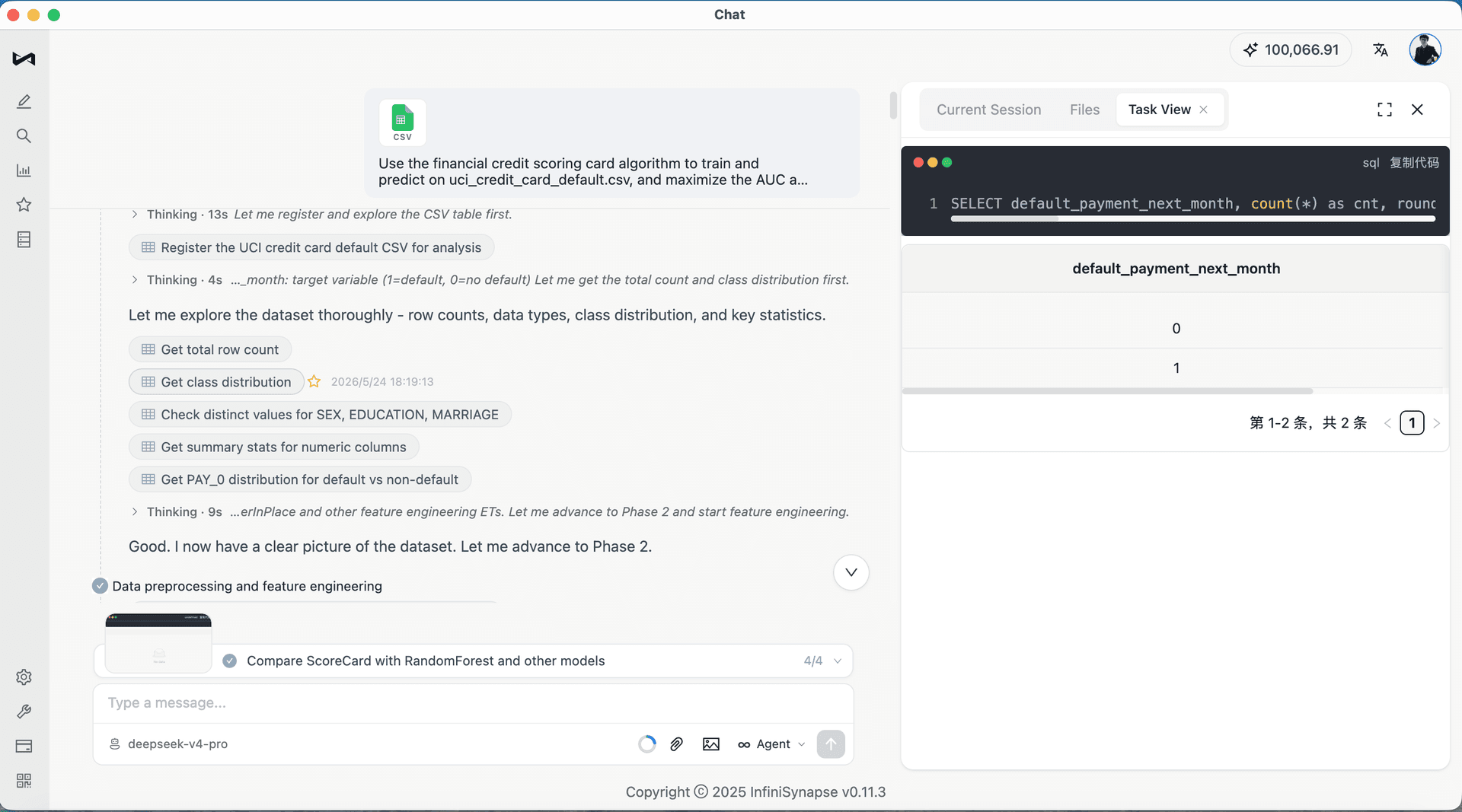
The agent begins like a careful analyst: register the CSV, count rows, inspect the label, check class distribution, check distinct values, inspect summary statistics, and look at repayment-status behavior.
This matters because machine learning mistakes often begin before training. A good agent should not blindly feed a file into a model. It should first establish what the table is, what the label means, whether the class balance is usable, and which raw fields are likely to become signals.
Step 2: Use InfiniSQL as a Feature Factory
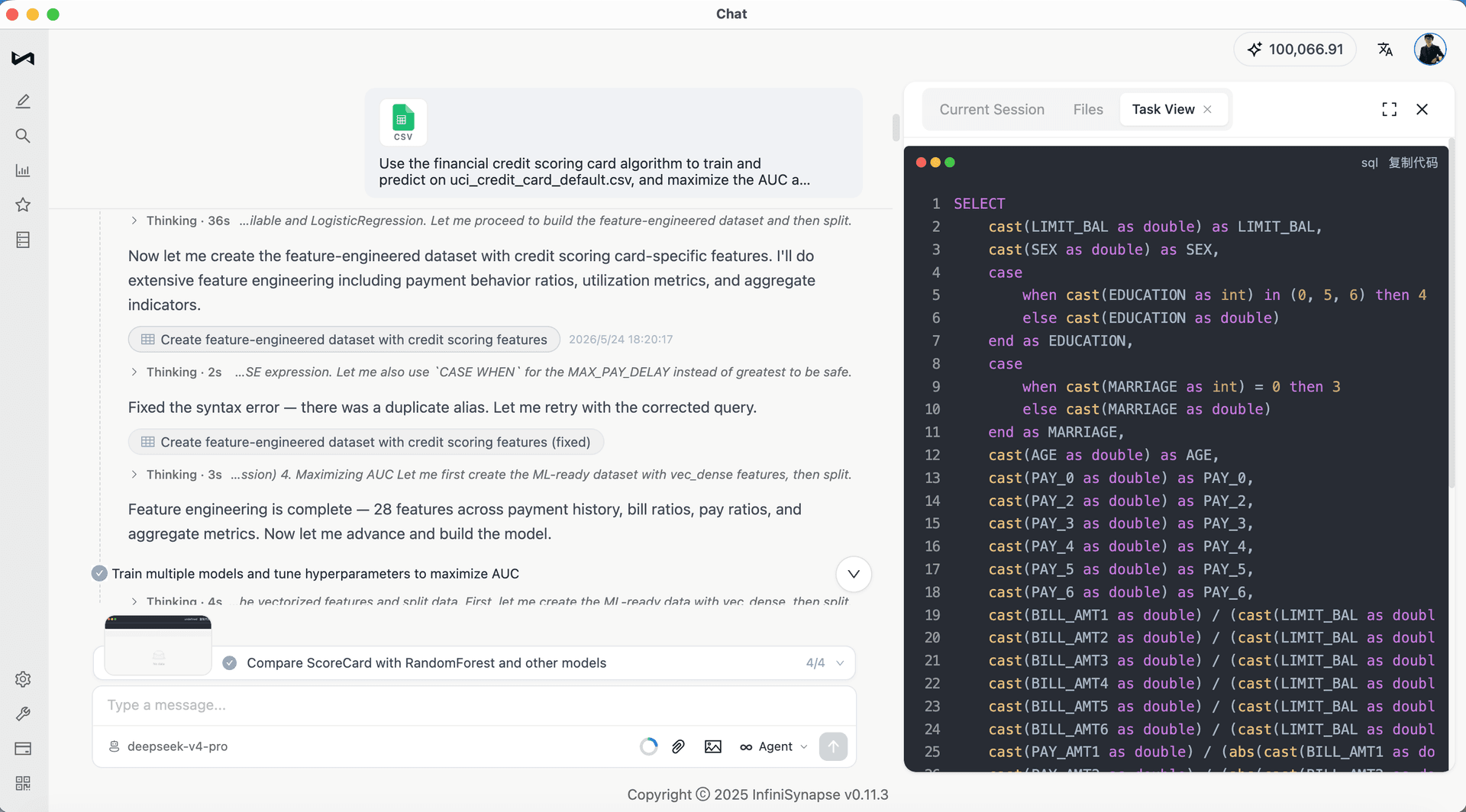
The agent then creates credit-risk features. These are not cosmetic columns. They are the signals that make traditional ML work:
- recent delinquency;
- maximum payment delay;
- number of delinquent months;
- cumulative delinquency severity;
- bill-to-limit utilization;
- monthly utilization;
- repayment ratio;
- bill growth;
- total payment ratio;
- aggregate payment behavior.
The reason InfiniSQL is important is that it makes this feature work executable and inspectable. The feature logic is not hidden in a notebook cell or a transient Python object. It is written as a data pipeline that the agent can rerun, revise, and audit.
The same design is what makes InfiniSynapse powerful beyond one CSV. In real enterprises, useful ML features rarely live in one file. A fraud model may need transaction logs, user profile tables, device fingerprints, merchant metadata, customer-service records, and external risk signals. A churn model may need product usage, billing, tickets, campaigns, and CRM history.
InfiniSQL is built for that world.
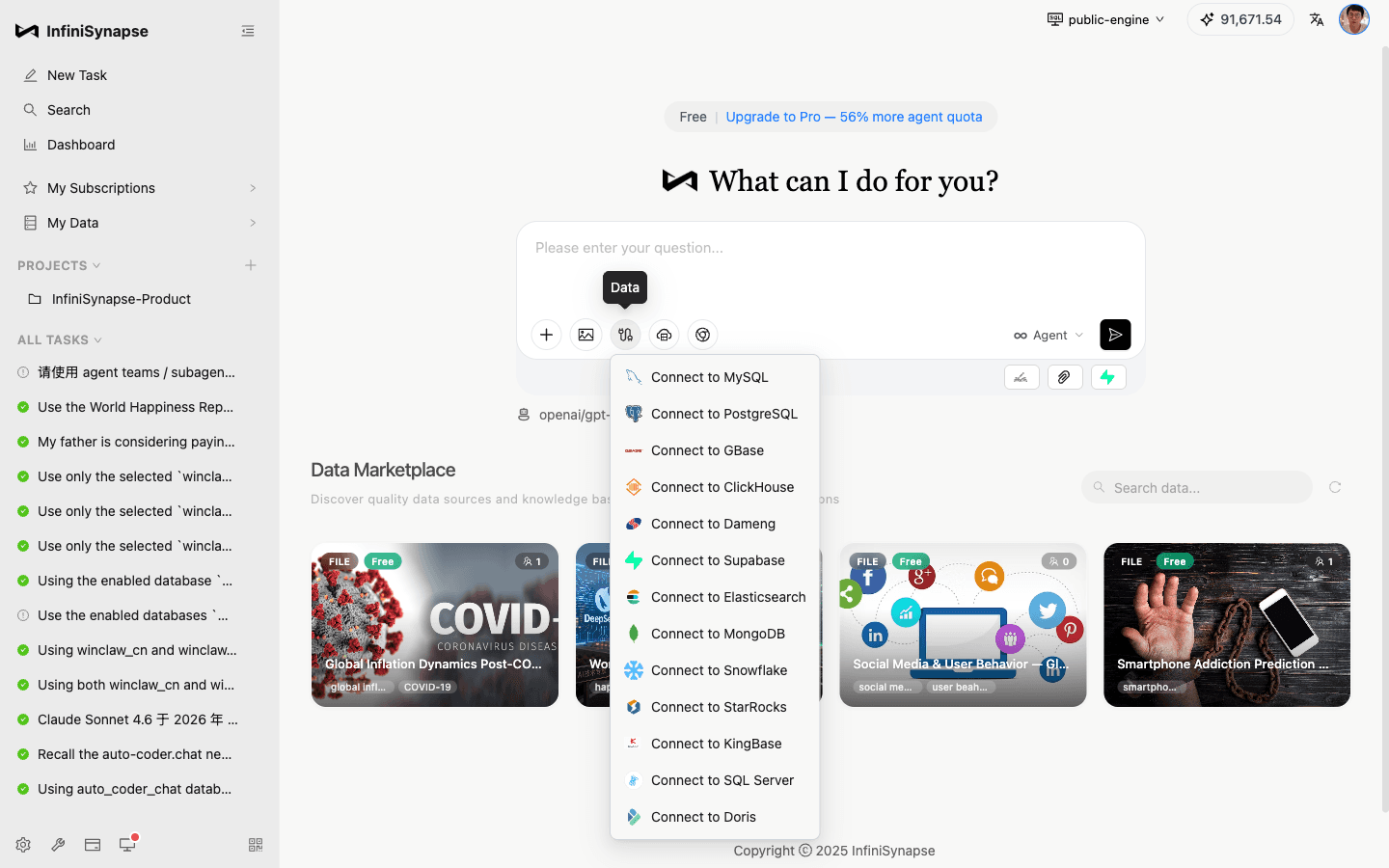
With connect and load, data from local files, databases, cloud warehouses, and operational systems can coexist as tables in the same session. With cross-source JOIN and computation pushdown, the agent does not need to pull everything into a Python process before it can build features.
That is a critical ML advantage:
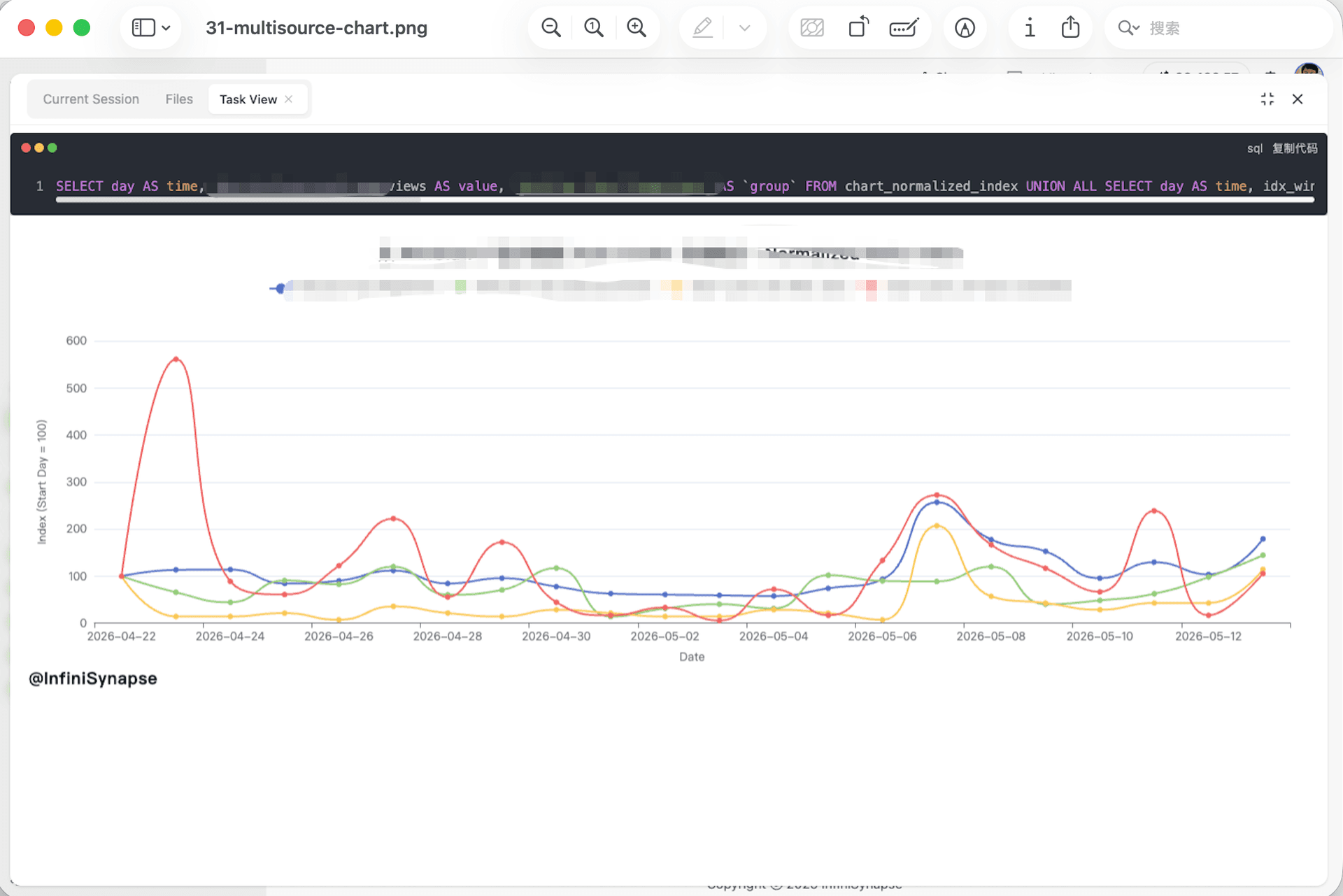
More data sources mean more feature candidates. More feature candidates mean a larger search space. InfiniSynapse can keep running experiments against that search space.
Step 3: Create ML-Ready Tables and Compare Algorithms
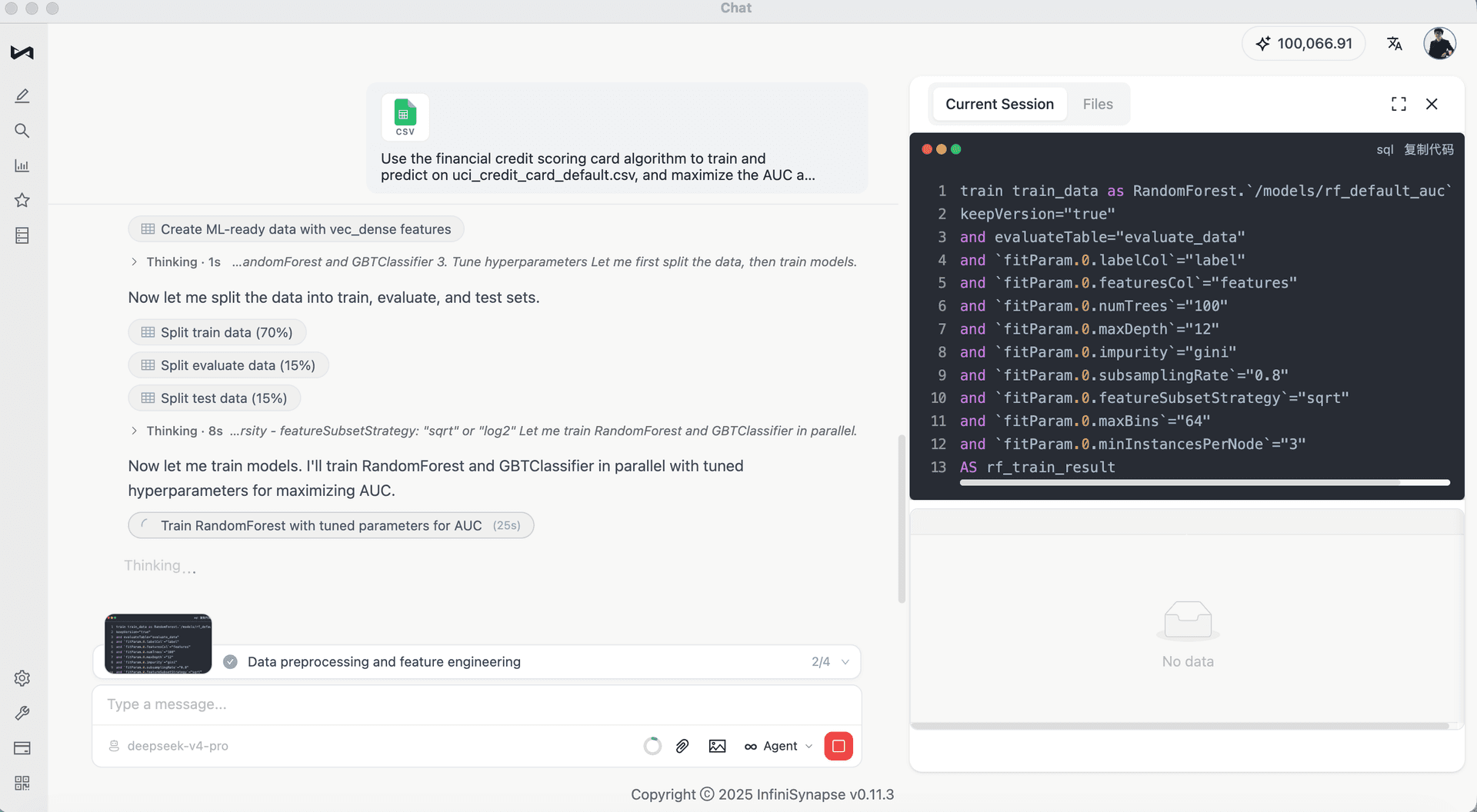
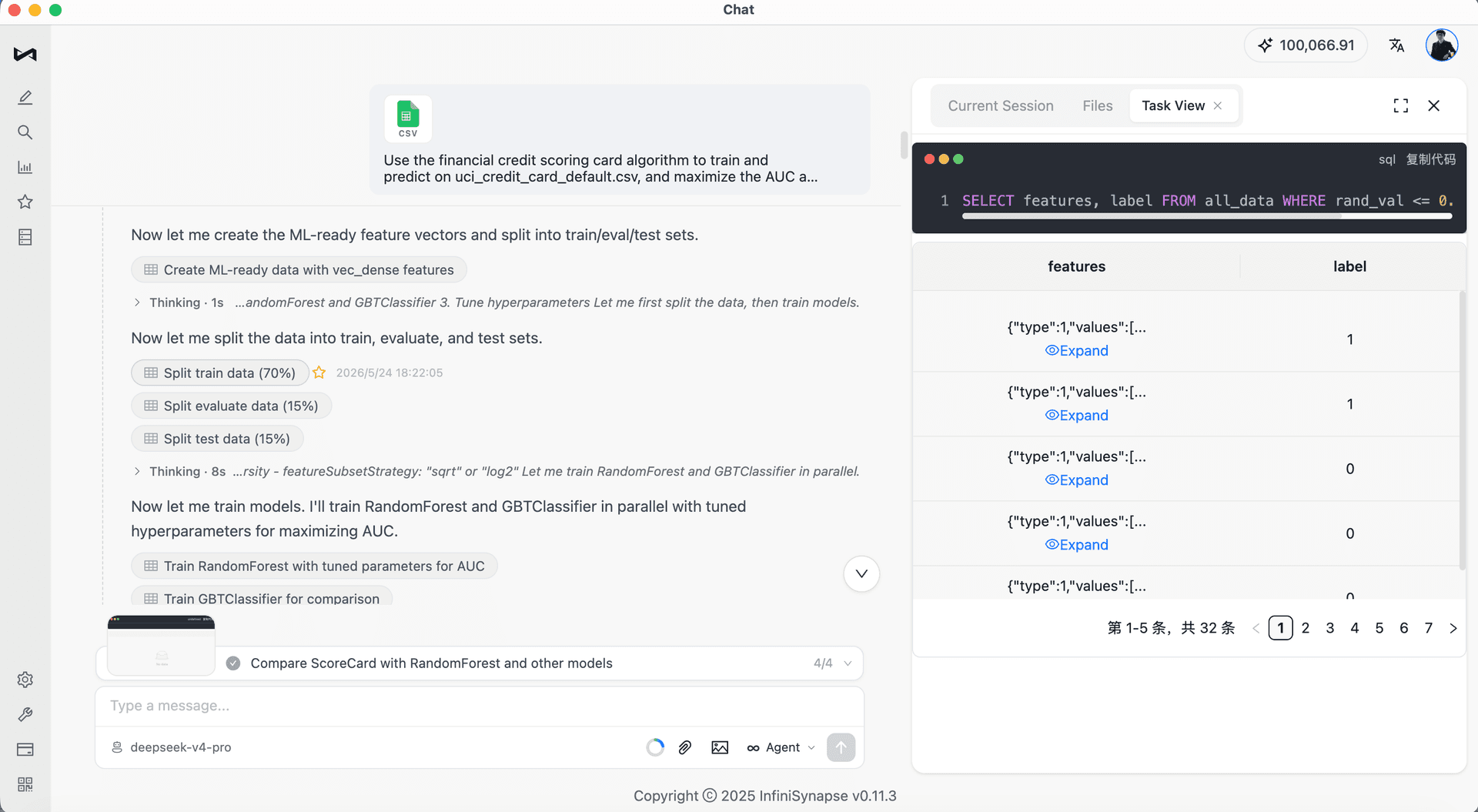
After feature engineering, the agent converts the data into ML-ready feature vectors and splits it into train/evaluate/test sets.
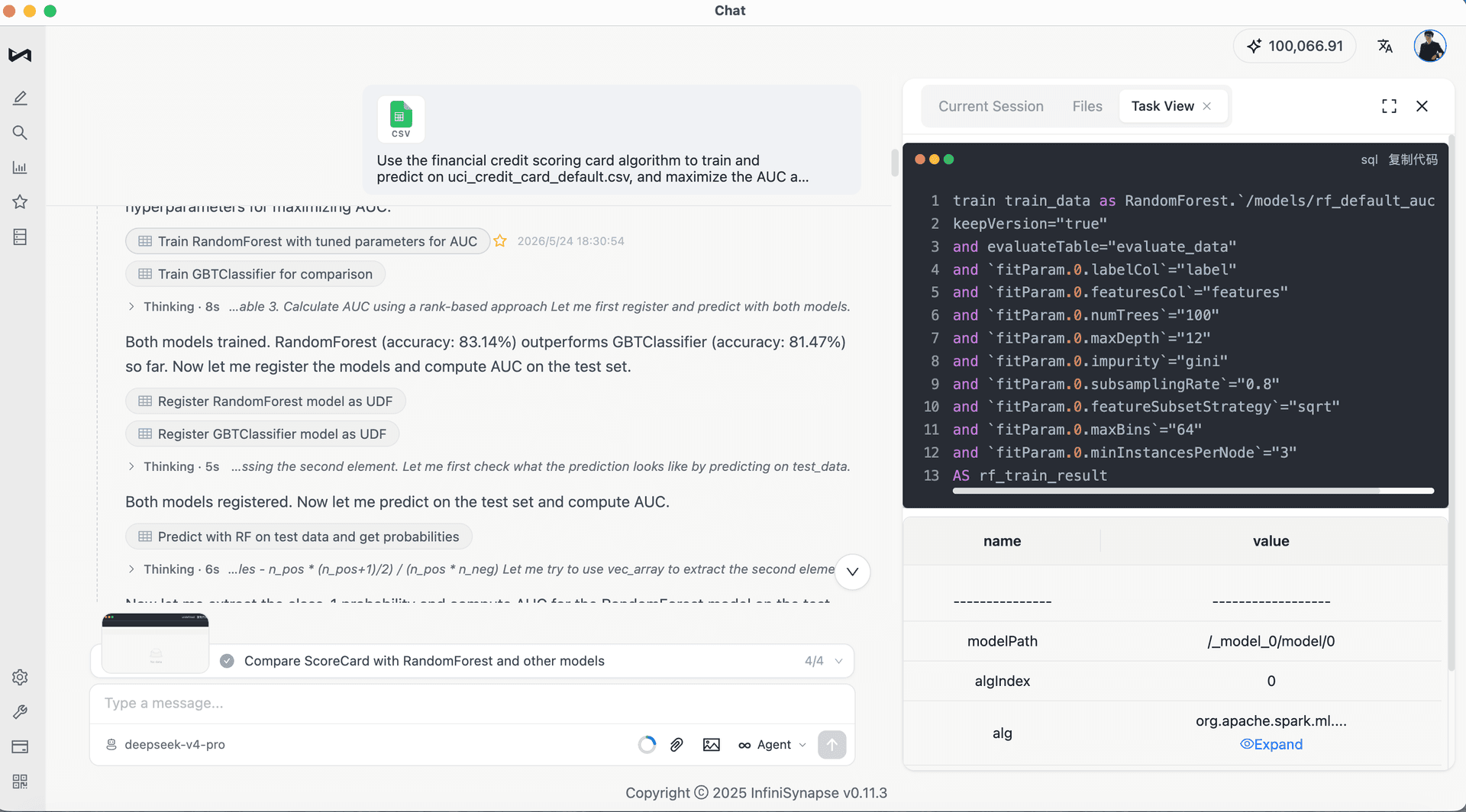
Then it trains multiple algorithms instead of pretending one algorithm is always right:
- RandomForest v1;
- RandomForest v2;
- RandomForest v3;
- GBTClassifier;
- Logistic Regression;
- ScoreCard.
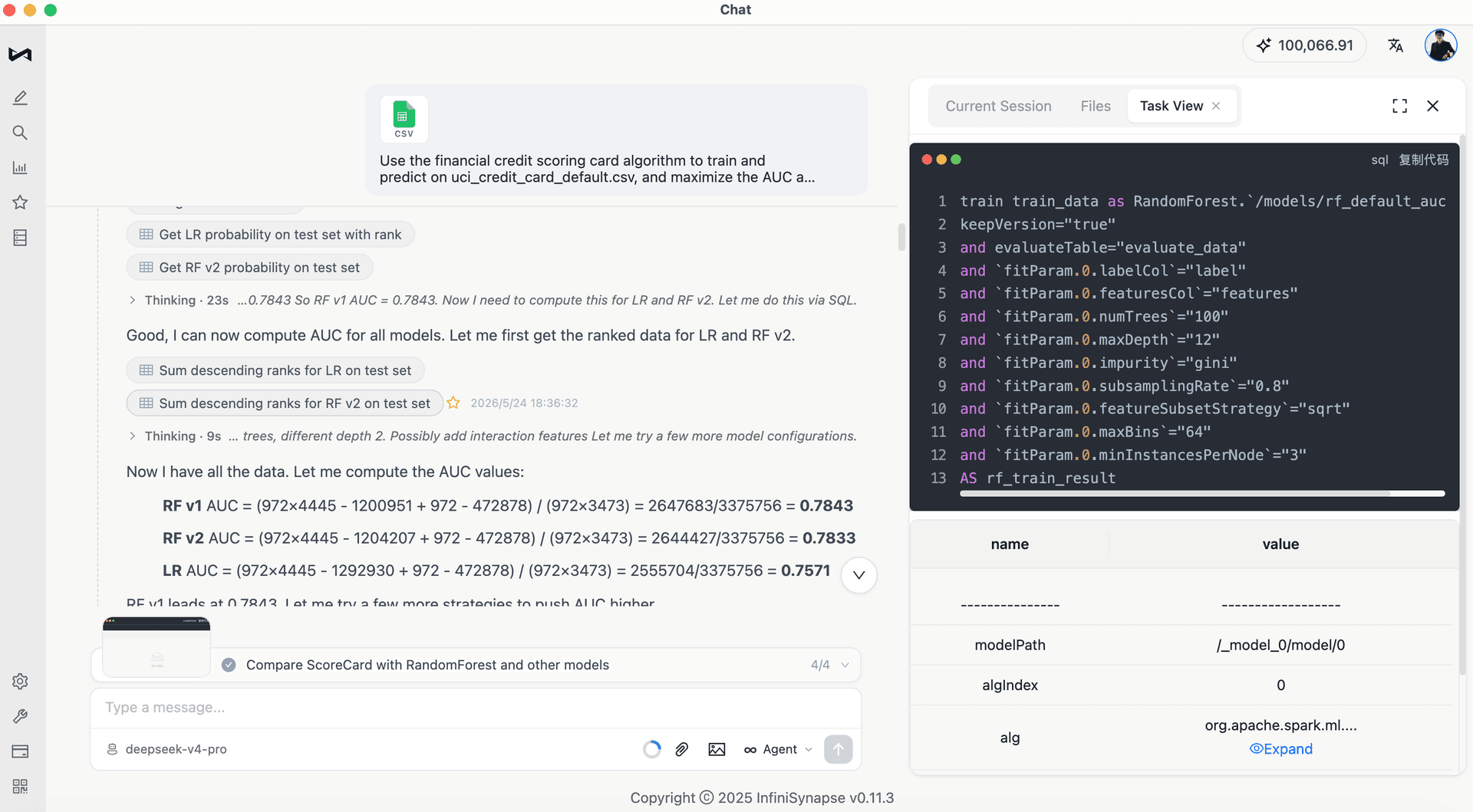
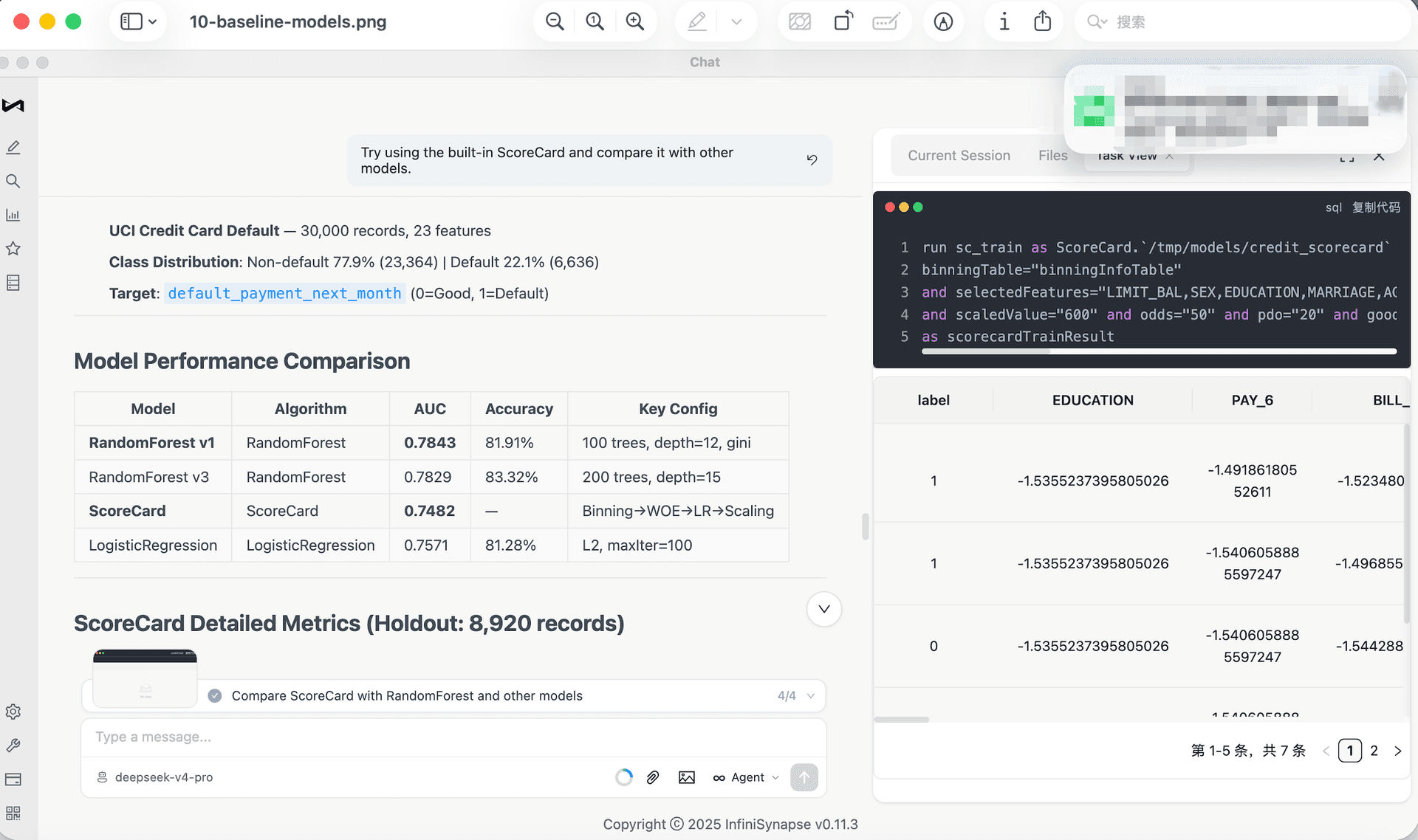
The first comparison is clear:
| Model | AUC | Role |
|---|---|---|
| RandomForest v1 | 0.7843 | Best black-box challenger in the demo |
| RandomForest v2 | 0.7833 | Alternative tree ensemble |
| RandomForest v3 | 0.7829 | Alternative tree ensemble |
| Logistic Regression | 0.7571 | Semi-transparent baseline |
| Initial ScoreCard | 0.7482 | Explainable regulated model |
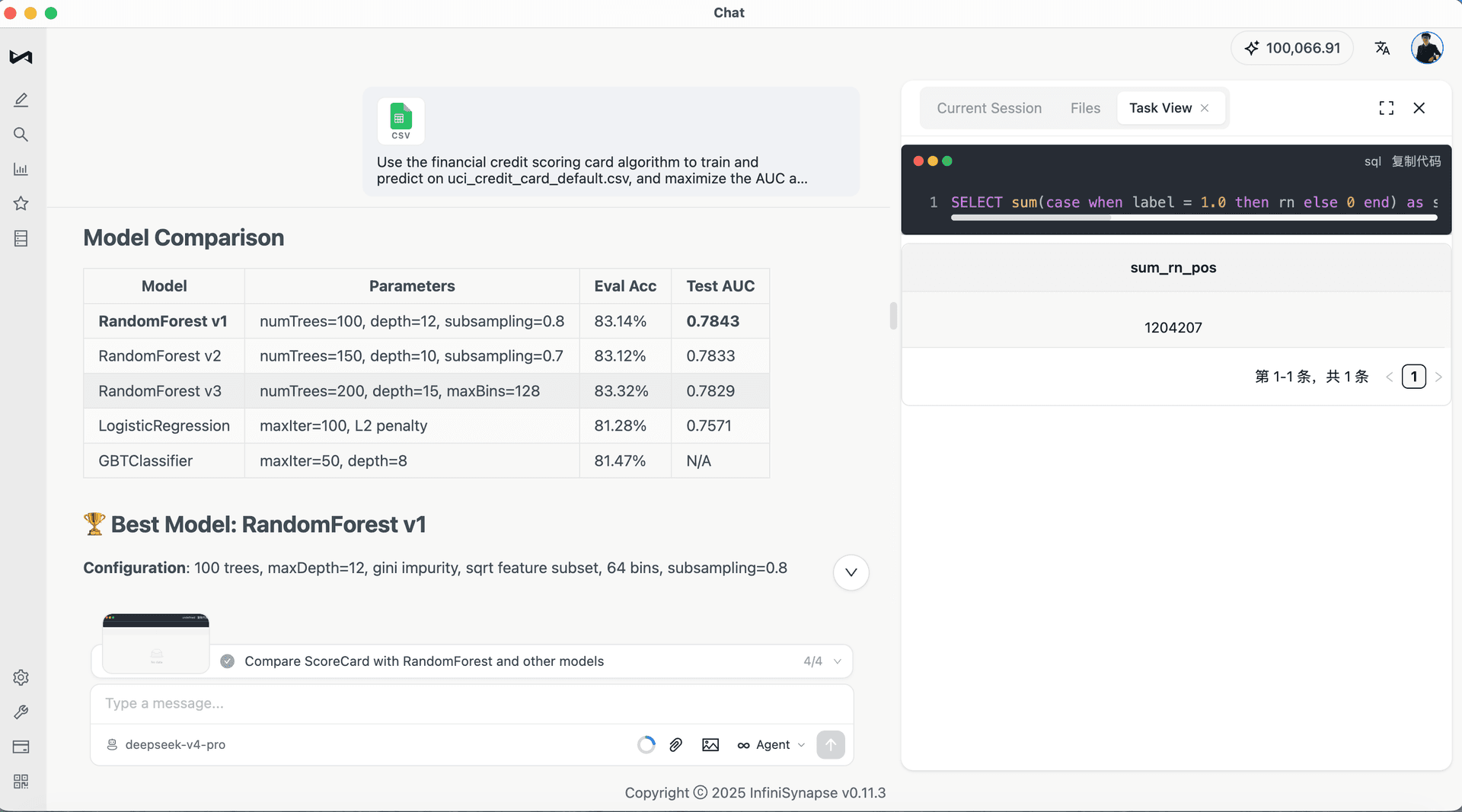
This is the right professional framing. InfiniSynapse does not force a single modeling ideology. It can compare algorithms and then choose the model that matches the business requirement.
For pure AUC, RandomForest is strong. For regulated credit scoring, ScoreCard is often more useful because it produces bins, WOE, IV, points, and reviewable business rules.
Step 4: Move From Black-Box AUC to Explainable ScoreCard
The agent then switches to ScoreCard. It does not guess the API. It checks whether ScoreCard is available, loads ScoreCard and Binning documentation, and follows the documented workflow.
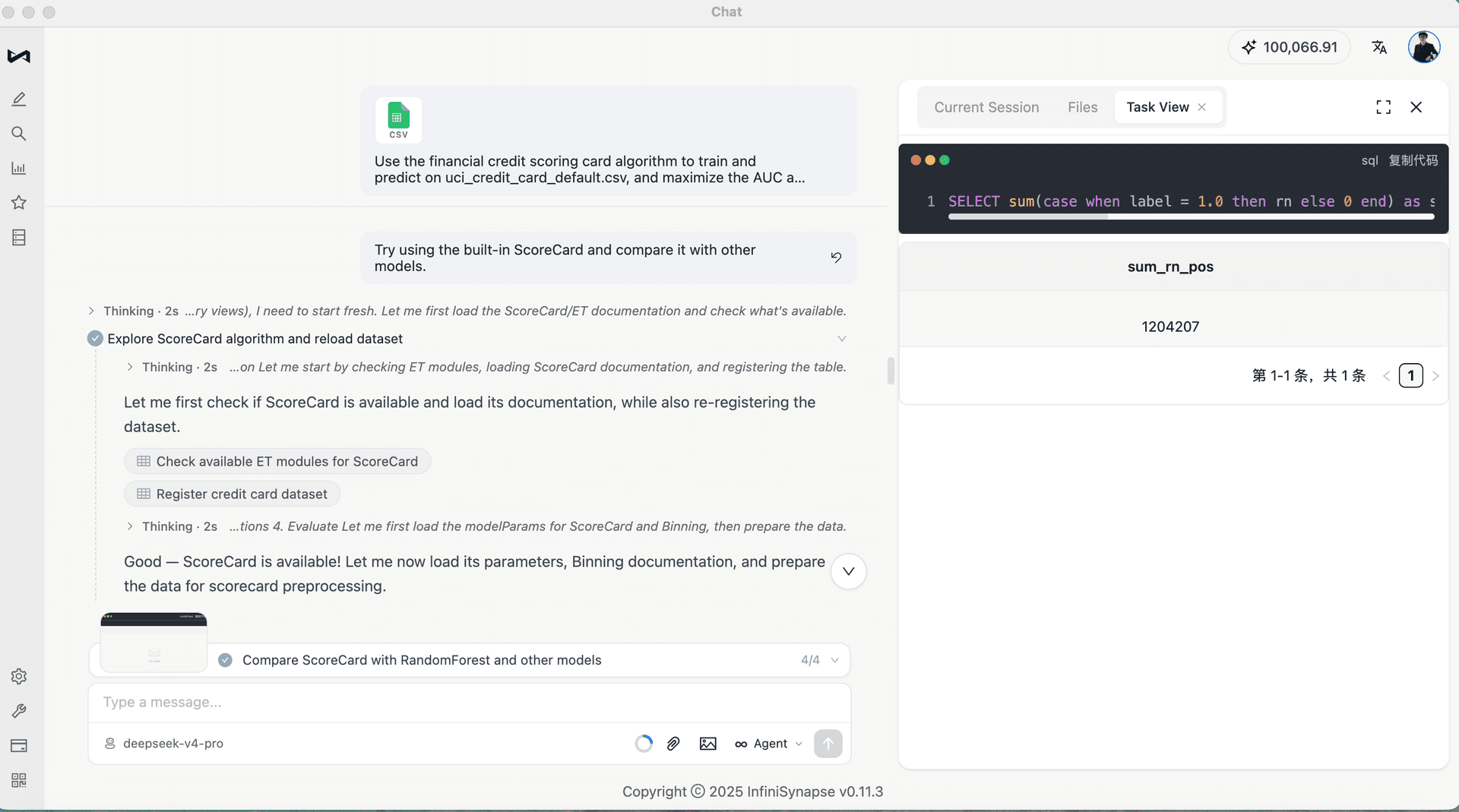
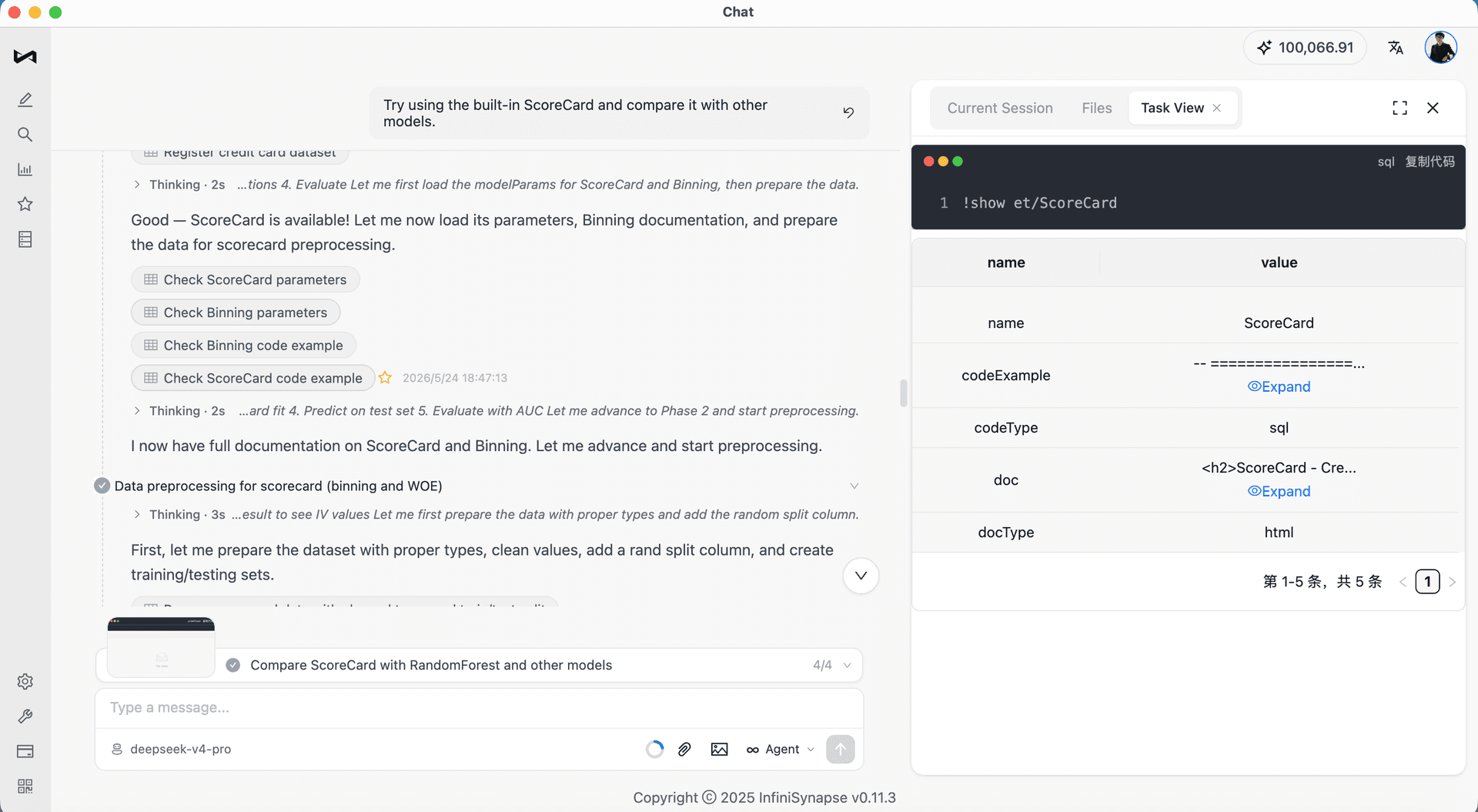
The first ScoreCard run trains on the selected features, predicts on the holdout set, and evaluates AUC/Gini/KS.
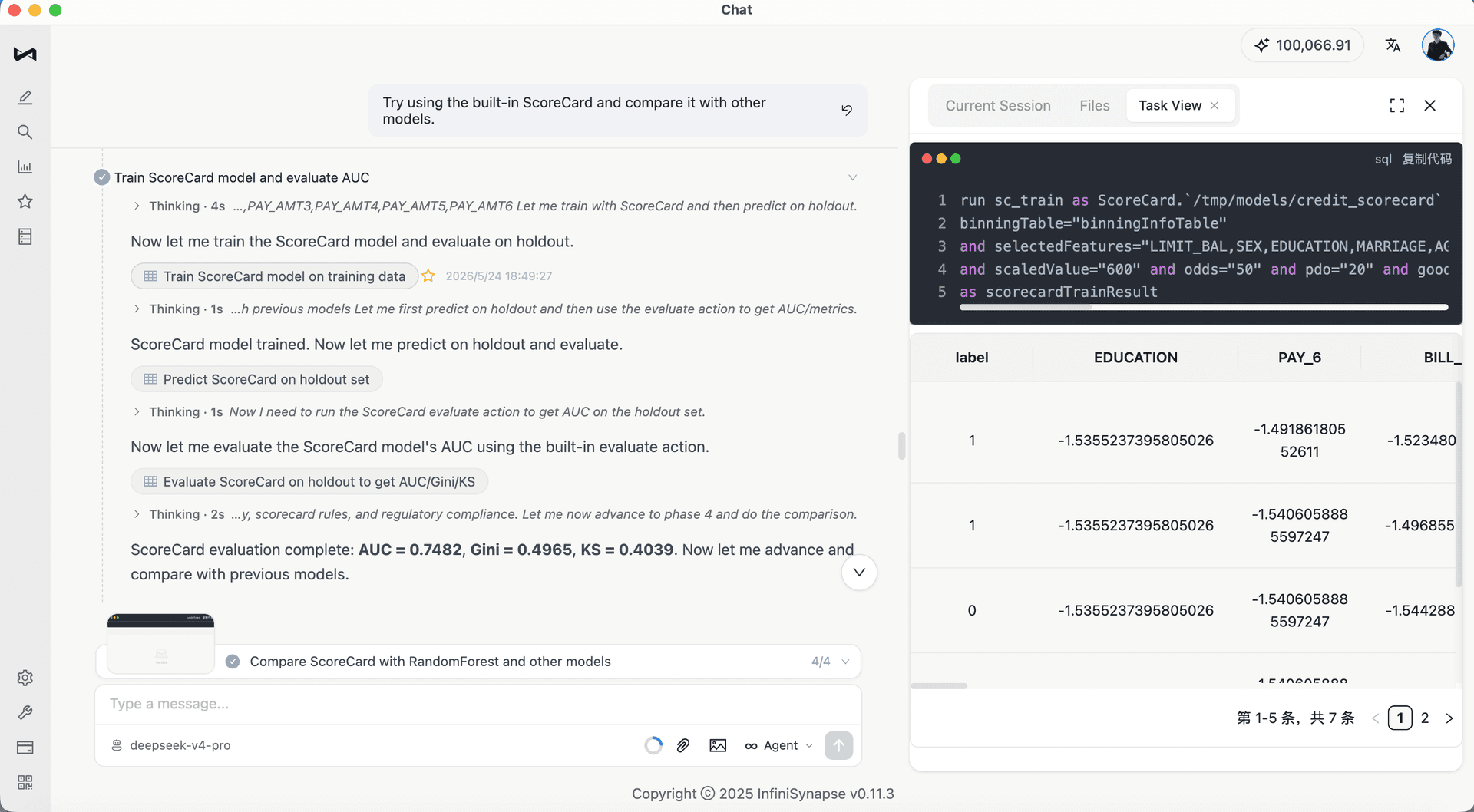
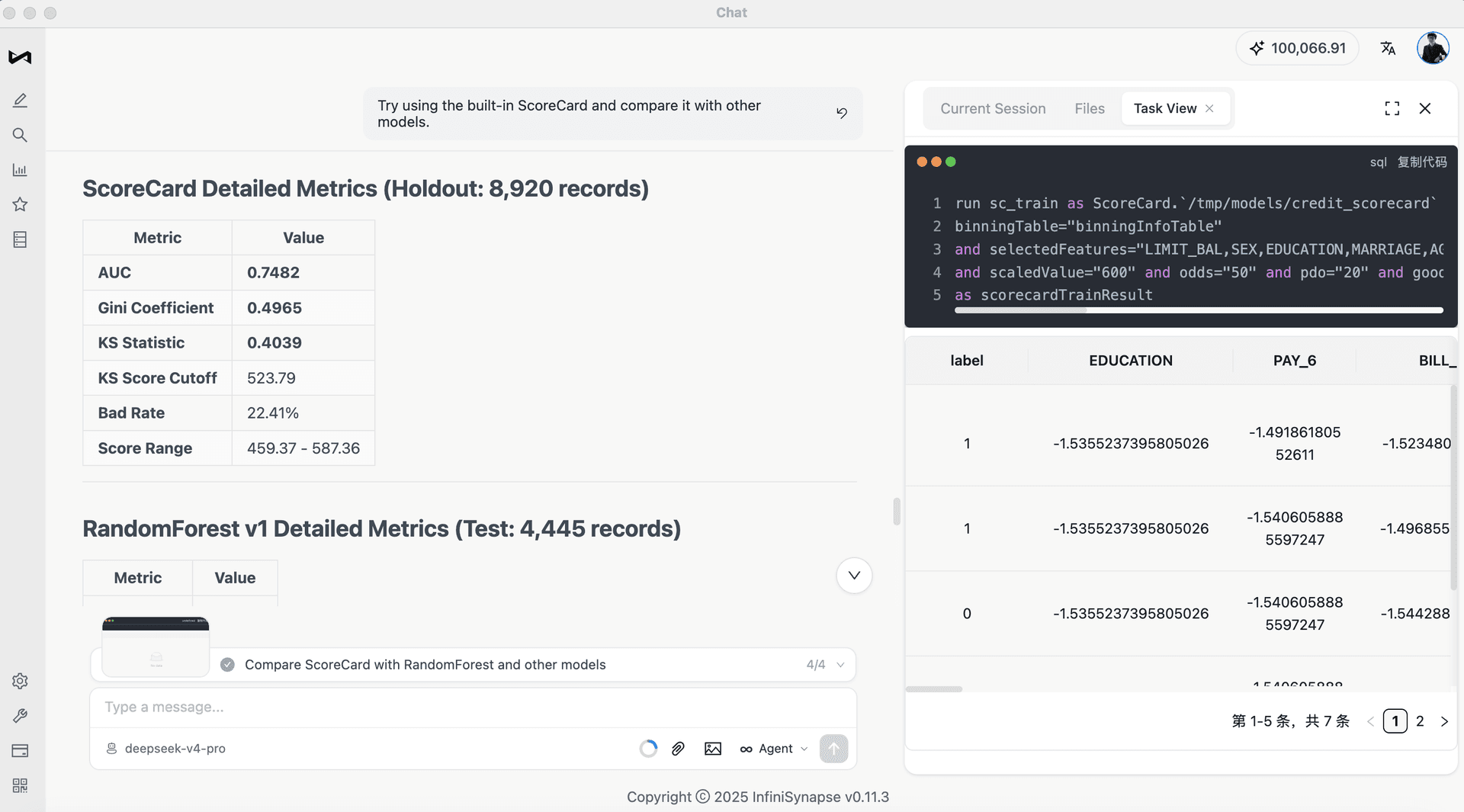
The baseline ScoreCard metrics:
| Metric | Value |
|---|---|
| AUC | 0.7482 |
| Gini | 0.4965 |
| KS | 0.4039 |
| KS cutoff | 523.79 |
| Score range | 459.37-587.36 |
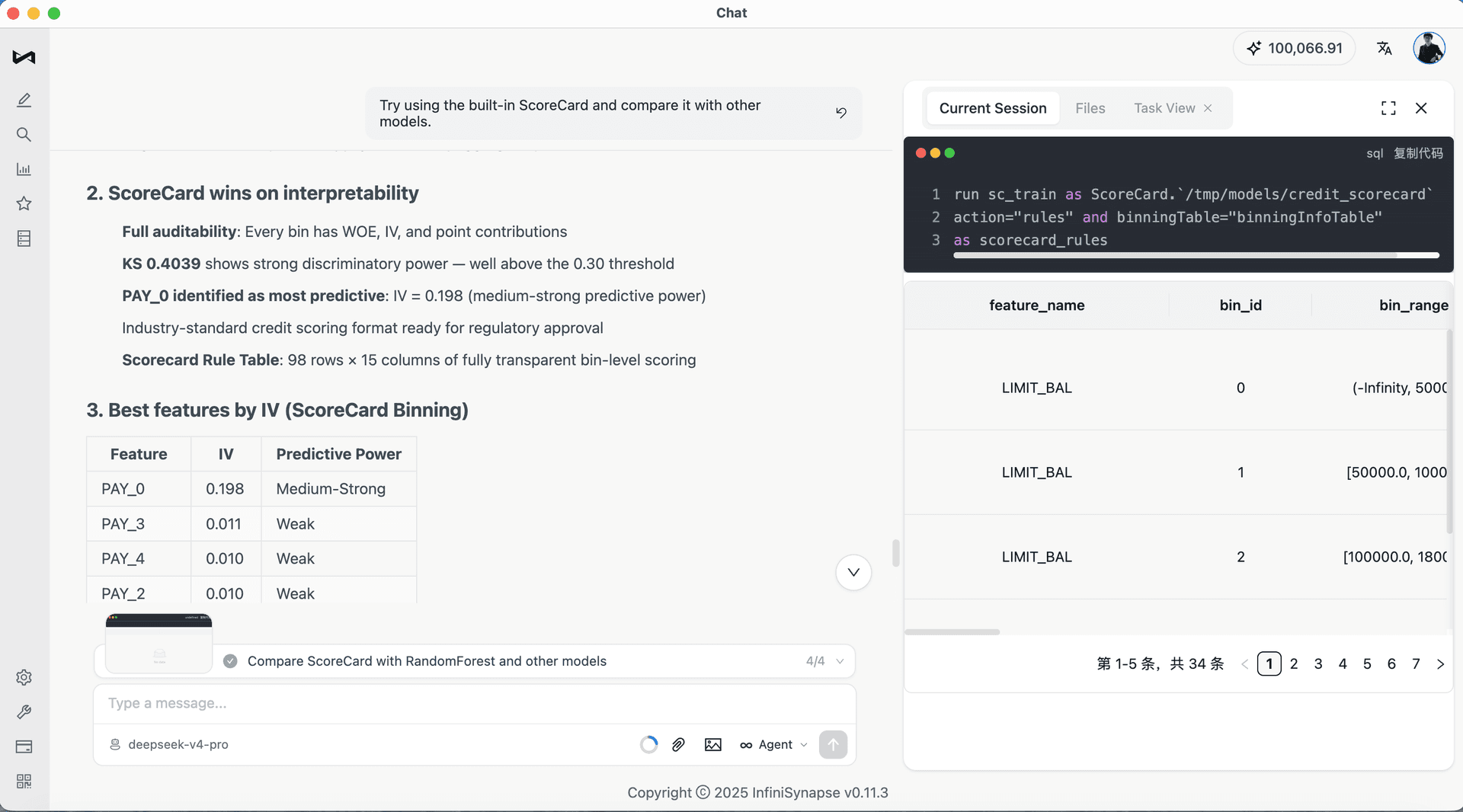
The key benefit is interpretability:
- every bin has WOE;
- every feature has IV;
- every score contribution can be explained;
- the rules table can be reviewed by risk and compliance teams;
- a black-box challenger can still be retained for validation.
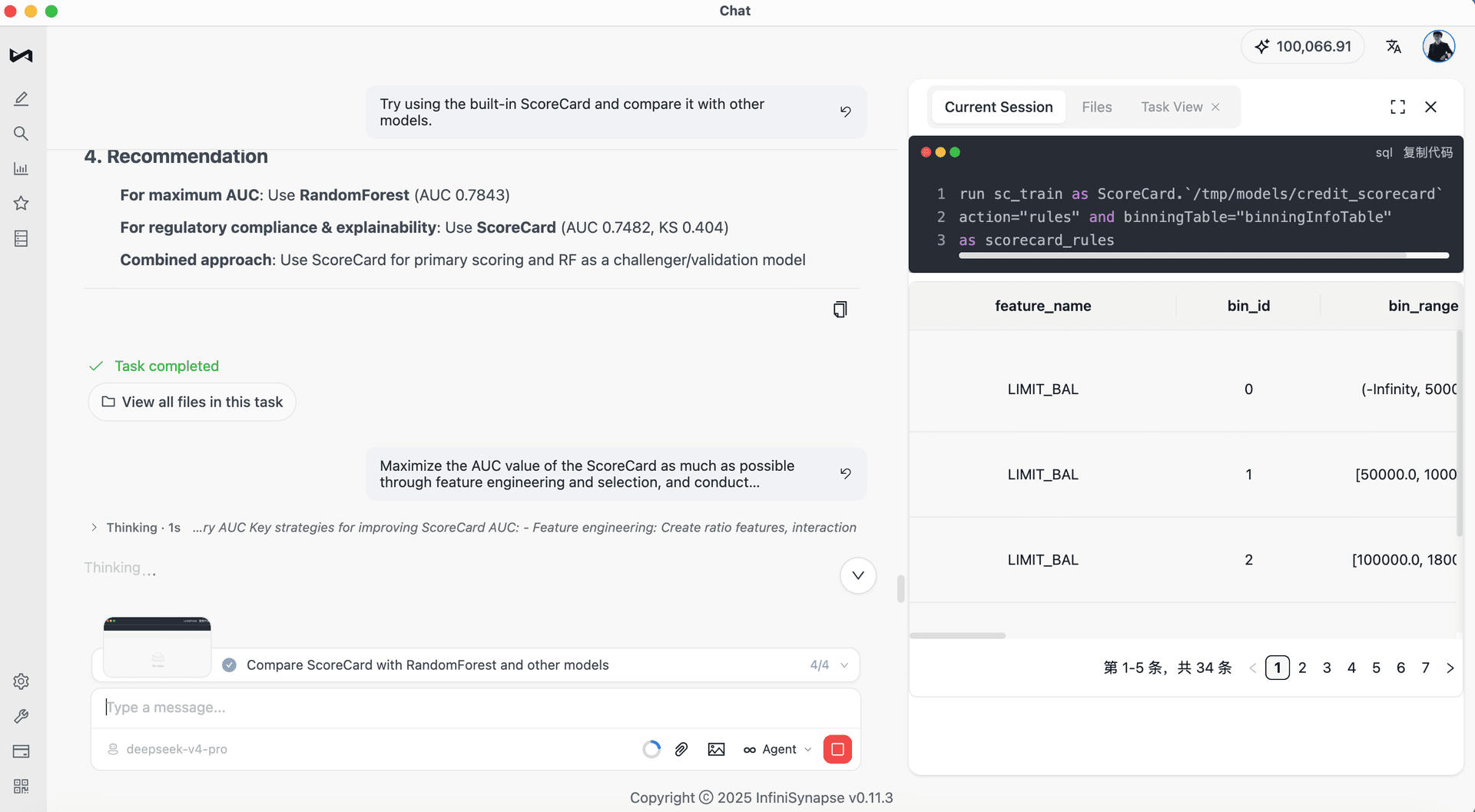
The agent's recommendation is exactly the kind of balanced decision a risk team would expect:
- use RandomForest when maximum AUC is the only goal;
- use ScoreCard when regulatory compliance and explainability matter;
- use ScoreCard as the primary scoring model and RandomForest as a challenger/validation model.
Step 5: Launch Agent Teams for Parallel ML Experiments
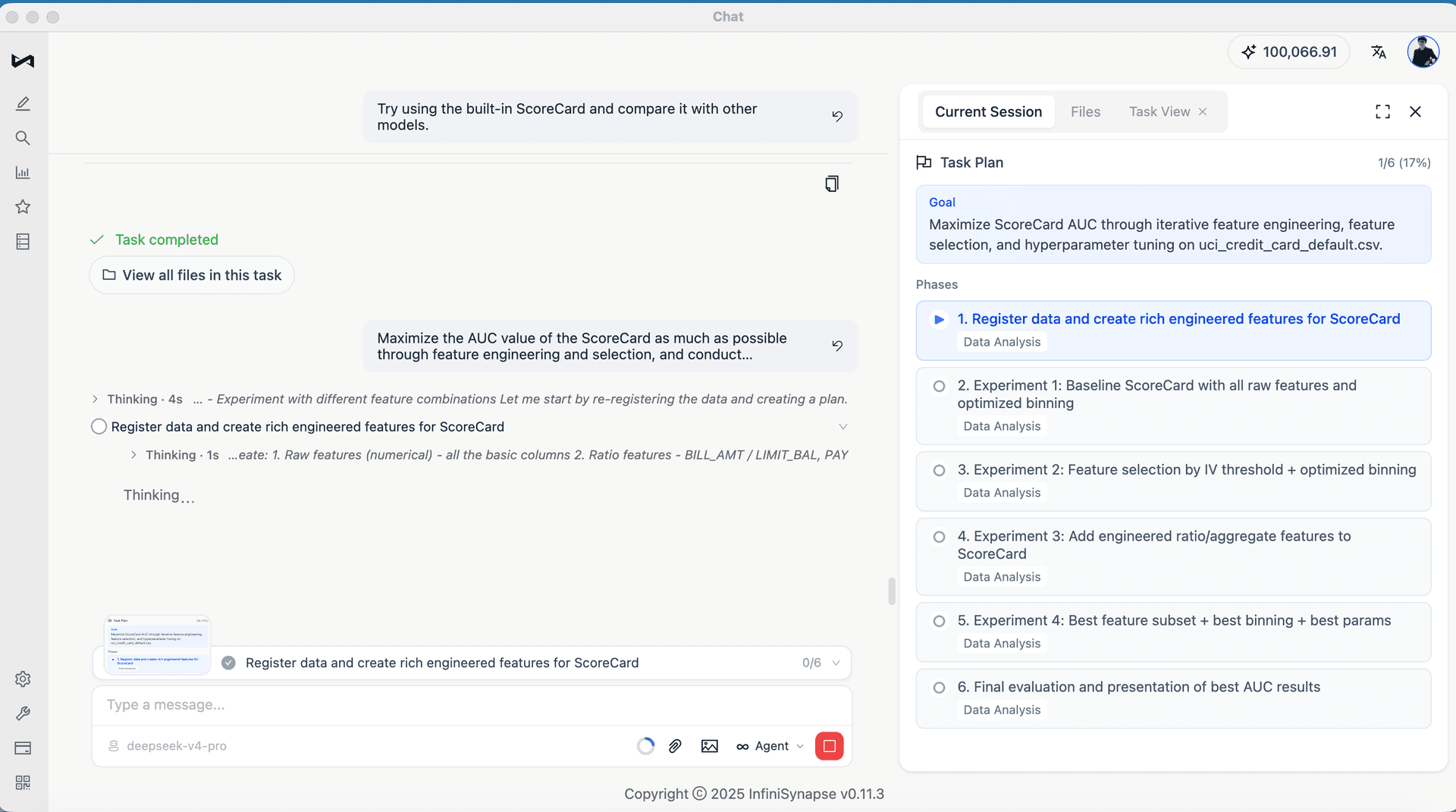
After the first ScoreCard result, the user asks InfiniSynapse to maximize ScoreCard AUC as much as possible.
The agent turns that into a structured plan:
- Register data and create rich engineered features.
- Run a baseline ScoreCard with all raw features and optimized binning.
- Try feature selection by IV threshold and optimized binning.
- Add engineered ratio and aggregate features.
- Try the best feature subset with the best binning and best parameters.
- Present the final evaluation and best AUC.
Then the key InfiniSynapse capability appears: Agent Teams.
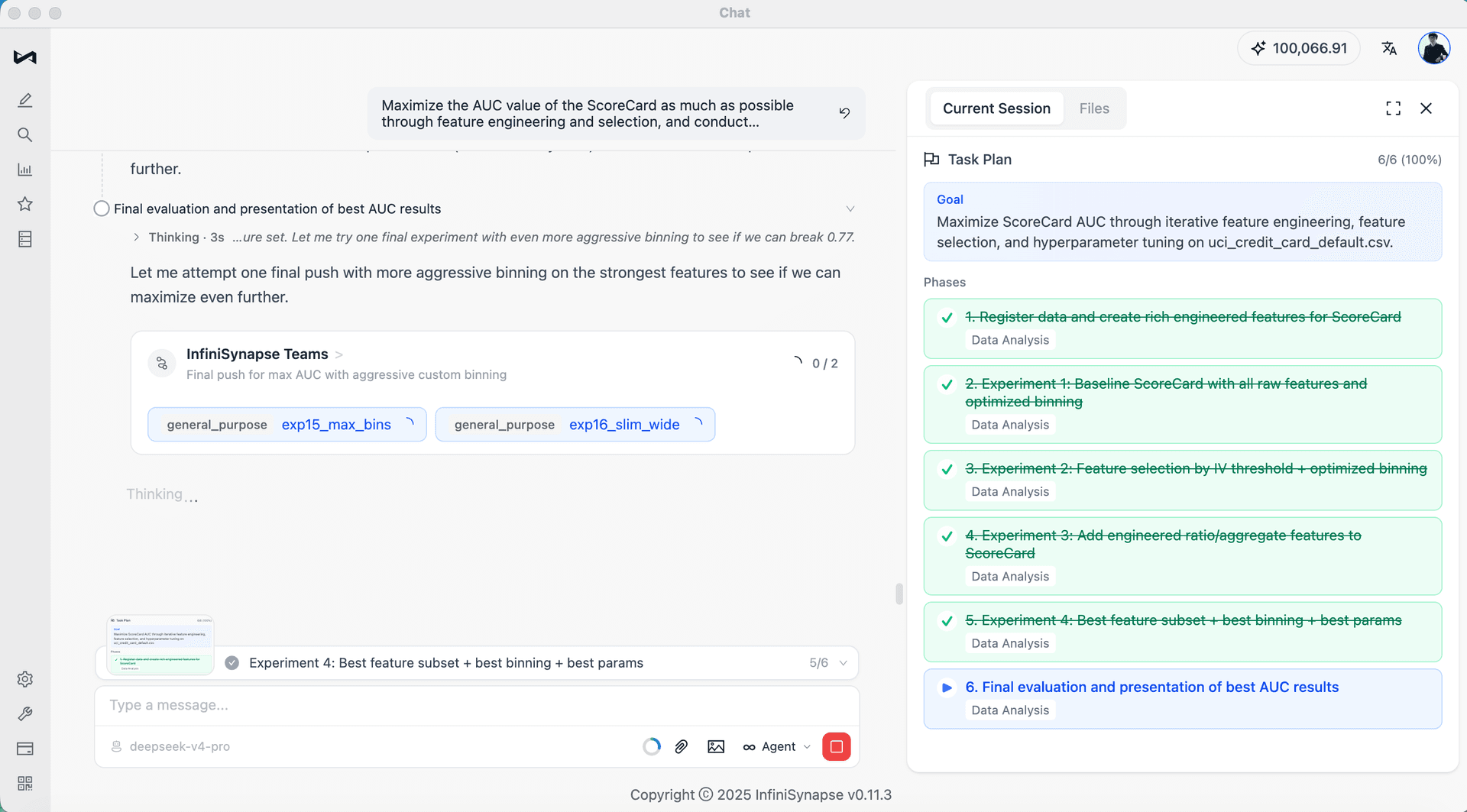
Instead of running one linear experiment at a time, InfiniSynapse delegates work to parallel sub-agents. Each sub-agent can run a specific modeling hypothesis: enhanced feature set, top-IV feature set, pay-focused feature set, custom binning, slim feature set, or aggressive binning.
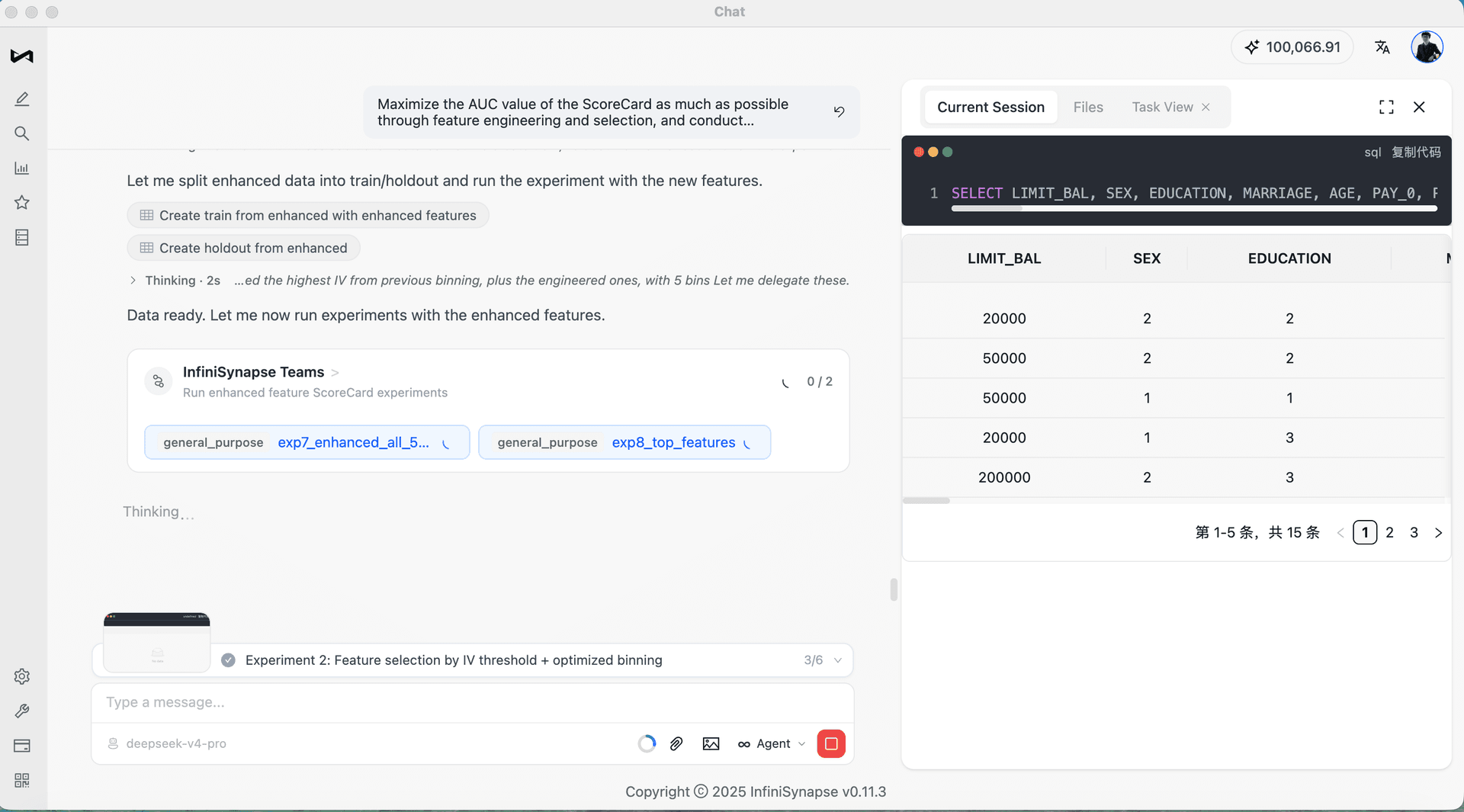
This matters because ML experimentation is naturally parallel. If the metric is clear, there is no reason to make an LLM test one hypothesis at a time forever. It can delegate, compare, and keep the best results.
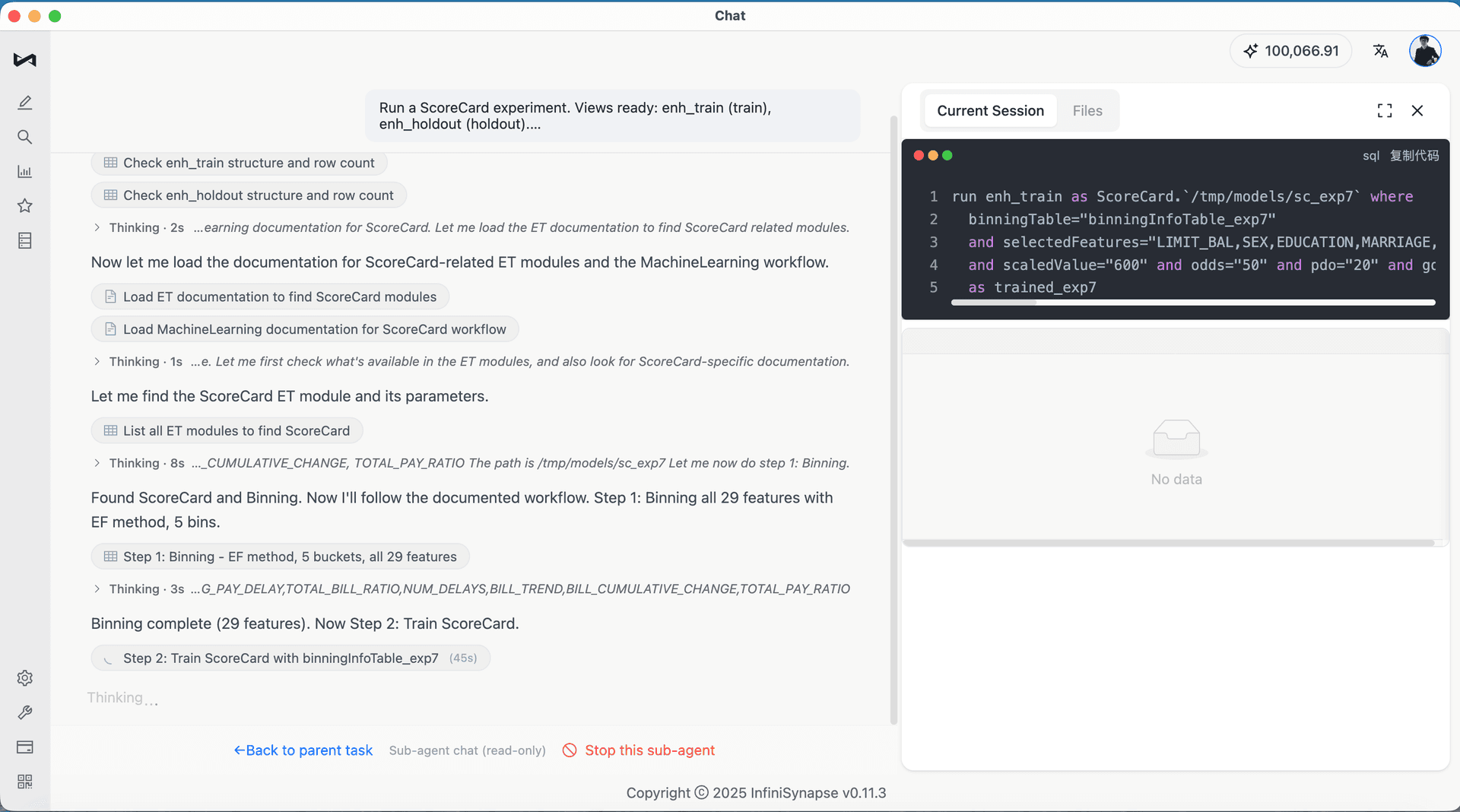
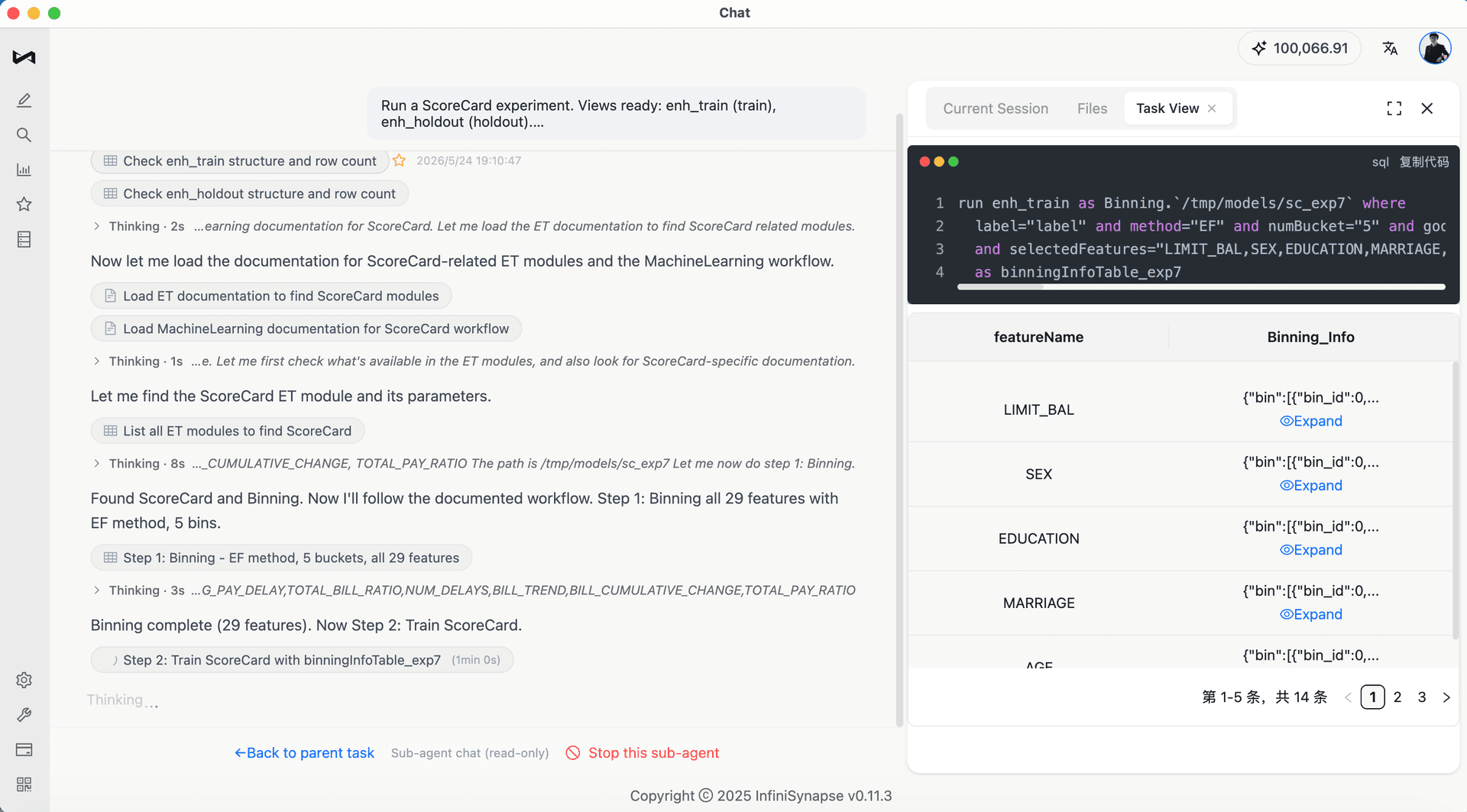
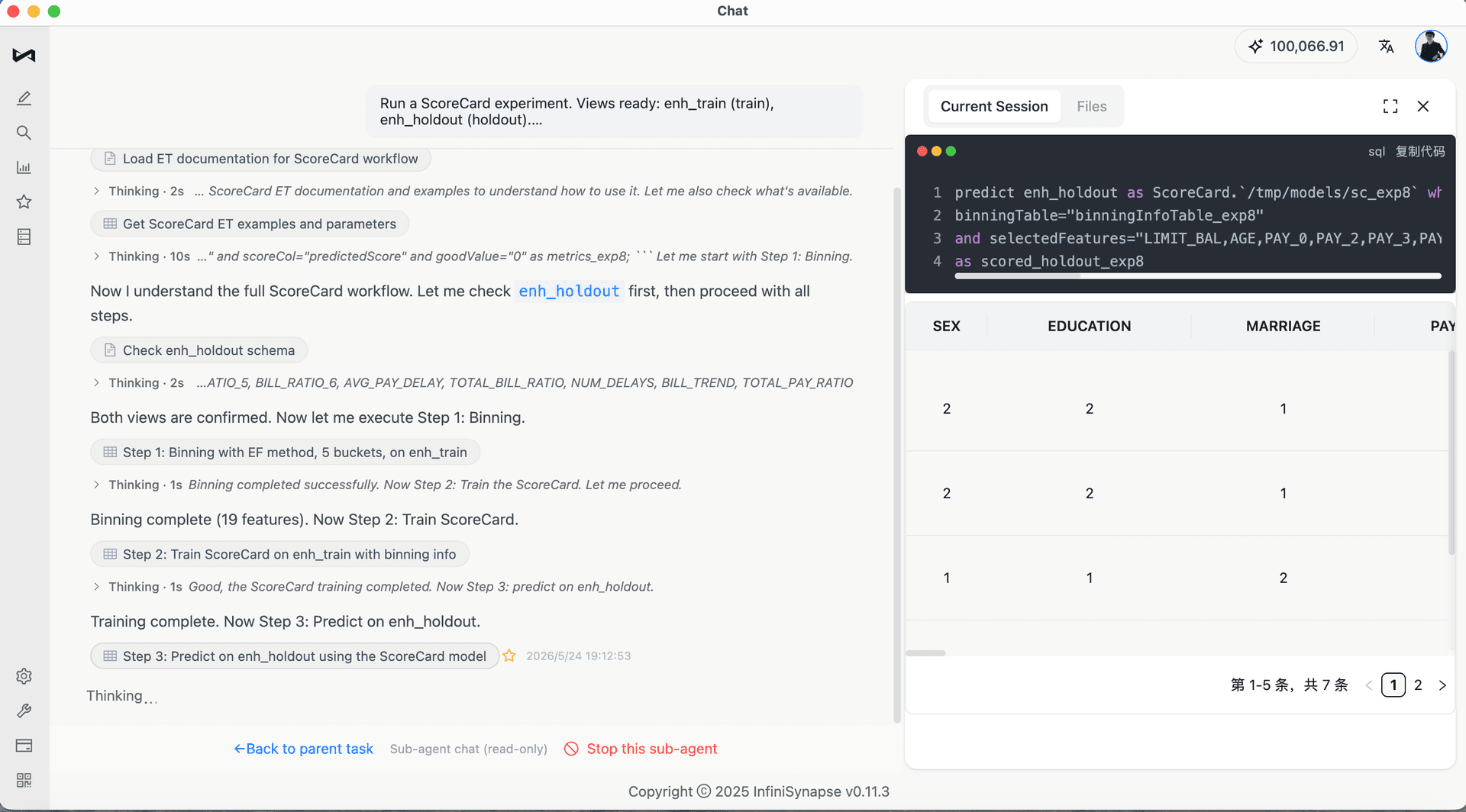
One experiment drops weak payment-amount features and reaches AUC 0.7517.
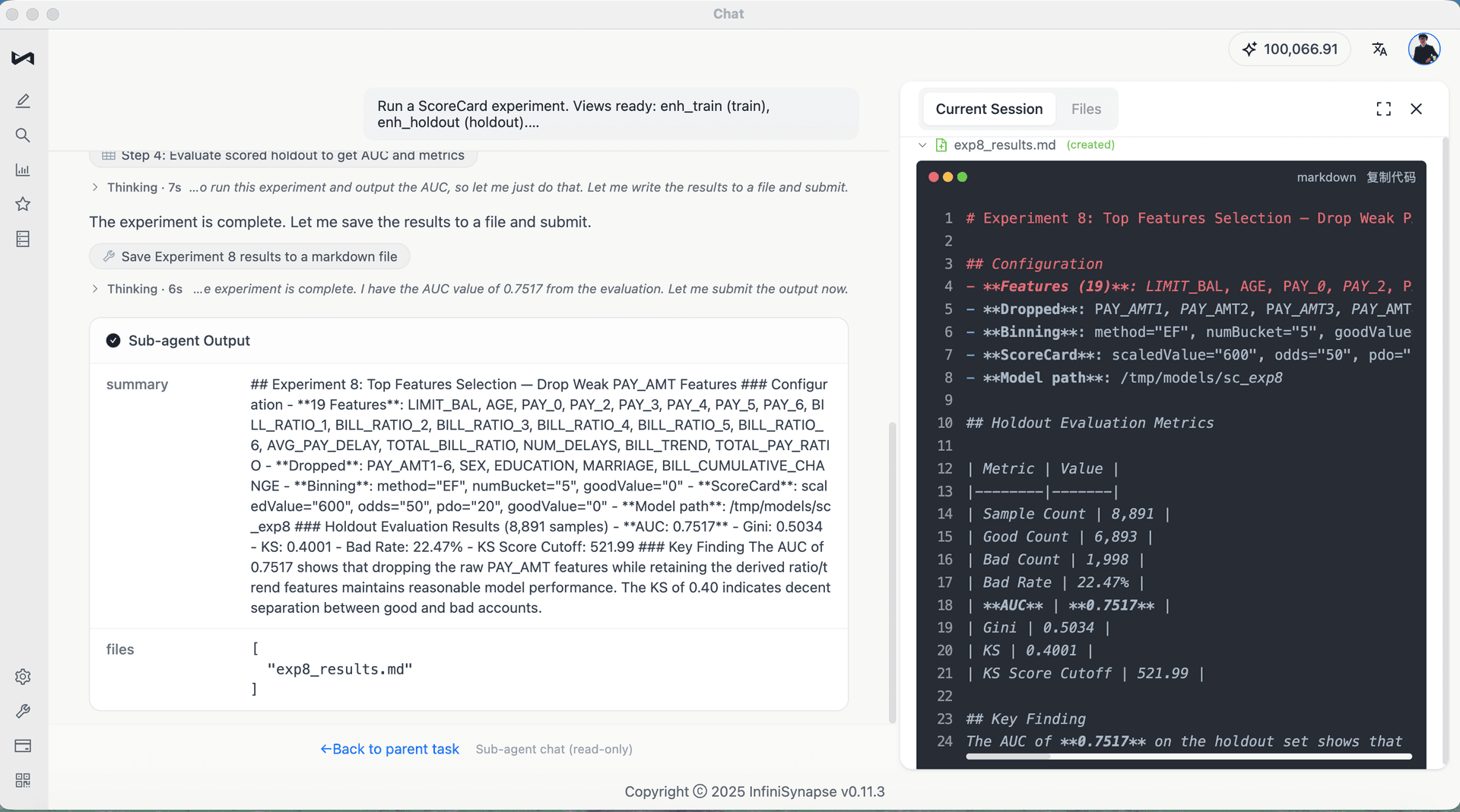
Another round reaches AUC 0.7605.
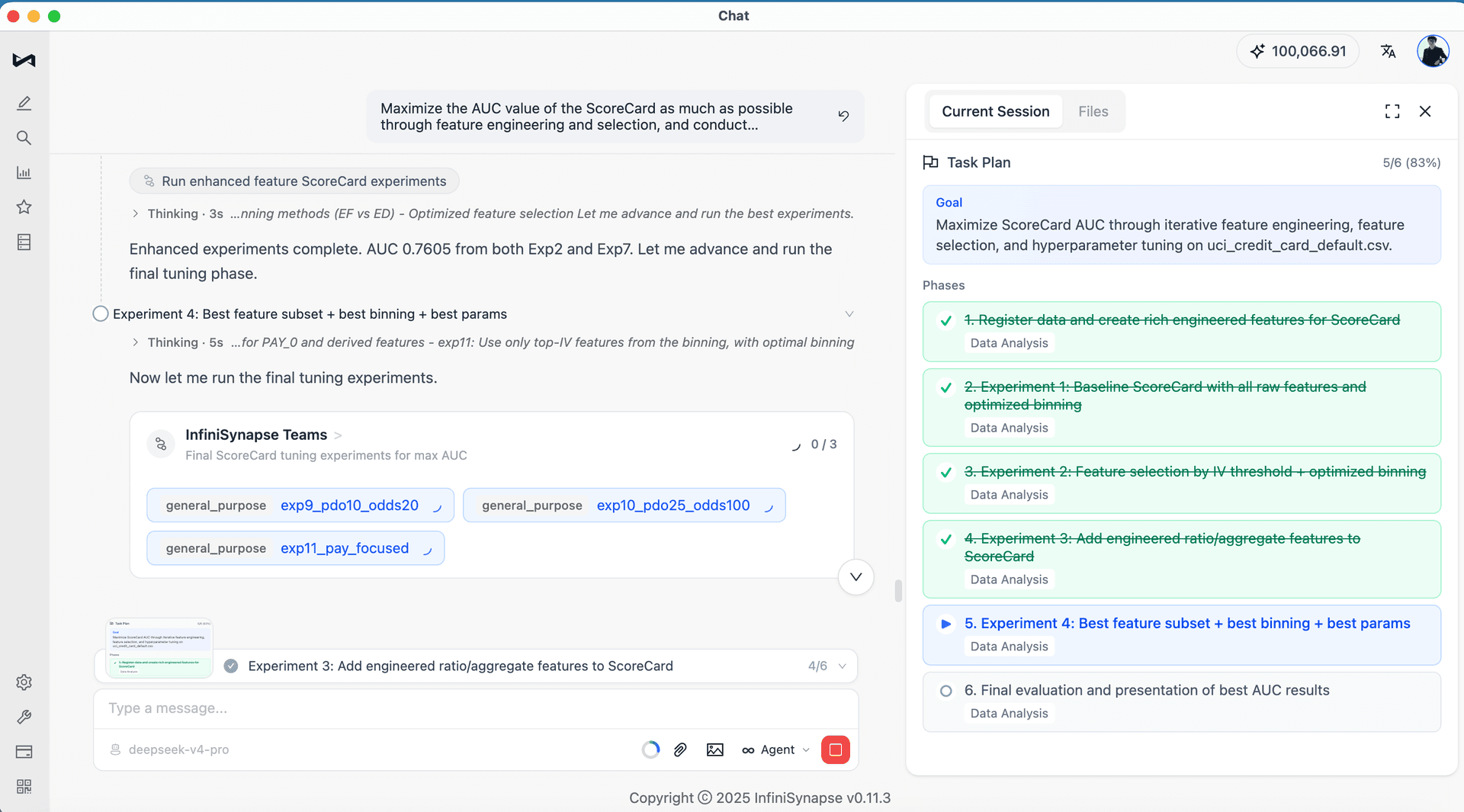
Then custom heavy binning reaches a new best AUC 0.7639.
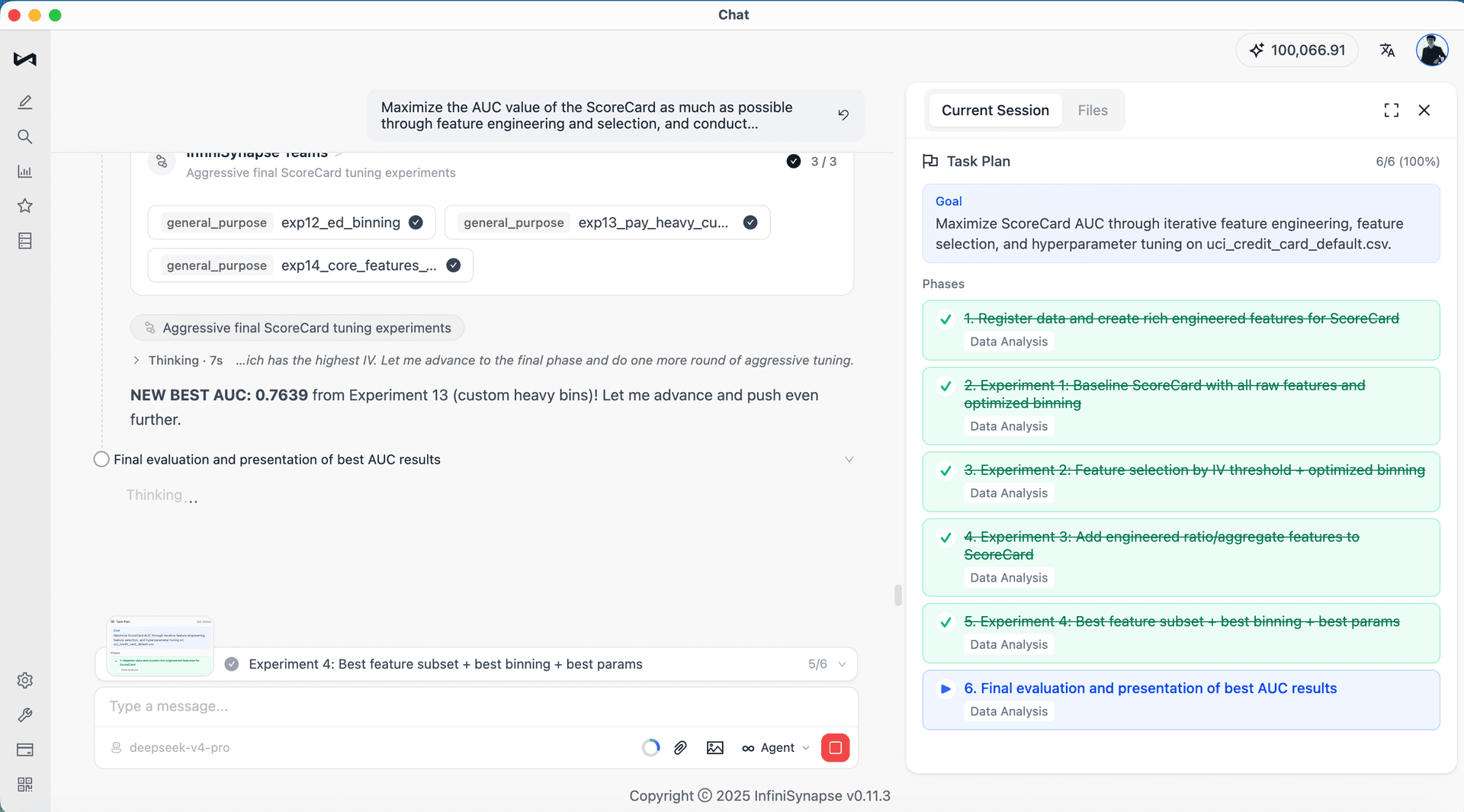
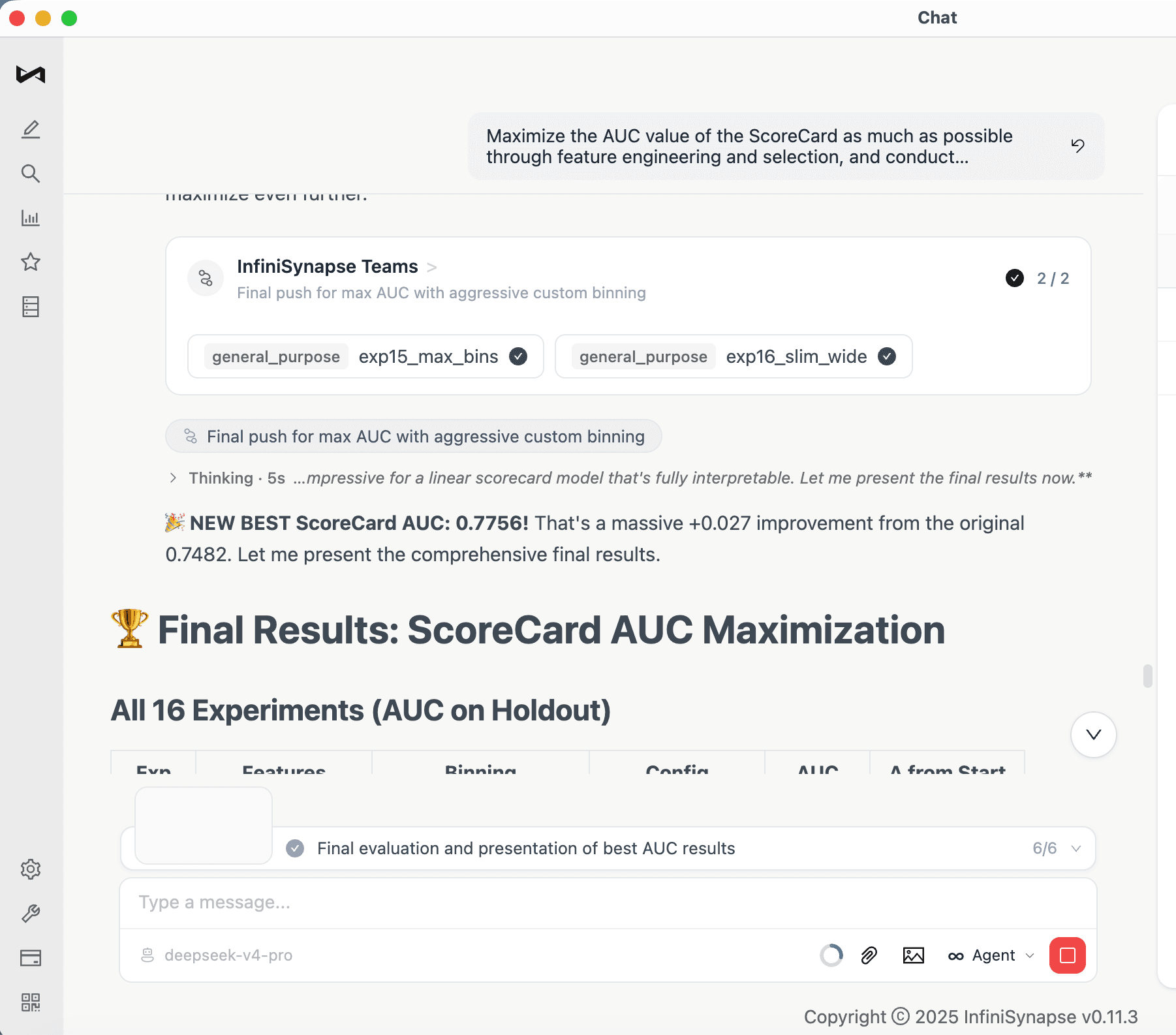
Finally, the agent launches a last push with aggressive custom binning on the strongest features.
The best recorded ScoreCard result:
AUC 0.7756, up from 0.7482, after 16 experiments.
Step 6: Explain the Improvement, Not Just the Number
The final result is not a mysterious jump. The agent records the experiment history and the improvement drivers.
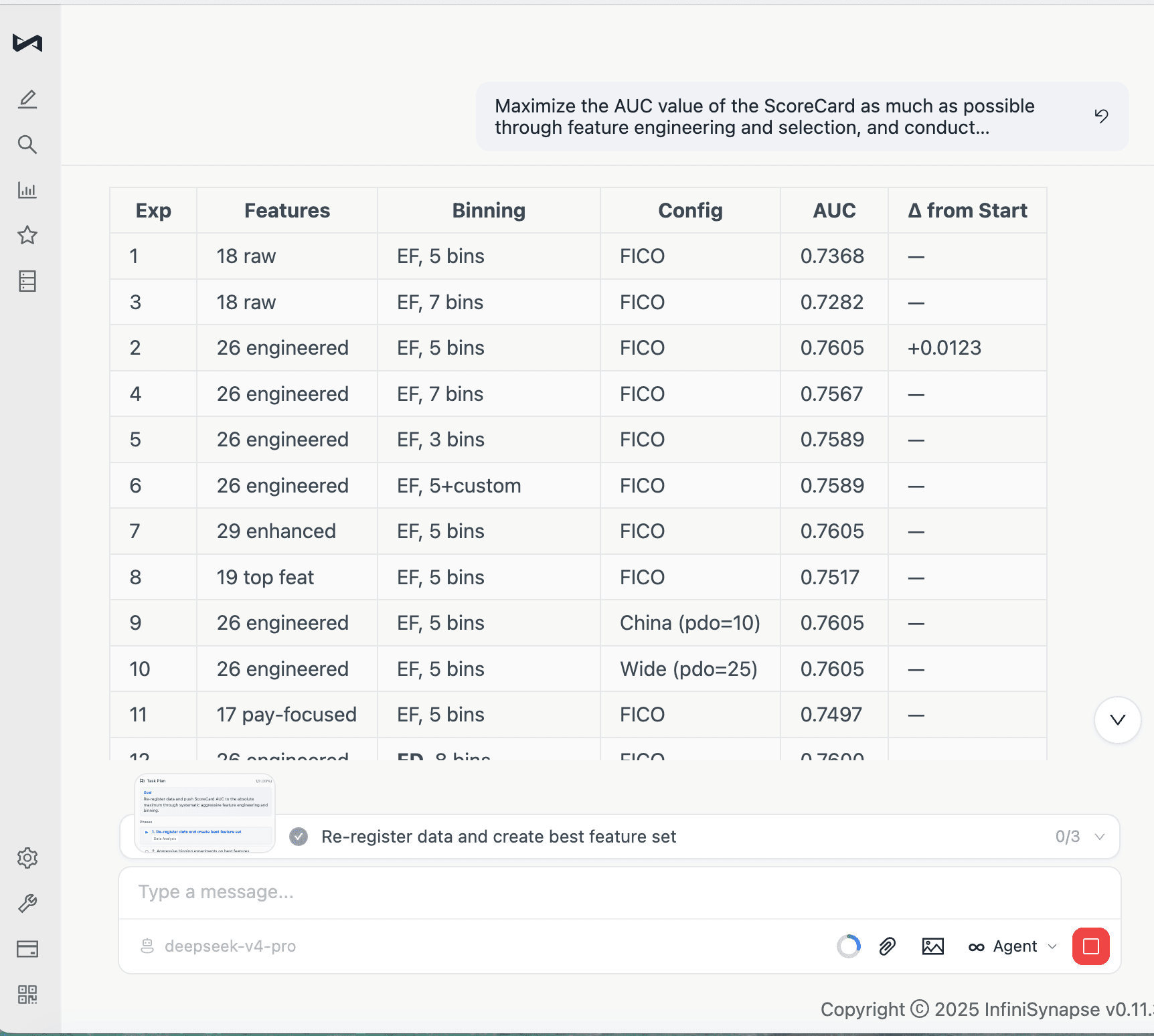
The main improvement path:
- baseline ScoreCard with raw features: 0.7482 AUC;
- engineered bill/payment/delay features: additional signal;
- optimized feature selection and binning: better separation;
- aggressive custom bins on strongest repayment variables: final lift;
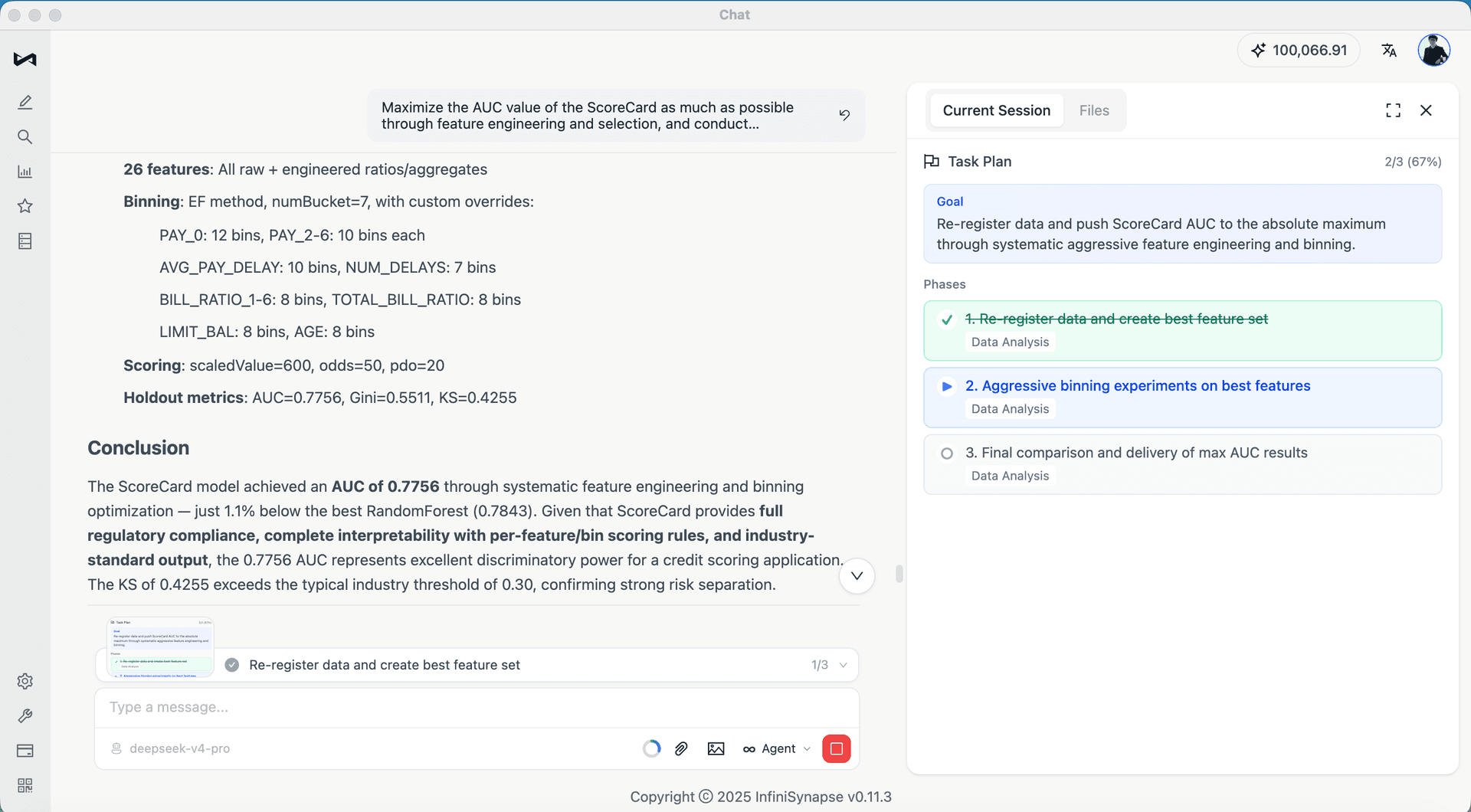
- best ScoreCard: 0.7756 AUC, 0.5511 Gini, 0.4255 KS.
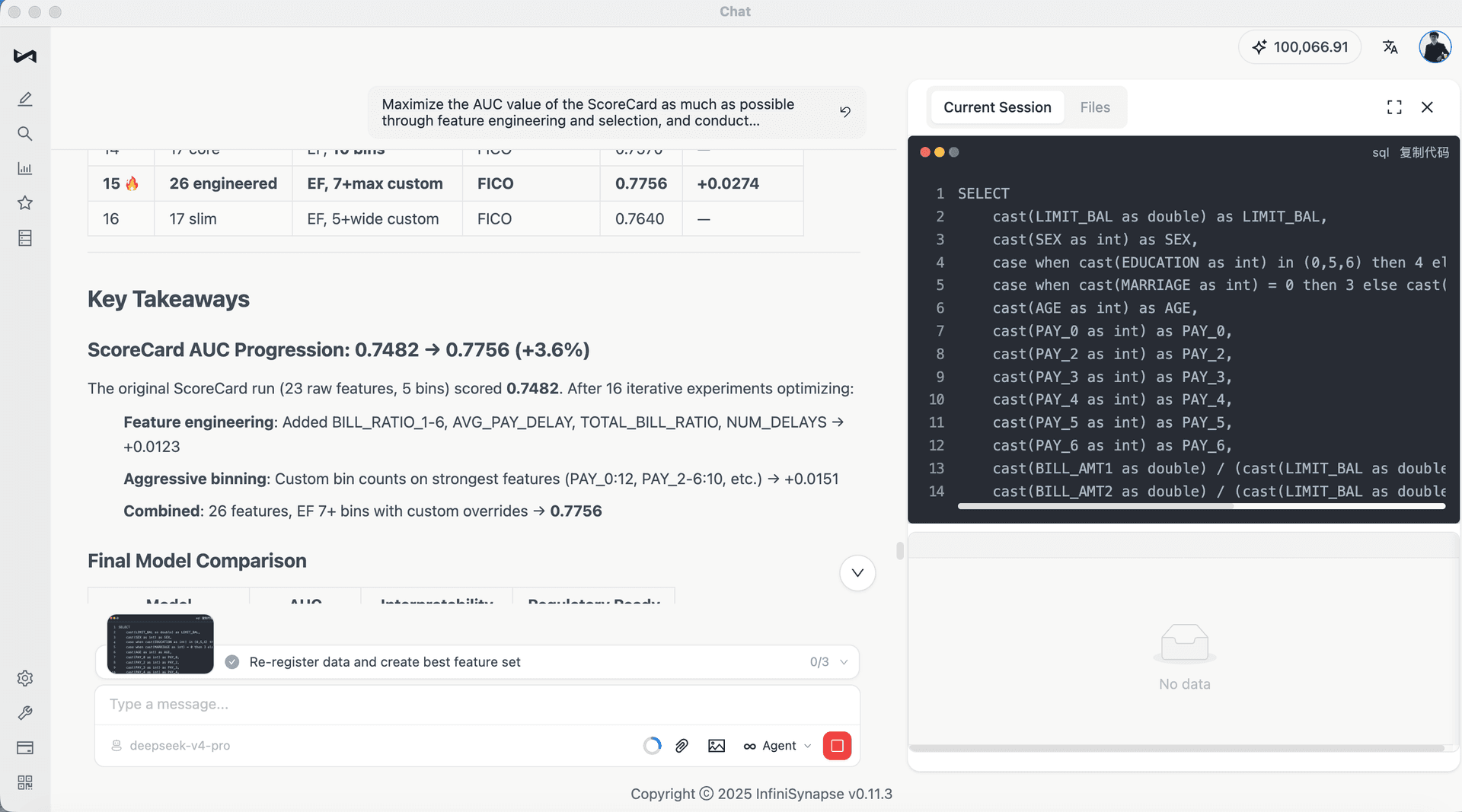
The final model comparison is the business point:
| Model | AUC | Interpretability | Regulatory Readiness |
|---|---|---|---|
| RandomForest v1 | 0.7843 | Black-box | No |
| ScoreCard Exp15 | 0.7756 | Fully transparent | Yes |
| Logistic Regression | 0.7571 | Semi-transparent | Yes |
| GBTClassifier | shown as black-box challenger | Black-box | No |
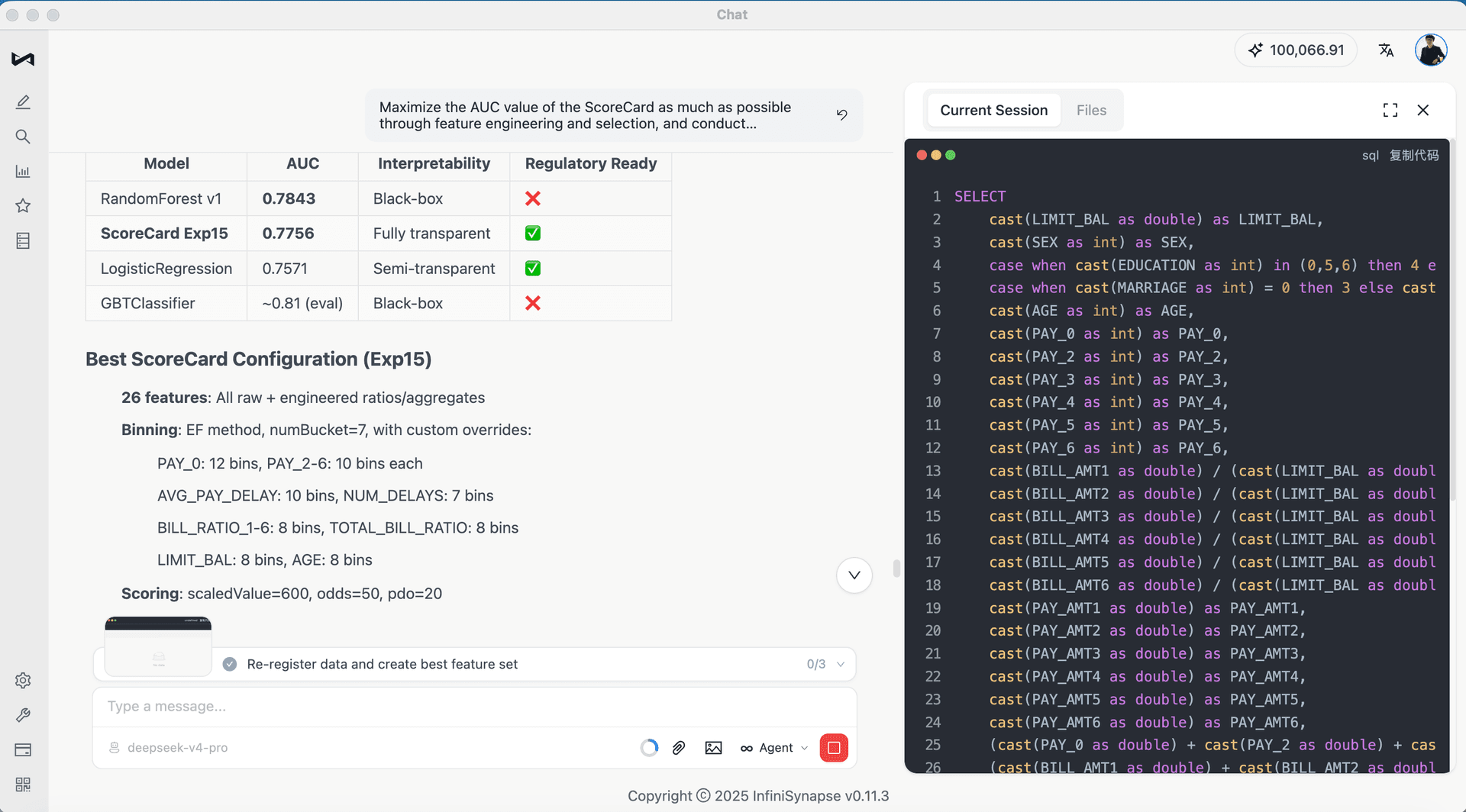
The best ScoreCard configuration:
- 26 features: raw fields plus engineered ratios and aggregates;
- EF binning;
- 7 default buckets with custom overrides;
- PAY_0: 12 bins;
- PAY_2 to PAY_6: 10 bins each;
- AVG_PAY_DELAY: 10 bins;
- NUM_DELAYS: 7 bins;
- holdout AUC: 0.7756;
- Gini: 0.5511;
- KS: 0.4255.
Feature Visualization: Make the Feature Work Reviewable
At this point, the story should not end with "the metric improved." For a credit scorecard, the more important questions are: which features actually carry information, whether the binning direction makes business sense, and whether a feature is stable signal or accidental noise.
InfiniSynapse can put that intermediate evidence directly into the review chain. WOE curves are useful for checking how risk evidence changes across bins, while IV ranking is useful for quickly seeing which features deserve more attention.
WOE review is not decoration. It makes binning reviewable. A risk team can inspect:
- whether a feature's risk direction matches business intuition;
- whether the bins are too granular, too coarse, or unstable;
- why custom binning may improve the model;
- which features should be kept, down-weighted, or removed.
The clearer article visual is the IV ranking. IV is not the same as final model performance, but it answers a practical question: which features provide more information for separating good and bad customers?
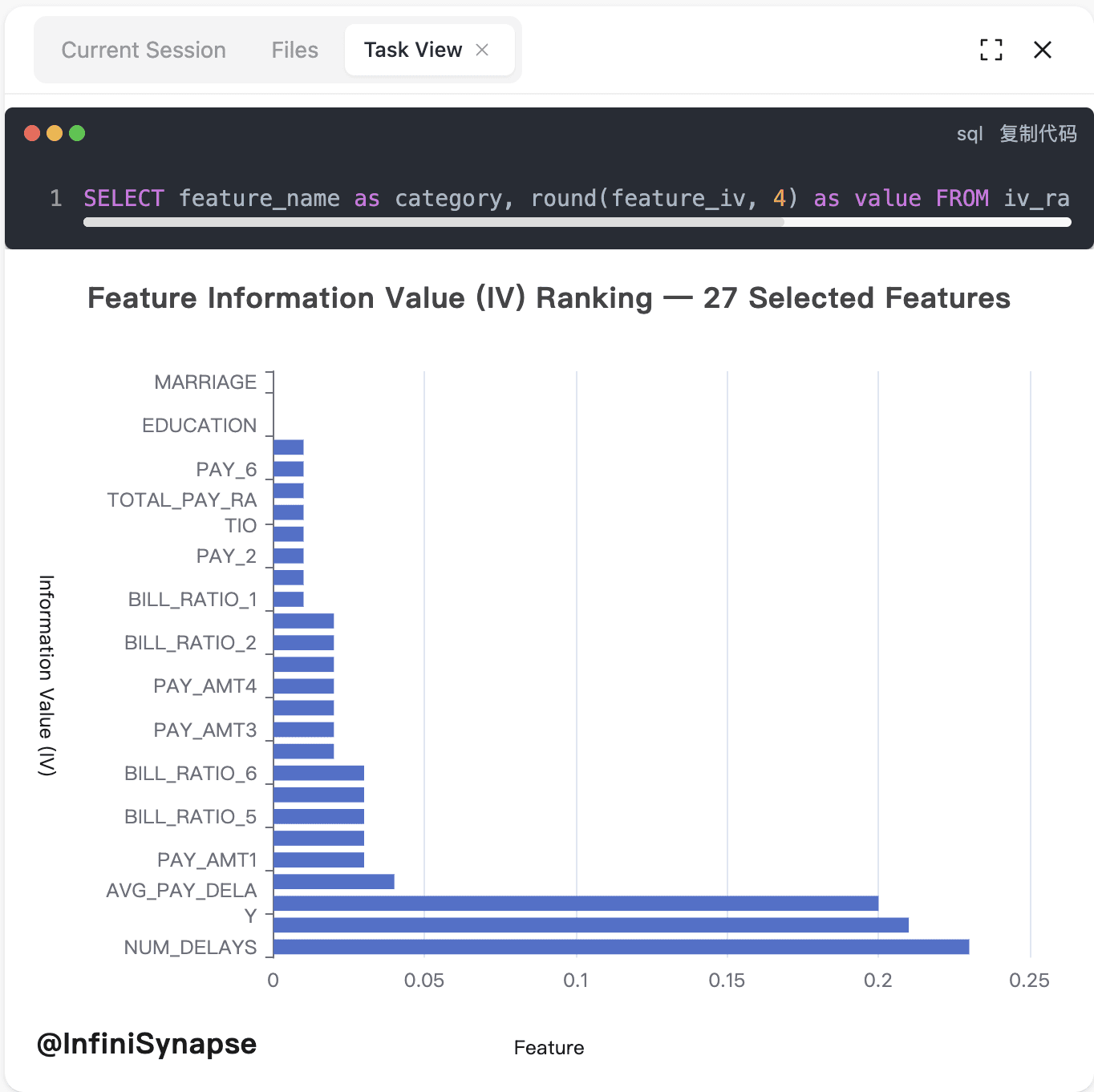
This turns feature engineering from "the agent says it optimized the model" into something a human reviewer can inspect. Variables such as NUM_DELAYS, AVG_PAY_DELAY, bill ratios, and payment amounts can be read alongside the AUC lift and the custom-binning configuration.
That is an important layer of the InfiniSynapse ML workflow. It does not only return a final model file. It keeps feature candidates, binning evidence, IV rankings, WOE movement, and final metrics in the same evidence chain.
The model lift is not a black-box result. It is a reviewable feature story for business and risk teams.
Why This Is More Than a Demo
The architecture behind this workflow is not a collection of disconnected features. InfiniSynapse is built as a full Data Agent stack:
- Agent planning and self-correction;
- InfiniSQL as the tool language;
- cross-source execution;
- persistent session tables;
- knowledge and memory;
- report and artifact delivery;
- machine learning inside the same table-based workflow.
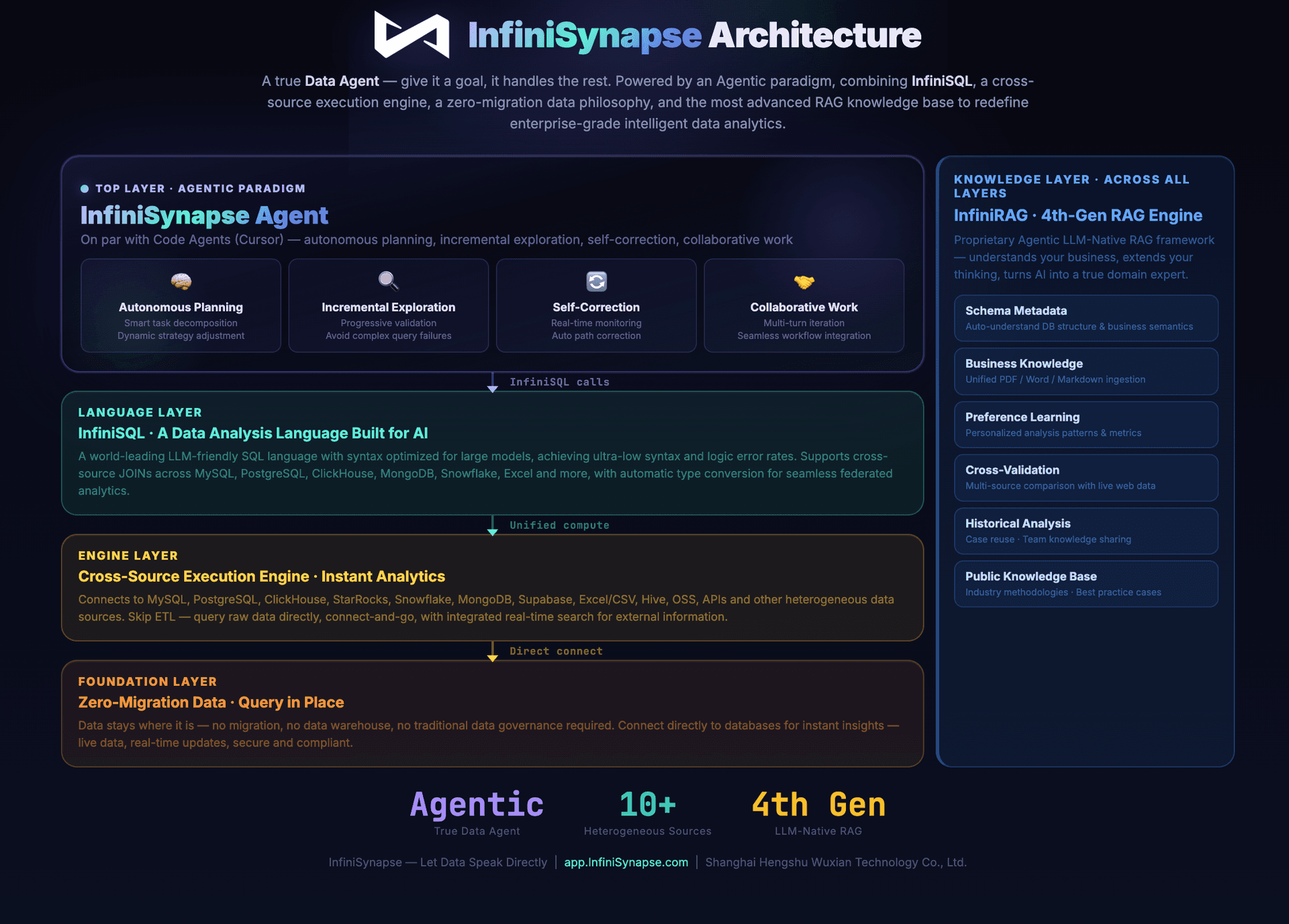
This is why the ML workflow feels coherent. The agent is not jumping from SQL to pandas to sklearn to a separate report generator. It is using one table-centered operating model:
| Step | InfiniSQL Form |
|---|---|
| Load data | load ... as table |
| Engineer features | select ... as table |
| Train model | train table as Model... |
| Register model | register Model... as function |
| Predict | select model_function(features) ... as table |
| Evaluate | run ... as ScoreCard... where action="evaluate" |
| Explain | rules, WOE, IV, deciles, PSI, score contributions |
That is the deeper fit:
Traditional ML has explicit targets. InfiniSQL provides the feature factory. Agent Teams provide the experiment engine. InfiniSynapse keeps running until the metric stops improving.
Official Takeaways
- InfiniSynapse can execute complete ML workflows, not just answer analytical questions.
It loads data, engineers features, trains models, compares algorithms, evaluates metrics, and saves audit artifacts.
- Traditional ML is especially well matched with Agentic execution.
Metrics such as AUC, Gini, KS, IV, PSI, and decile lift give the Agent a clear optimization signal.
- Feature engineering is the center of the workflow.
The demo improves ScoreCard performance by creating repayment, utilization, bill-ratio, delay, and aggregate features.
- Agent Teams turn experimentation into parallel work.
Different sub-agents test different feature subsets, binning strategies, and scorecard parameters at the same time.
- InfiniSQL expands the feature universe.
Because it supports files, operational databases, warehouses, search systems, and cross-source JOINs, more sources can become more candidate features.
- Feature visualization makes the optimization process reviewable.
IV ranking and WOE curves show which features matter, whether binning is reasonable, and whether the risk direction is stable enough for business review.
- The final answer is not only a model.
The output includes metrics, rules, WOE, IV, deciles, PSI, scorecard configuration, feature visualizations, and business-readable recommendations.
The strongest careful claim is not that one demo proves universal SOTA. The right claim is more valuable:
InfiniSynapse can continuously search the traditional ML feature and parameter space, using InfiniSQL as the execution layer, until it produces a strong, reproducible, explainable model that a real business team can inspect.