Databricks' recent Genie messaging is sharp:
Genie is becoming the most important way to do data analysis in Databricks, because it can extract semantics from the entire Lakehouse.
That is the right problem to highlight.
Most AI data products fail not because the model cannot write a SQL query. They fail because the Agent does not understand the data deeply enough. It does not know which metric is official, which table is trusted, which dashboard is certified, which notebook contains the real logic, or which business document explains a field name.
Databricks Genie is answering that problem from the Databricks world: extract and route semantics from the Lakehouse, dashboards, notebooks, Genie Spaces, Apps, and external knowledge sources, then let business users ask questions through one AI entry point.
InfiniSynapse answers a harder and more general problem:
What if the data, semantics, execution steps, and business knowledge are not already unified inside one Lakehouse?
That is the real difference.
Genie is becoming a semantic front door for Databricks.
InfiniSynapse is building an Agentic Analytics Workbench: connect live data sources, bind them to high-accuracy knowledge bases, let the Agent use an Agentic-friendly SQL language, show every meaningful execution step, and deliver charts, SQL, files, and reports that people can review.
This is not just "chat with data." It is a different way to make AI perform data analysis.
1. Genie's Key Idea: Extract Semantics From the Lakehouse
The new Genie direction is not trivial.
Databricks is not merely saying: "We added a chat box." It is saying that the AI experience should understand the semantic surface of the Lakehouse:
- certified Genie Spaces;
- governed dashboards;
- Databricks Apps;
- notebooks;
- external knowledge stores such as Google Drive and SharePoint;
- metadata and descriptions;
- business definitions and verified metric logic;
- mobile access for business users.
The bet is clear: if the Lakehouse already contains the assets a business trusts, Genie can become the natural interface over those assets.
That is powerful because enterprise analytics is full of semantic traps:
- a table name can be misleading;
- two dashboards can calculate "active user" differently;
- a notebook might contain the real transformation logic;
- a metric might be valid only under a specific filter;
- a business term might have a very different meaning across departments.
Genie's answer is to use the Databricks estate as the semantic substrate. It tries to find, route, and use the right trusted asset for the question.
This is much deeper than basic Text-to-SQL.
But it still leaves a bigger question:
Is extracting semantics from existing platform assets enough for true Agentic data analysis?
For many companies, the answer is no.
2. InfiniSynapse's Key Idea: Bind Semantics to the Data Source
InfiniSynapse starts from a different observation:
Business semantics should not merely be discovered after the fact. They should be explicitly bound to the data source the Agent is analyzing.
That is why database + knowledge-base binding is one of the most important InfiniSynapse ideas.
The database tells the Agent what happened.
The knowledge base tells the Agent what it means.
This sounds simple, but it changes the whole analysis process.
In the current InfiniSynapse console, winclaw_cn is not just a PostgreSQL-backed business database. It is a data source with an associated knowledge base: winclaw_cn_telemetry_knowledge.
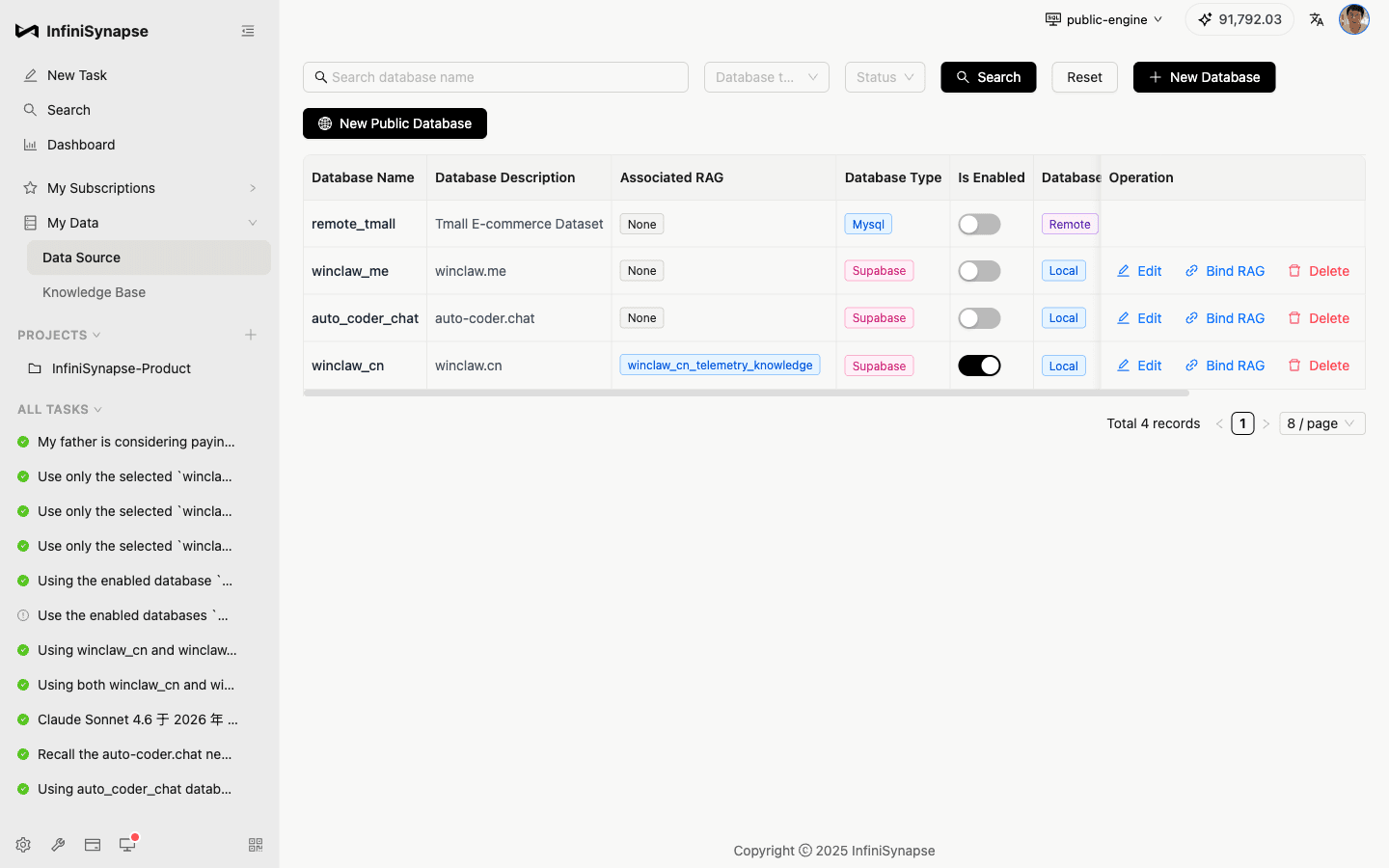
A data source in InfiniSynapse can be enabled, queried, and bound to a knowledge base that explains its business semantics.
The matching knowledge-base page shows the other side of the binding:
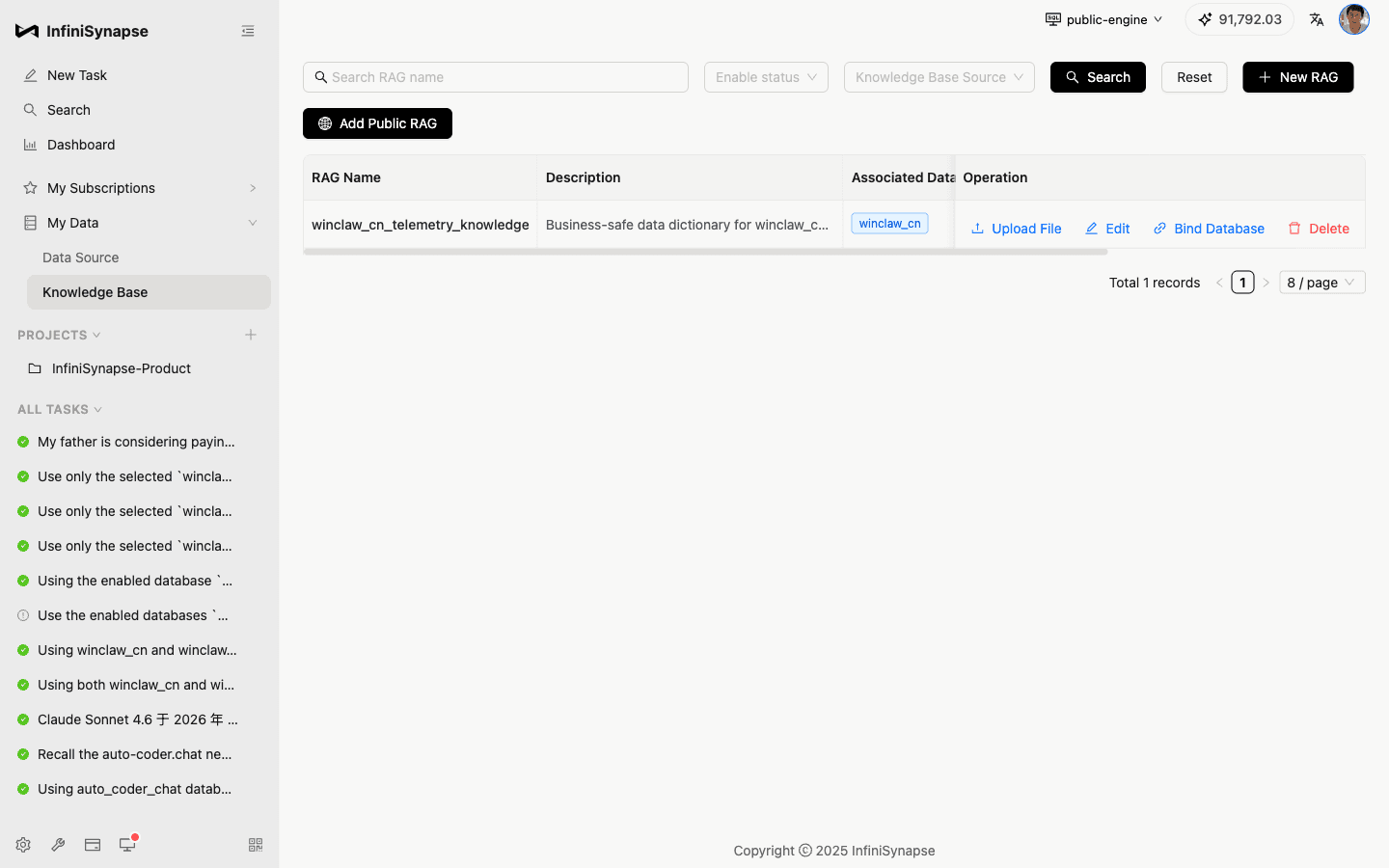
The knowledge base is not a generic document bucket. It is attached to the database whose business meaning it explains.
This solves a problem that metadata alone cannot solve.
Take a telemetry key such as:
download:tool:windows:x64:agent_excel
A database can count it. A schema can tell you the column name is metric_key. A dashboard may show it as a row. But none of that is enough to answer:
- Is this a download intent or a confirmed installation?
- Is
agent_excelpart of Office automation? - Should this key be grouped with document workflow demand?
- Is it public-safe to show this in an external case study?
- Does it belong in the top-of-funnel, activation, or workload part of the analysis?
The Agent needs business meaning, not just column metadata.
InfiniSynapse makes that meaning callable. In a real task, the Agent can first ask the bound knowledge base before running SQL.
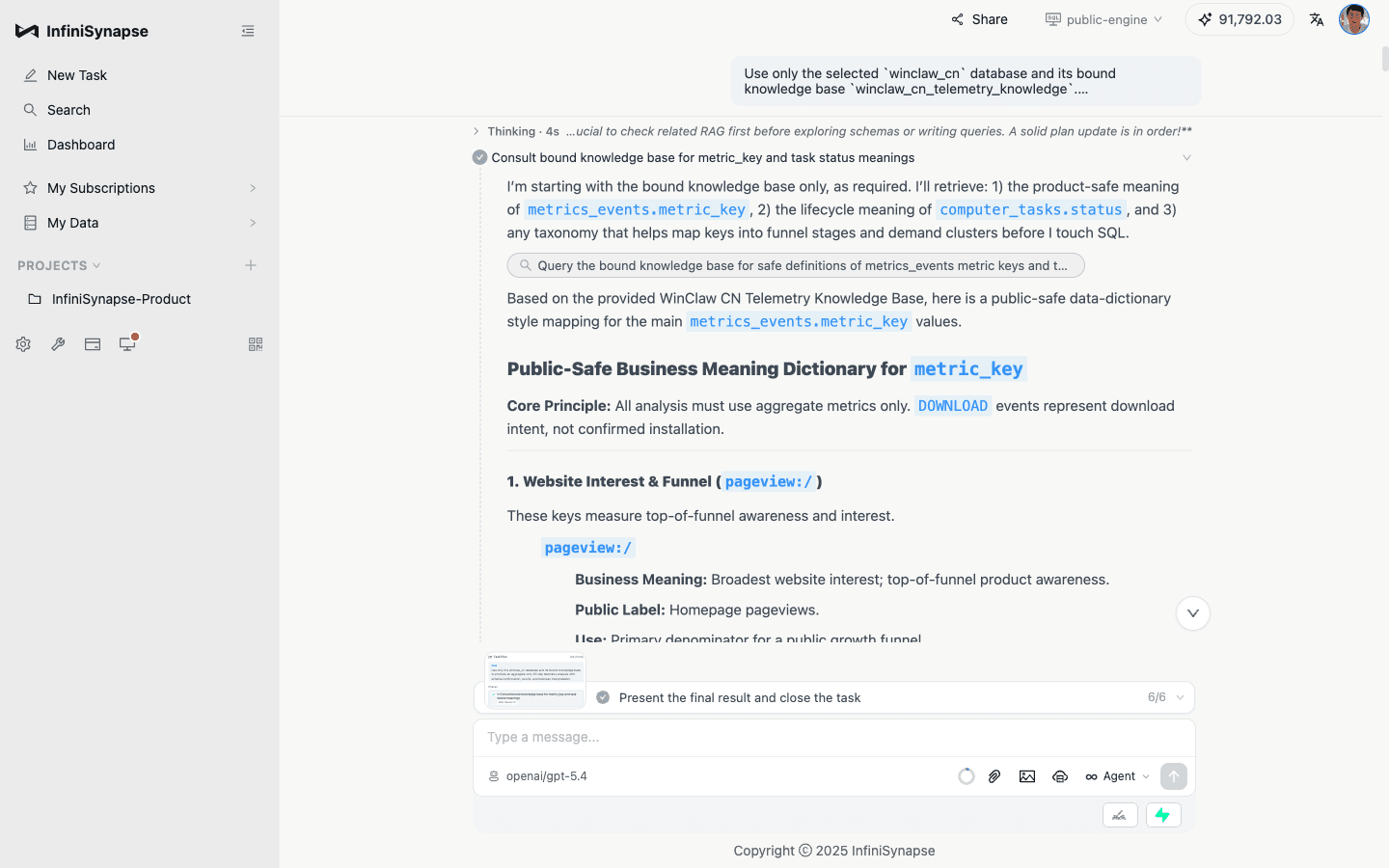
The Agent queries the bound knowledge base first, then uses SQL to verify measurable facts.
This is the difference between a semantic search layer and a semantic operating layer.
Search can retrieve text.
Binding tells the Agent: "When you analyze this database, this is the business knowledge you should use."
That only works if the knowledge base is accurate enough. A weak RAG system would mislead the Agent. InfiniSynapse's fourth-generation knowledge base matters because database-bound knowledge is not decorative context. It becomes part of the analysis toolchain.
3. Genie Is a Strong Consumer Interface; InfiniSynapse Is an Analysis Workbench
Genie is becoming a better way for business users to consume trusted Databricks assets.
That is a very valuable product direction. Business users should not need to know which workspace, dashboard, Genie Space, or notebook contains the answer. The AI layer should route them to the right trusted asset.
InfiniSynapse is aiming at a different job:
Let the Agent perform the work of analysis itself, step by step, while leaving behind a trace people can inspect.
That is why the InfiniSynapse home screen looks less like a dashboard catalog and more like an Agent workspace.
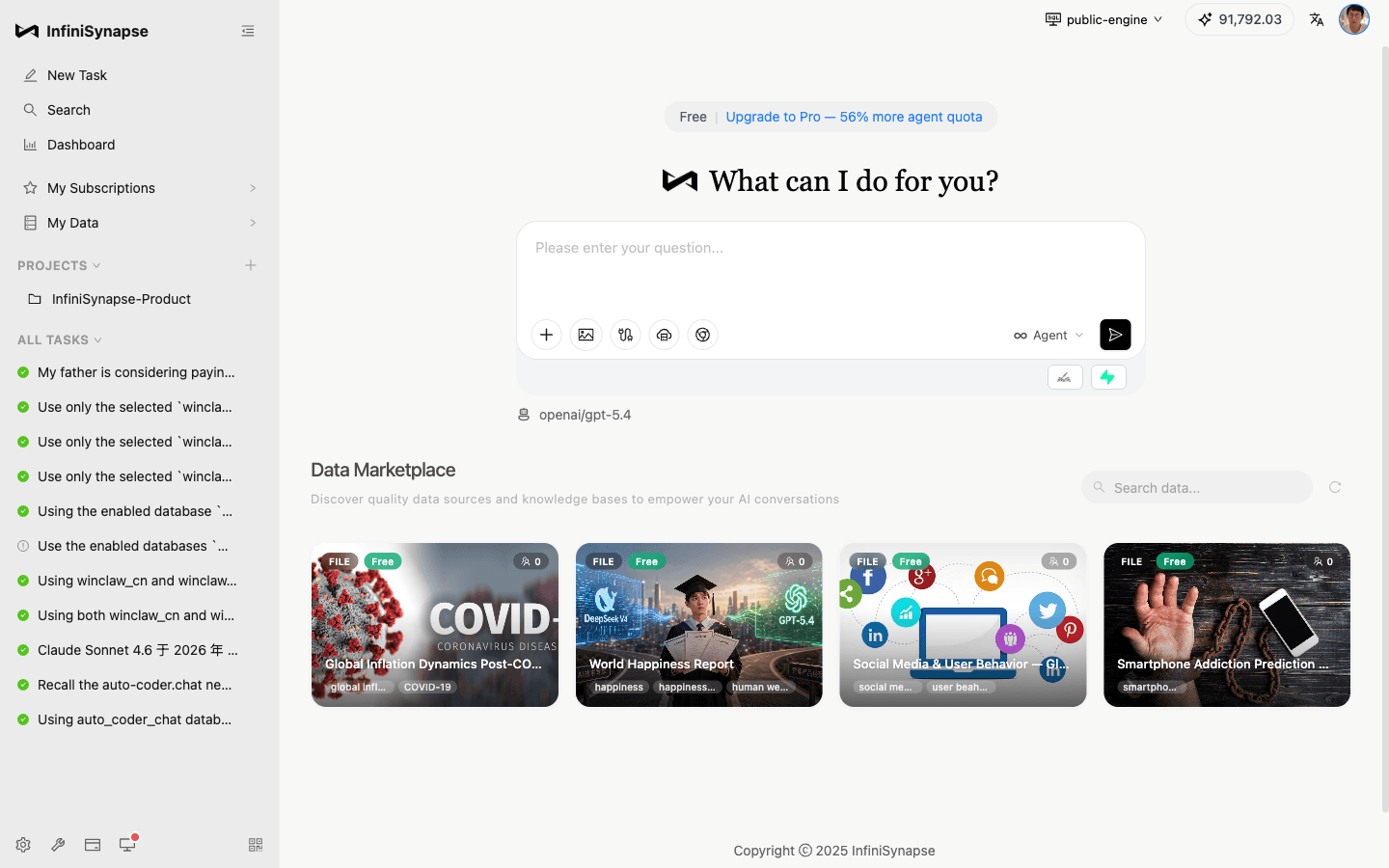
The starting point is a business task, plus selectable context: model, Agent mode, data sources, files, browser, and data marketplace.
A serious analytical task is rarely one question and one answer. It usually looks like this:
- Understand the business question.
- Identify relevant data sources.
- Inspect schema.
- Ask for missing metric definitions.
- Run a first aggregation.
- Notice an anomaly.
- Create an intermediate table.
- Join another source.
- Generate a chart.
- Write a report.
- Keep SQL and files for review.
This is the work of an analyst, not just the work of a chat interface.
InfiniSynapse treats the task as a work object. It can expose SQL, result tables, charts, and files inside the same task.
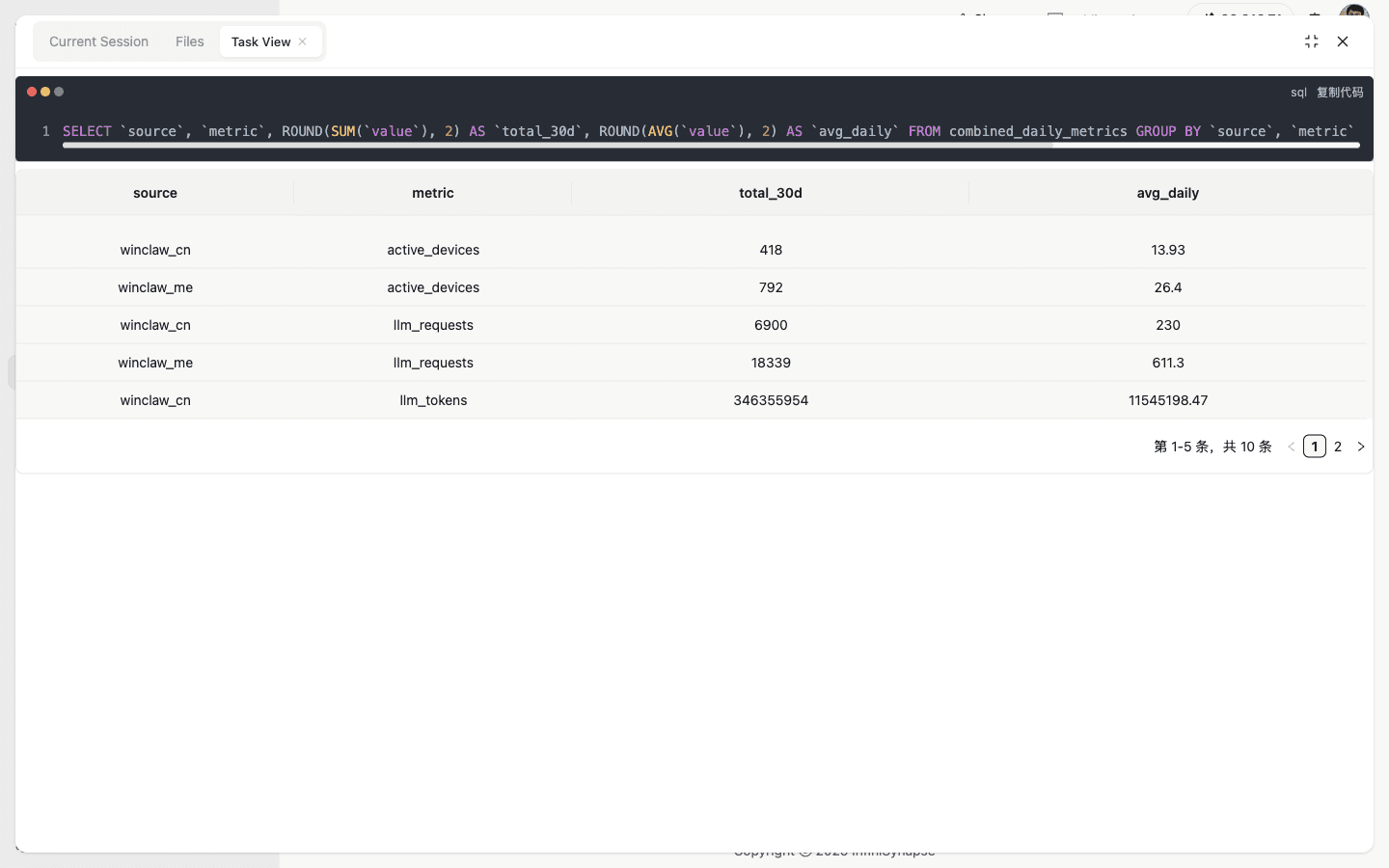
The Task View exposes the SQL and result table behind the Agent's analysis.
It can also turn intermediate analytical states into visual outputs:
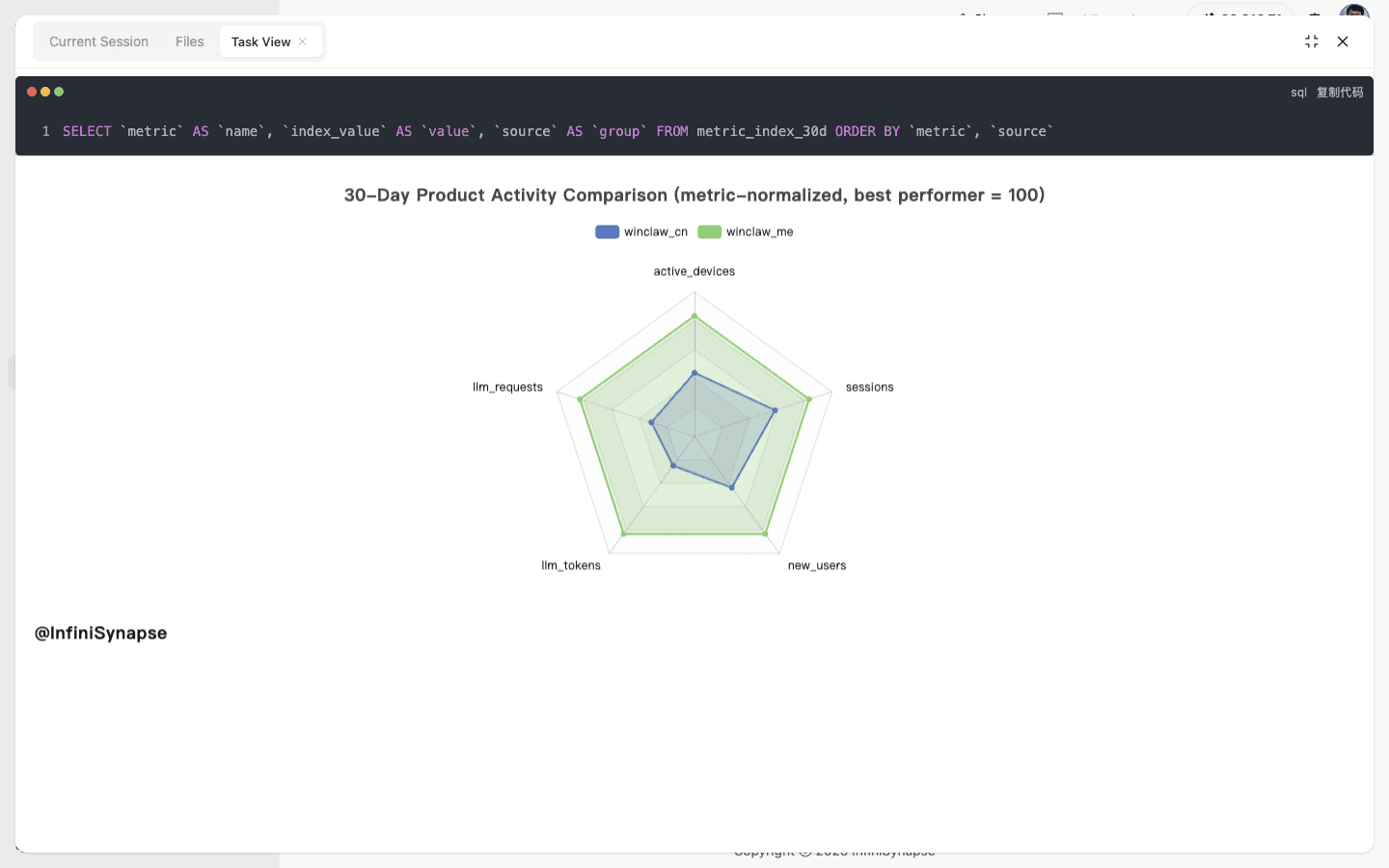
The Agent can move from query to table to chart, while keeping the path inspectable.
This is important because businesses do not only need answers. They need answers they can trust, inspect, reuse, and turn into decisions.
4. The Missing Layer in Many Data Agents: An Agentic-Friendly SQL Language
This is the part that should not be underplayed.
InfiniSynapse is not only connecting databases. It also defines an Agentic-friendly SQL language: InfiniSQL.
This is a major product decision.
Most AI data tools choose one of two paths:
- Let the model generate normal SQL.
- Let the model write Python or pandas code.
Both can work in demos. Both become fragile in long Agentic workflows.
Normal SQL is good for a single query, but an Agent doing real analysis needs a persistent workspace. It needs to name intermediate results, reuse them, drill into them, and continue from them.
Python/pandas is flexible, but it gives the Agent too much surface area: variables, package APIs, memory limits, object lifecycles, hidden side effects, environment errors, and debugging burden. The Agent becomes a fragile programmer instead of a stable analyst.
InfiniSQL is designed around the Agentic loop:
connect: register a data source;load: load a source into the analysis session;select ... as tableName: every query result becomes a named table;- session table space: previous results remain available to later steps;
train,predict,register: modeling can stay inside the same table-oriented workflow;- distributed execution and pushdown: analysis does not require pulling everything into local memory.
The key design is select ... as tableName.
That small syntax decision is much more important than it looks.
It forces every analytical step to leave a named artifact.
An Agentic analysis then becomes a growing chain of inspectable tables:
select ... as daily_metrics;
select ... from daily_metrics ... as funnel_summary;
select ... from funnel_summary ... as business_readout;
The Agent does not need to rewrite a giant Python notebook after every follow-up. It can append the next step.
Old results stay available.
Humans can inspect them.
Later steps can reuse them.
This is why InfiniSQL is not "another SQL dialect." It is a data work protocol for Agentic analysis.
Genie emphasizes deep data understanding inside the Lakehouse.
InfiniSynapse adds another layer: a language and execution model designed for long, multi-step Agent work.
That may be the most underappreciated difference.
5. Semantic Extraction vs. Semantic Binding + Agentic Execution
The Databricks message can be summarized as:
Genie extracts semantics from the Lakehouse so business users can ask complex data questions.
The InfiniSynapse message should be:
InfiniSynapse binds semantics to data sources, lets an Agent execute analysis with an Agentic-friendly SQL language, and leaves a reviewable work trail.
Those are not the same product philosophy.
Semantic extraction is about finding meaning from existing assets.
Semantic binding is about attaching meaning to the data source before and during analysis.
Agentic execution is about turning that meaning into a sequence of tool calls, SQL steps, tables, charts, and reports.
That combination is what makes InfiniSynapse different:
- Database + knowledge-base binding gives the Agent business semantics.
- InfiniSQL gives the Agent a stable language for multi-step data work.
- Task View gives humans an audit trail.
- Charts and files turn the work into deliverables.
- Multi-source connection lets analysis start where data already lives.
The final report below is a small example. The Agent separates measured database facts from knowledge-base interpretation. That is exactly what a serious Data Agent should do.
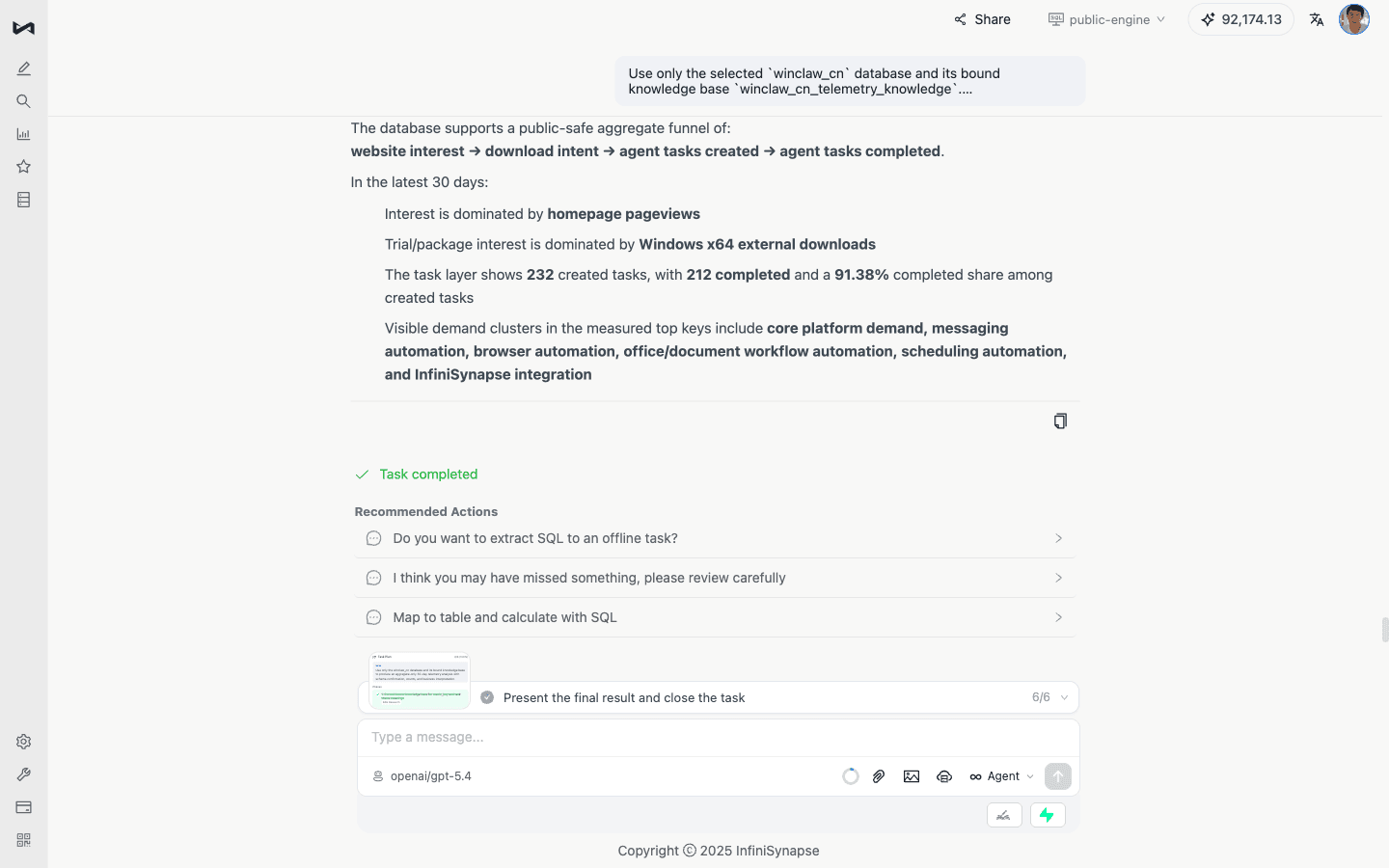
The result is not just a generated answer. It separates measurable facts from business definitions supplied by the bound knowledge base.
6. A Deeper Comparison
| Dimension | Databricks Genie | InfiniSynapse |
|---|---|---|
| Core idea | Extract semantics from the Databricks Lakehouse and trusted assets | Bind semantics to each data source and let the Agent use them during analysis |
| Main user experience | Unified AI entry point for Databricks business users | Agentic Analytics Workbench for complete analysis tasks |
| Knowledge model | Genie Spaces, metadata, dashboards, notebooks, Apps, external knowledge connectors | High-accuracy knowledge bases explicitly associated with databases |
| Execution model | Route questions to trusted Databricks assets and generate answers | Execute multi-step analysis with SQL traces, named tables, charts, files, and reports |
| Agent language | Primarily natural language to governed Databricks query/asset interaction | InfiniSQL: an Agentic-friendly SQL language for session-based, cross-source analysis |
| State management | Conversation and platform assets | Named intermediate tables, task history, knowledge memory, reusable outputs |
| Best fit | Companies standardizing data and analytics assets on Databricks | Companies with live databases, business documents, scattered systems, and analysis workflows that must be inspected |
| Strategic advantage | Business users can ask over the Lakehouse without knowing where trusted assets live | Agents can perform long-chain, auditable analysis over data sources with bound business semantics |
This is a more useful comparison than "which one has chat."
The real issue is how each product gives the Agent enough understanding and enough execution discipline.
Genie emphasizes semantic understanding from the Lakehouse.
InfiniSynapse emphasizes semantic binding, Agentic SQL, and inspectable execution.
7. Why This Matters
The Data Agent category is moving through three stages.
Stage one was Text-to-SQL:
Can AI write a query?
Stage two is semantic grounding:
Can AI understand which data and definitions to trust?
Stage three is Agentic execution:
Can AI carry out a multi-step analysis, preserve state, consult knowledge, execute safely, show its work, and deliver artifacts?
Databricks Genie is a strong move from stage one into stage two, with a business-user experience wrapped around Databricks assets.
InfiniSynapse is trying to go all the way into stage three.
That is why InfiniSQL matters.
That is why database-bound knowledge matters.
That is why Task View matters.
And that is why "chat with your data" is no longer a sufficient product description.
The real product is the whole analytical system around the Agent:
- how it understands business meaning;
- how it decides the next step;
- how it executes;
- how it remembers intermediate results;
- how it avoids hallucinating semantics;
- how it exposes evidence;
- how it delivers something useful.
8. Closing
Databricks Genie is an important signal: the future of BI and analytics inside the Lakehouse will be AI-native, semantic, and business-user friendly.
InfiniSynapse is an equally important signal in a different direction: the future Data Agent needs more than semantic extraction. It needs semantic binding, an Agentic-friendly SQL language, inspectable execution, and deliverable outputs.
If your company lives deeply inside Databricks, Genie is a natural AI layer over trusted Lakehouse assets.
If your company needs an Agent that can connect live data sources, bind business knowledge to them, reason through multi-step analysis, generate named intermediate tables, show SQL and charts, and produce a reviewable report, InfiniSynapse is attacking the more complete Agentic analytics problem.
The next generation of data analysis will not be won by the nicest chat box.
It will be won by the product that gives the Agent deep semantics, a stable working language, and a trustworthy execution trail.
That is the direction InfiniSynapse is building toward.