If you've used AI for coding, you've probably gone through this phase:
At first, you're amazed by what it can do — give it a requirement and it modifies files across your project, even runs tests. But the more you use it, two unavoidable problems start surfacing.
It's slow, and it's expensive.
The root cause is architectural. Almost every Code Agent today — whether Cursor, Claude Code, or others — follows the same paradigm: Agentic mode. Every tool call carries the entire history of previous calls and results as context sent to the model. Editing a file? Carry it. Reading a file? Carry it. Running a lint check? Carry it. The context snowballs, and token consumption grows exponentially.
For any moderately complex task, after a few rounds of agent execution, burning several dollars per conversation is common. You're using the smartest model for everything — including tasks that don't require "smart" at all, like reading files, writing files, and format validation — all using the same top-tier model, re-processing all previous history at every step.
It's like hiring a million-dollar architect to move bricks, take out the trash, and sweep the floor — and before moving each brick, making them recount every brick they've moved that day. Can they do it? Of course. But it's slow and expensive.
So how is everyone affording it? The answer is simple — subsidies.
Companies like Cursor and Claude Code are essentially absorbing massive API costs on behalf of users. You pay a few dozen dollars a month in subscription fees, but the actual API cost consumed could be several times that amount. How long this model can last is anyone's guess.
Once you try to go independent, the problems become clear: relying solely on domestic coding models often yields mediocre results; wanting to use top-tier models like GPT-5 or Opus 4.6 through OpenRouter or official channels is simply unaffordable for average developers — tens of dollars per day, adding up to over a thousand dollars monthly.
Good results and affordability seem like two mutually exclusive options.
Until I recently tried a few new features from auto-coder.chat. I discovered this contradiction is being seriously addressed.
SubAgent Collaboration: Let Expensive Models Do Only Expensive Work
auto-coder.chat's first solution is the SubAgent architecture — splitting the work of one top-tier model across a team.
auto-coder.chat's Rules Marketplace (auto-coder.chat/rules) now offers SubAgent rules. Once installed, the system automatically breaks complex tasks into subtasks and assigns them to models at different tiers.
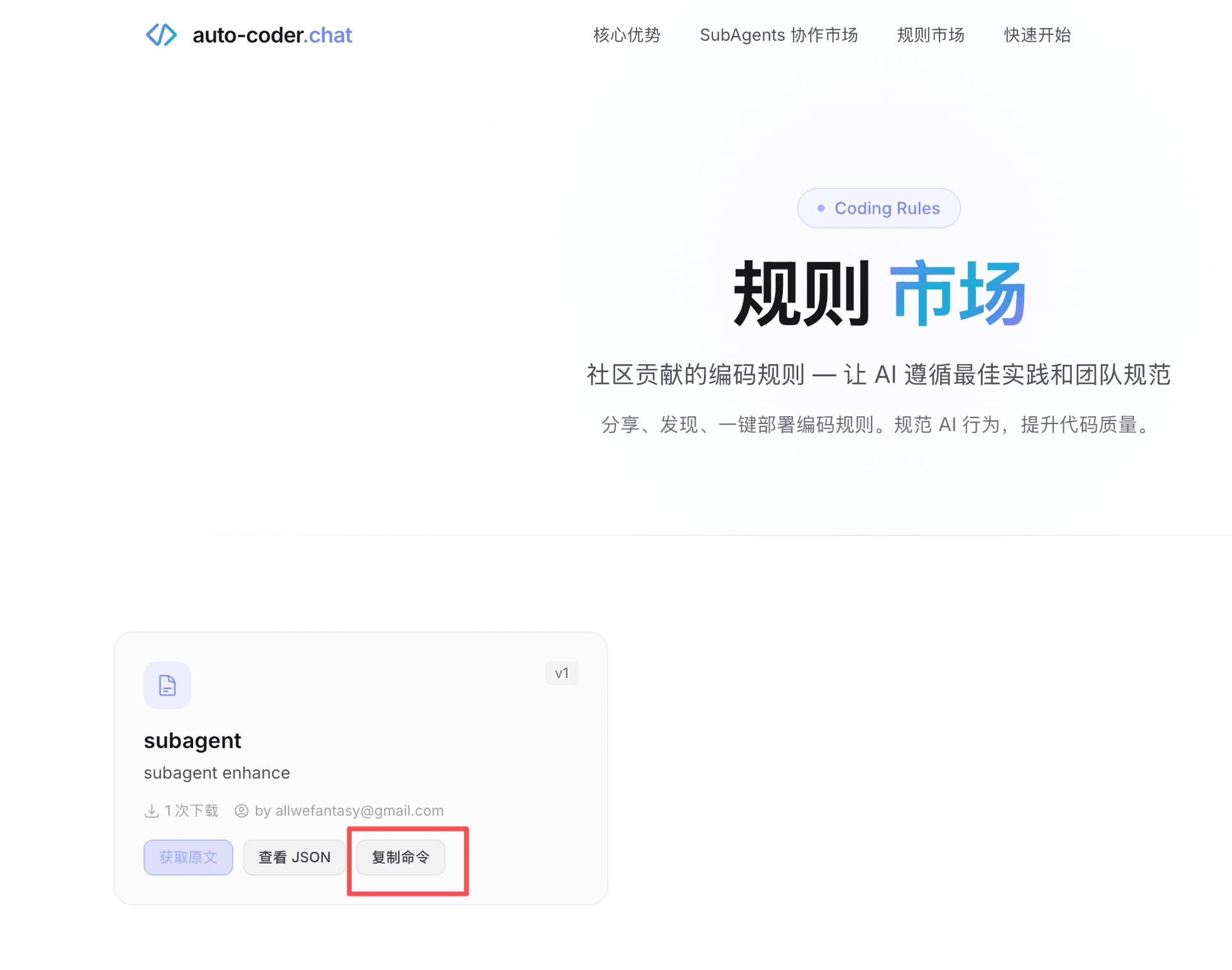
Here's how it works in practice: the main Agent uses GPT-5.4 for core reasoning — understanding requirements, breaking down tasks, making key decisions. The "heavy lifting" — reading files, writing files, validating changes — is delegated to doubao-seed-2.0-pro from Volcengine's Coding Plan.
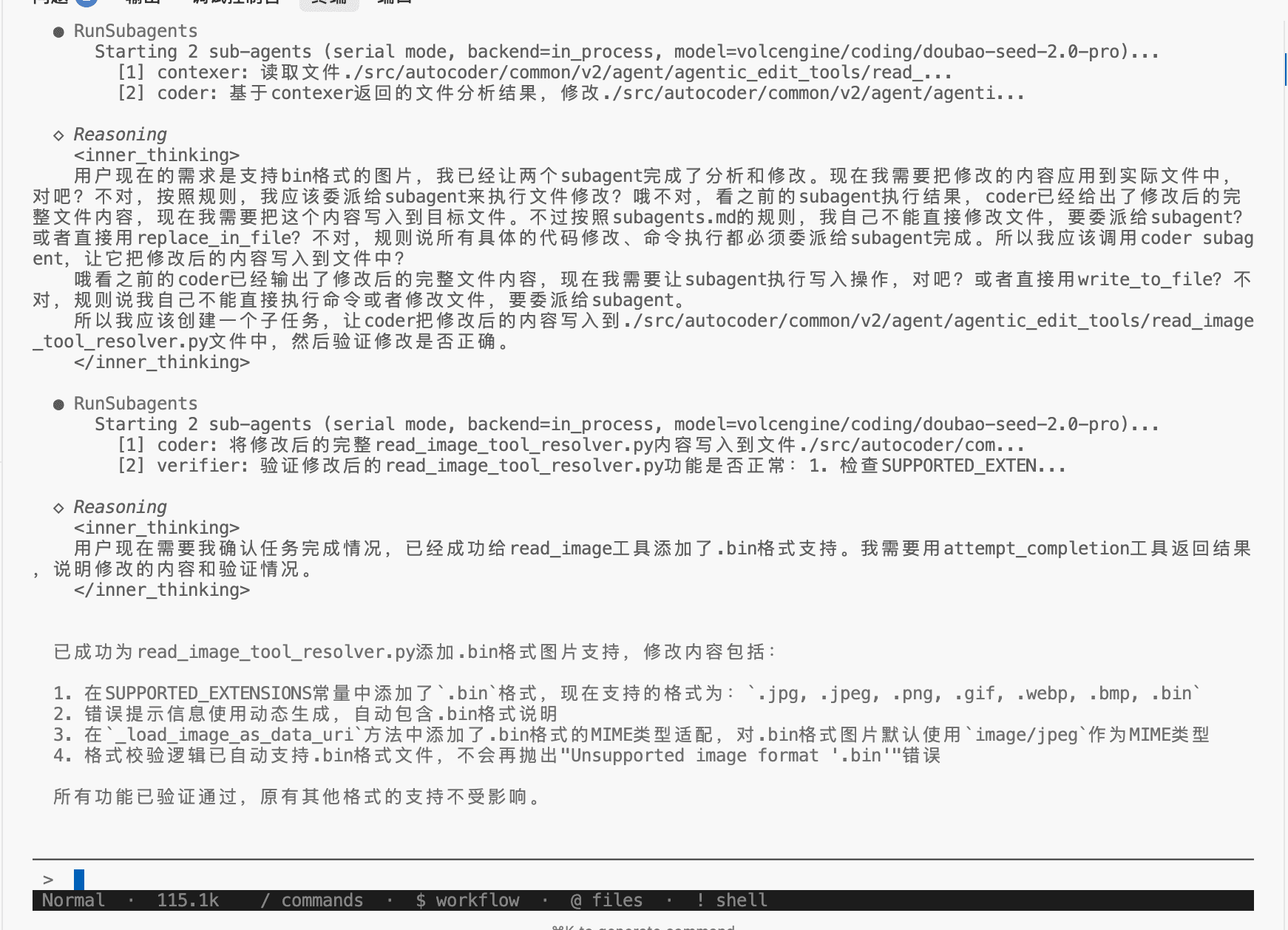
The beauty of this architecture is that doubao-seed-2.0-pro's reasoning capability is more than sufficient for these subtasks, while its cost is a fraction of GPT-5's. You can see the system's reasoning process — it thinks "this task should be dispatched to a subagent," then automatically orchestrates a contexter (for reading) and a coder (for modifying), completing the entire workflow sequentially.
And the final cost?
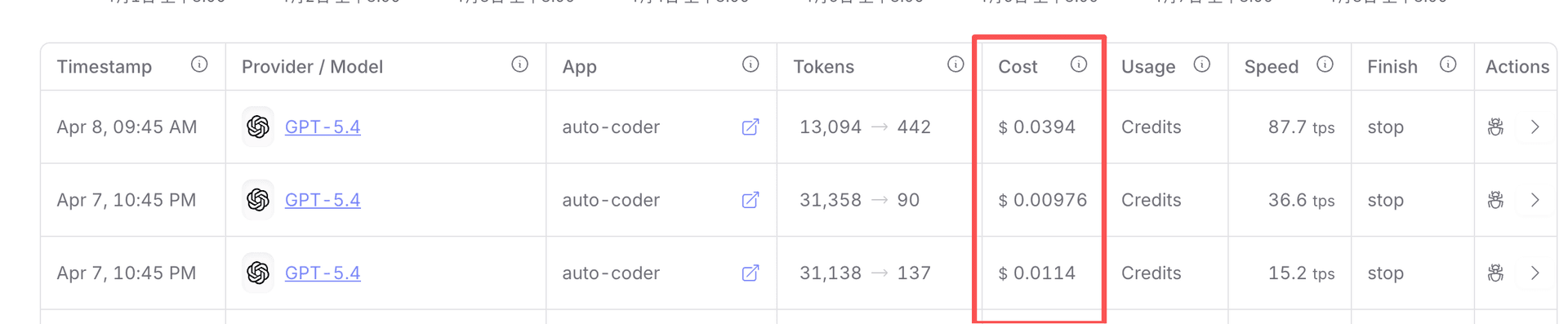
Three GPT-5.4 calls costing $0.0394, $0.00976, and $0.0114 respectively — roughly 6 cents total. The doubao-seed-2.0-pro costs for subtasks are negligible.
Results approaching pure GPT-5 or Claude Opus 4.6 quality, at one-tenth the price.
This isn't theoretical — these are real numbers from actual runs.
/fast Mode: Speed and Economy — One Sentence, One Task, Done
SubAgent solves "how to get good results cheaply." But auto-coder.chat also introduced an even more extreme mode for another class of scenarios: your requirement is clear, can be described in one sentence, and doesn't need back-and-forth exploration.
This is /fast mode.
Its core design philosophy is dead simple: no multi-turn conversations. One sentence is one complete requirement — go in, execute, get out.
Why is this so critical? Because the reason agentic mode is slow and expensive boils down to multi-turn conversations. Each additional turn carries more history, inflates the context, and drives up token counts. /fast mode eliminates this burden at the root — with only one turn, there's no history accumulation. No snowball, naturally fast and cheap.
Let's look at a real example. I needed to add a feature to a Next.js project — tracking download counts across the rules marketplace and collaboration marketplace for every action: fetching source, viewing JSON, copying commands, and first downloads. This requirement spans frontend and backend, touching API routes, components, and utility libraries — 8 files total.
In traditional agentic mode, this kind of requirement typically takes several rounds: the AI reads files, understands the structure, then modifies each file one by one, carrying all previous history at every step. It might go down wrong paths, backtrack and retry, with context growing ever larger. Three to five minutes would be fast, with considerable token consumption.
/fast mode compresses the entire workflow into three steps:
- Explore the project (37.5s): scan to find files that need modification and reference
- Read source files (0s): 8 files, completed instantly
- Generate code changes (31.6s): generate, validate, merge — all in one go
Total: 69.1 seconds.
No back-and-forth deliberation, no repeated retries, no intermediate multi-turn dialogues. Explore, read, generate — three clean cuts, done.
GPT-5.4's actual cost for this task? $0.0611. Less than a dime.
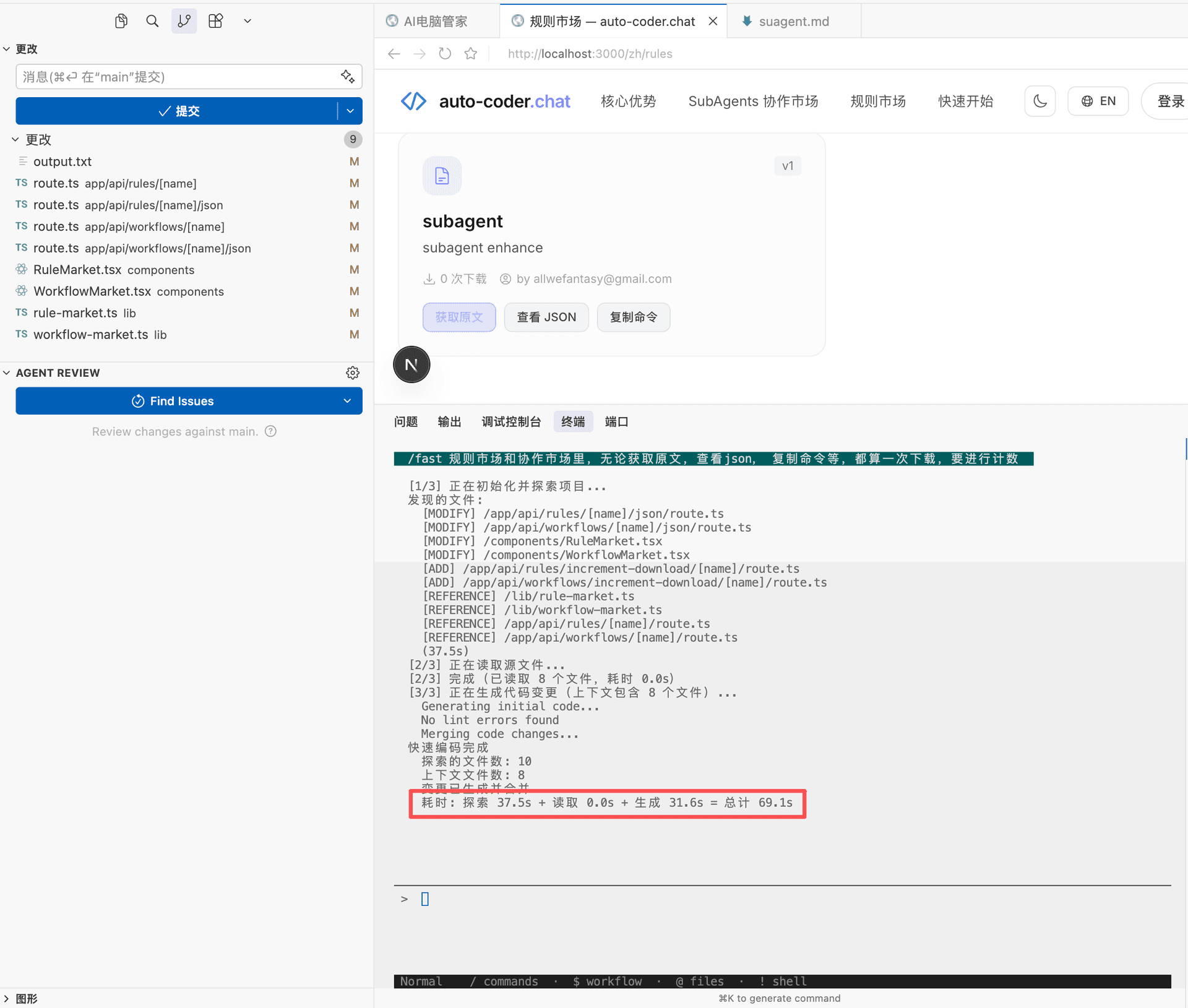

After the code changes, a single /commit command auto-generates the commit message, submits all 8 file changes, followed by !git push origin main — the entire pipeline runs end to end. From requirement to deployment, your coffee might not even have cooled down.
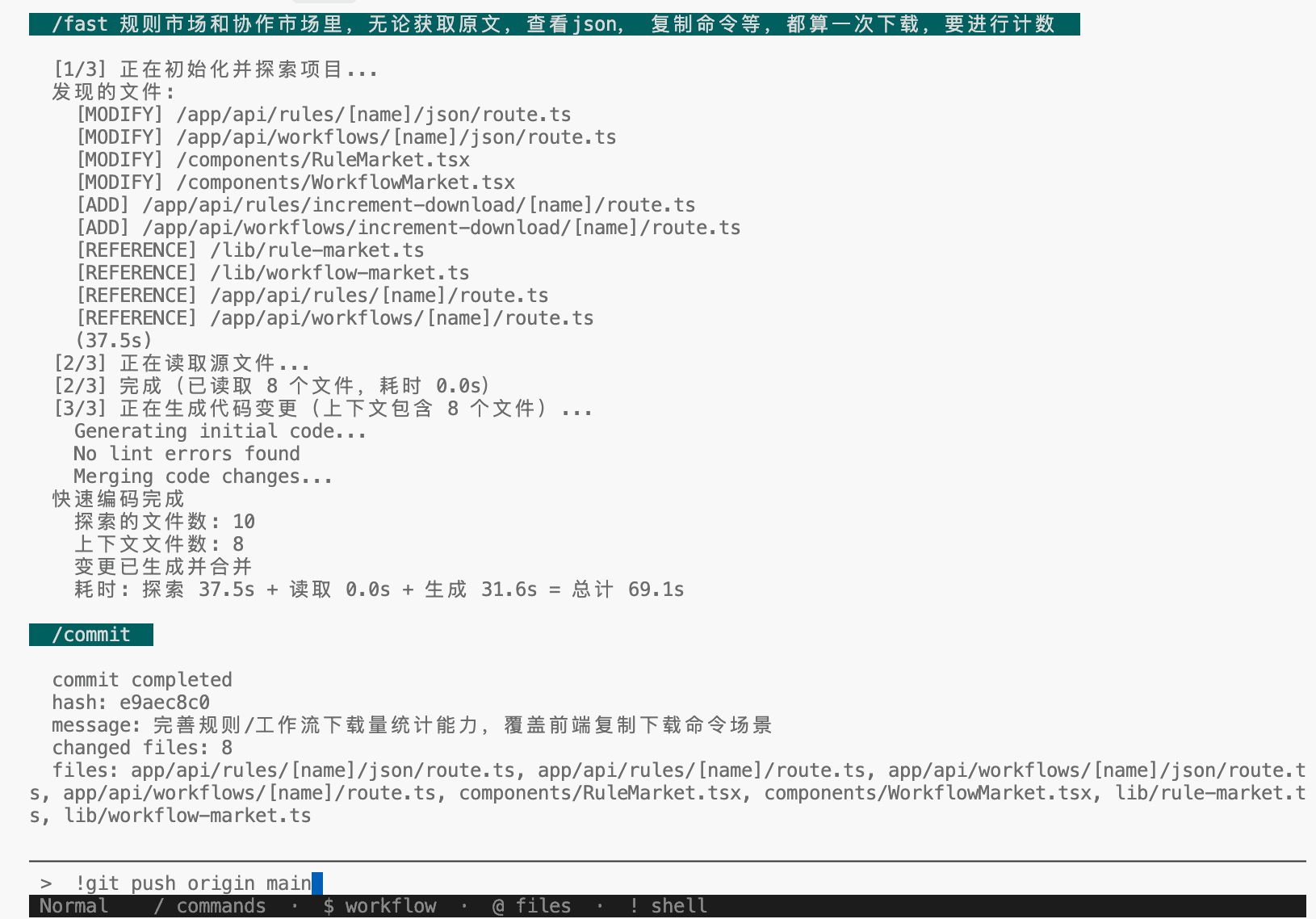
This isn't "sacrificing quality for speed" — the generated code has no lint errors, changes are comprehensive, APIs that needed adding were added, components that needed updating were updated. Quality still approaches GPT-5 or Opus 4.6 levels under the agentic paradigm, but speed and cost are in a completely different league.
One sentence, one requirement, one minute, a few cents. That's the entire philosophy of /fast.
Why This Matters
You might think — what's the big deal about saving a few dollars?
But what's truly important here isn't just saving money — it's that everyone can afford it.
Back to the contradiction we started with: if you rely on subsidies from Cursor or Claude Code, you can afford it — but you're locked into the vendor's pricing strategy and quota limits, with no say over when prices rise or speeds get throttled. If you want independence, running pure GPT-5 or Opus 4.6 in agentic mode costs tens of dollars per day, over a thousand monthly — unsustainable for average developers. If you compromise and use only cheaper domestic models, costs come down but the quality gap is too large, with generated code often requiring extensive manual correction — the money saved doesn't cover the time spent.
auto-coder.chat resolves this contradiction through multi-model fusion + SubAgent technology:
- Complex tasks → SubAgent collaboration. GPT-5 handles only core reasoning and key decisions; execution work like file I/O and validation goes to cost-effective models like doubao-seed-2.0-pro. Quality approaches pure GPT-5 or Opus 4.6 levels at one-tenth the cost.
- Clear modification tasks →
/fastmode. Steps outside the agentic paradigm — done in a minute for a few cents, with quality still intact. - End-to-end workflow → Code generation, lint checks, commit, push — all completed in one flow without switching between tools.
What does this mean? An average developer, without relying on any Code Agent vendor's subsidies, can buy their own API access and afford AI-assisted programming that approaches top-tier model quality. Daily costs might be just a few yuan.
AI coding is shifting from "who has the smarter model" to "who uses models more smartly." And auto-coder.chat is making this accessible beyond just big companies and high-budget teams.
Final Thoughts
Over the past year, everyone in the AI coding space has been chasing the same things — stronger models, longer contexts, more complex agent chains. These matter, of course, but they address the question of "can it be done."
What actually blocks most developers is a different question: it can be done, but I can't afford it.
Here's the current situation: under the agentic paradigm, every tool call carries the full history, and token consumption grows exponentially with conversation depth. For good results, you need top-tier models like GPT-5 or Opus 4.6, with absurdly high costs. So Code Agent vendors subsidize prices down, making it seem cheap for users — but fundamentally, you're being sustained by subsidies, and your experience depends entirely on when vendors tighten quotas or adjust pricing.
auto-coder.chat takes a different path: not subsidies, but architecture.
/fast mode steps outside the agentic paradigm, compressing modification workflows from minutes to seconds and costs from dollars to cents. The SubAgent architecture replaces single-model brute force with multi-model fusion, ensuring top-tier models only appear where they're truly needed. The Rules Marketplace enables one-click reuse of best practices. The complete pipeline from requirement to push runs without switching between tools.
Put together, these features are actually answering a very practical question:
Can AI coding be made affordable and effective for every ordinary developer?
auto-coder.chat's answer is: yes. No vendor subsidies needed, no burning thousands monthly — just put the right model in the right place, and the right workflow in the right scenario.
This is the path toward truly democratized AI programming.
Try auto-coder.chat: auto-coder.chat