Many data products have already entered the agentic stage.
They are becoming agentic: they can break down a question, choose tools, inspect schemas, run aggregations, and turn results into a report.
That is a major step forward. But it is still not enough.
Agentic behavior solves how the analysis workflow is organized. Real business analysis requires another question:
Does the Agent understand what the data means in the business?
Real business data is never just tables and columns. Every database contains silent product knowledge: what an event means, how a metric key is structured, which download channel matters, whether a status means success or only a temporary state, and which fields are safe to use in public reporting.
Without that knowledge, even an agentic Agent can count, plan, and write a report, while still failing to truly understand the business.
This is why InfiniSynapse introduces a first-of-its-kind capability:
Bind a database with a knowledge base, and expose that knowledge base as a callable tool inside the Agent workflow.
The result is not a passive RAG sidebar. The Agent can actively ask the bound knowledge base for business definitions while analyzing data, then use SQL to verify the measurable facts.
In other words:
The database tells the Agent what happened. The knowledge base tells the Agent what it means.
The Problem: Databases Know Facts, Not Meaning
For this case, we used the winclaw_cn database, which is a PostgreSQL (PG) database. It contains website telemetry and desktop agent workload signals for WinClaw, a privacy-first desktop AI assistant.
One of the core tables is metrics_events. It includes fields such as:
created_attypemetric_key
From the database alone, an Agent can safely count events by type and metric_key. It can tell us that PAGEVIEW and DOWNLOAD occurred. It can see keys such as:
pageview:/download:external:gitcode_windows_x64download:tool:windows:x64:agent_exceldownload:tool:windows:x64:agent_infini
But can it reliably explain what these keys mean in the product?
Not quite.
In the baseline run, we explicitly told InfiniSynapse:
Use only the selected
winclaw_cndatabase. Do not use any knowledge base, prior memory, or external website.
The Agent did the responsible thing. It measured the data, but it refused to overclaim.
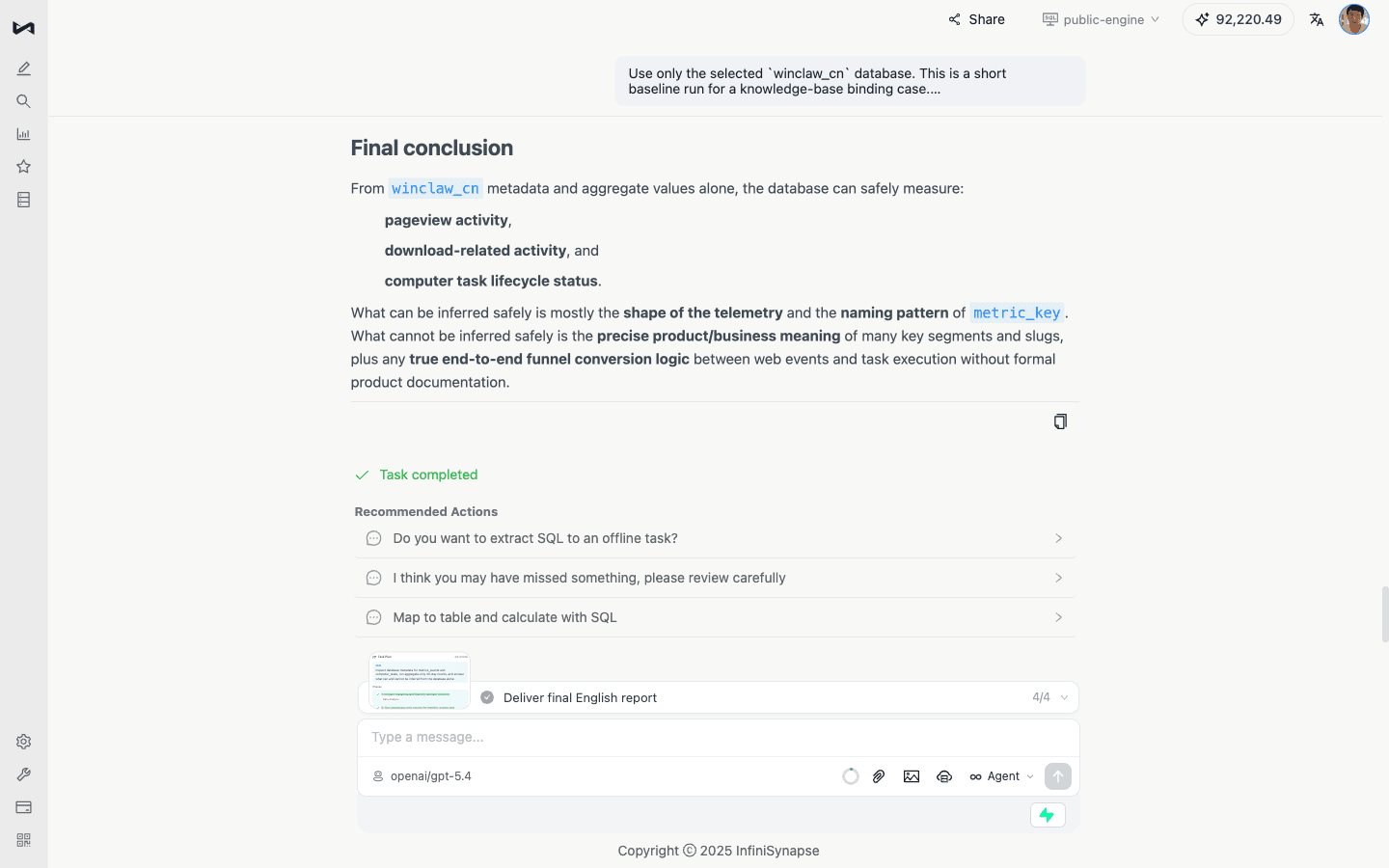
It concluded that the database could safely measure:
- pageview activity
- download-related activity
- computer task lifecycle status
But it also made the key limitation clear:
The precise product/business meaning of many key segments and slugs cannot be reliably inferred from database metadata alone.
That is exactly the right failure mode.
A serious Data Agent should not hallucinate business definitions just because a column name looks familiar. It should know when it needs business knowledge.
InfiniSynapse's Breakthrough: Database + Knowledge Base Binding
InfiniSynapse solves this by letting users bind a knowledge base directly to a database.
For this case, we created a knowledge base called:
winclaw_cn_telemetry_knowledge
It contains a business-safe data dictionary for winclaw_cn, including:
- what WinClaw is
- what
PAGEVIEWmeans - what
DOWNLOADmeans - why
DOWNLOADshould be interpreted as download intent, not confirmed installation - how to interpret
metric_keypatterns - how to label product/package keys
- how to interpret
computer_tasks.status - what public-safe funnel should be used
Then we bound that knowledge base to the winclaw_cn database.
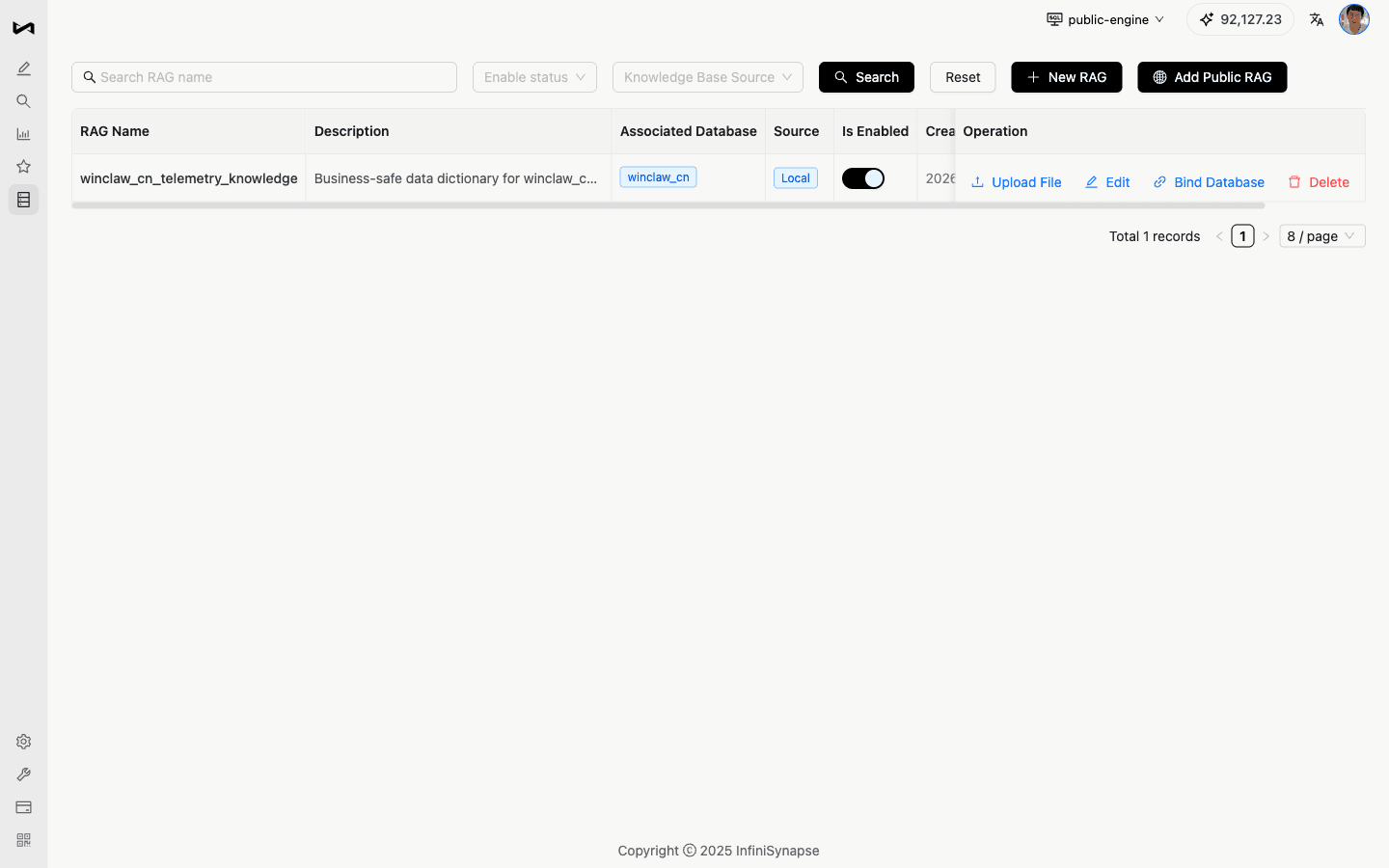
This is the important shift:
winclaw_cnis no longer just a database connection. It now carries its own business interpretation layer.
That is what makes the database useful to an Agent, not just queryable by an Agent.
Why This Requires a Fourth-Generation Knowledge Base
Binding a knowledge base to a database is only safe if the knowledge base implementation is accurate enough to participate in the Agent's reasoning loop.
This is where InfiniSynapse's fourth-generation knowledge base matters.
Earlier knowledge bases were mostly passive:
- store documents
- retrieve chunks
- place retrieved text into a prompt
- hope the model uses it correctly
That is not enough for serious data analysis, and it is especially not enough for an agentic workflow where the Agent actively calls knowledge as a tool.
InfiniSynapse's fourth-generation knowledge base is designed to be a high-precision Agent tool. It can be called by the Agent at the right moment in the workflow, with the right query, to retrieve the business knowledge needed for the current analysis.
Because its retrieval accuracy is high, it can support this capability without misleading the Agent. The knowledge base does not blindly flood the context. It returns targeted business meaning that the Agent can separate from measured database facts.
This is the difference between:
"Here is some text that might be relevant."
and:
"Here is the business definition the Agent needs before interpreting this metric."
That distinction is the foundation for trustworthy business-aware analytics.
The Agent Calls the Knowledge Base as a Tool
After binding the knowledge base, we asked the same type of question again. This time the prompt explicitly required:
Before running SQL, first consult the bound knowledge base.
The input area showed both the selected database and the bound local RAG context:
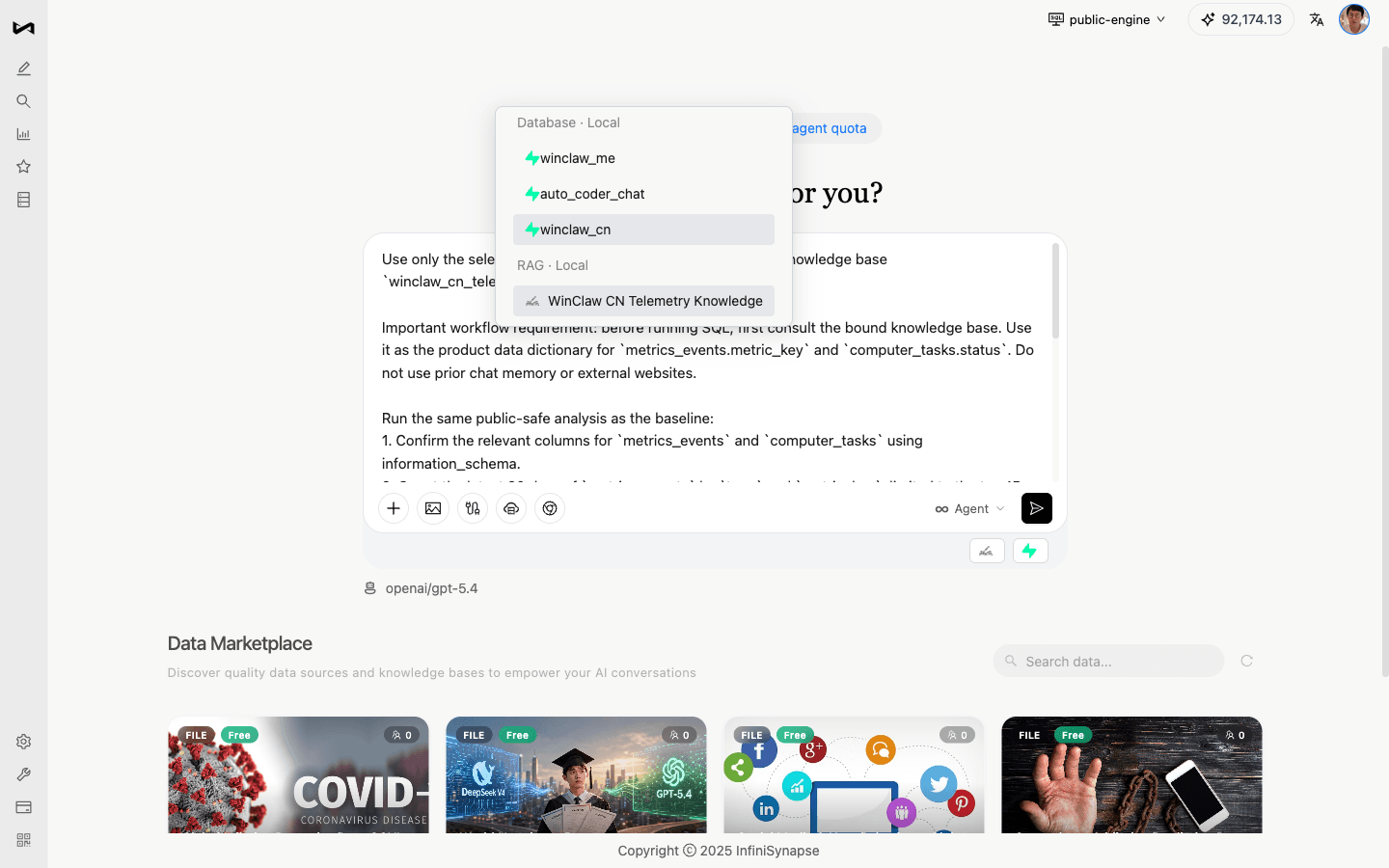
The execution plan changed immediately.
The first phase became:
Consult bound knowledge base for metric_key and task status meanings
RAG Research
Looking inside the execution trace, the Agent did not simply dump the document into the prompt. It made several targeted RAG calls inside the analysis workflow. First, it asked the knowledge base for the public-safe business meaning of metrics_events.metric_key, retrieving definitions for PAGEVIEW, DOWNLOAD, and the download-related keys.
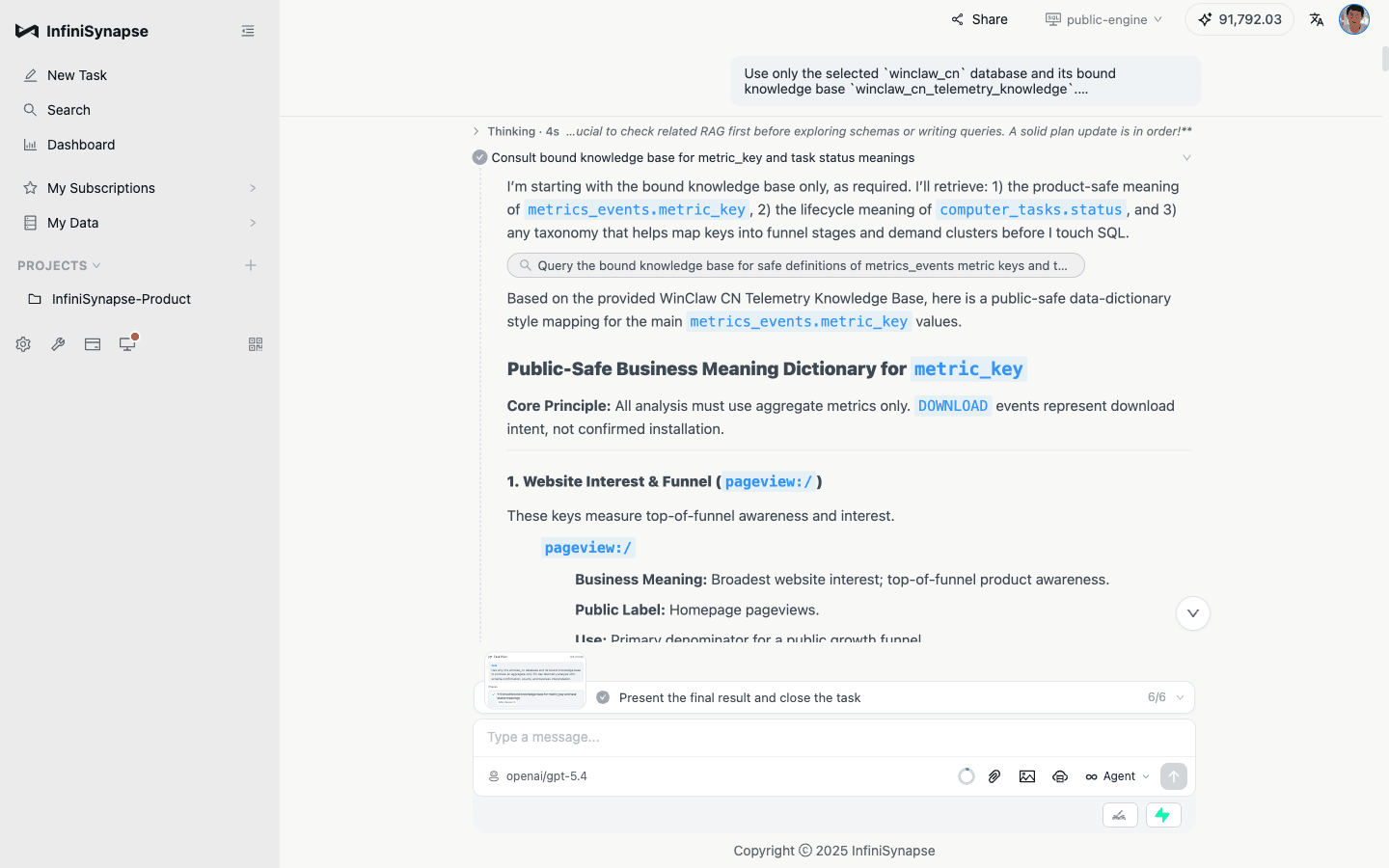
Then it asked for the lifecycle meaning of computer_tasks.status, turning PENDING, CLAIMED, COMPLETED, and FAILED into business-stage semantics.
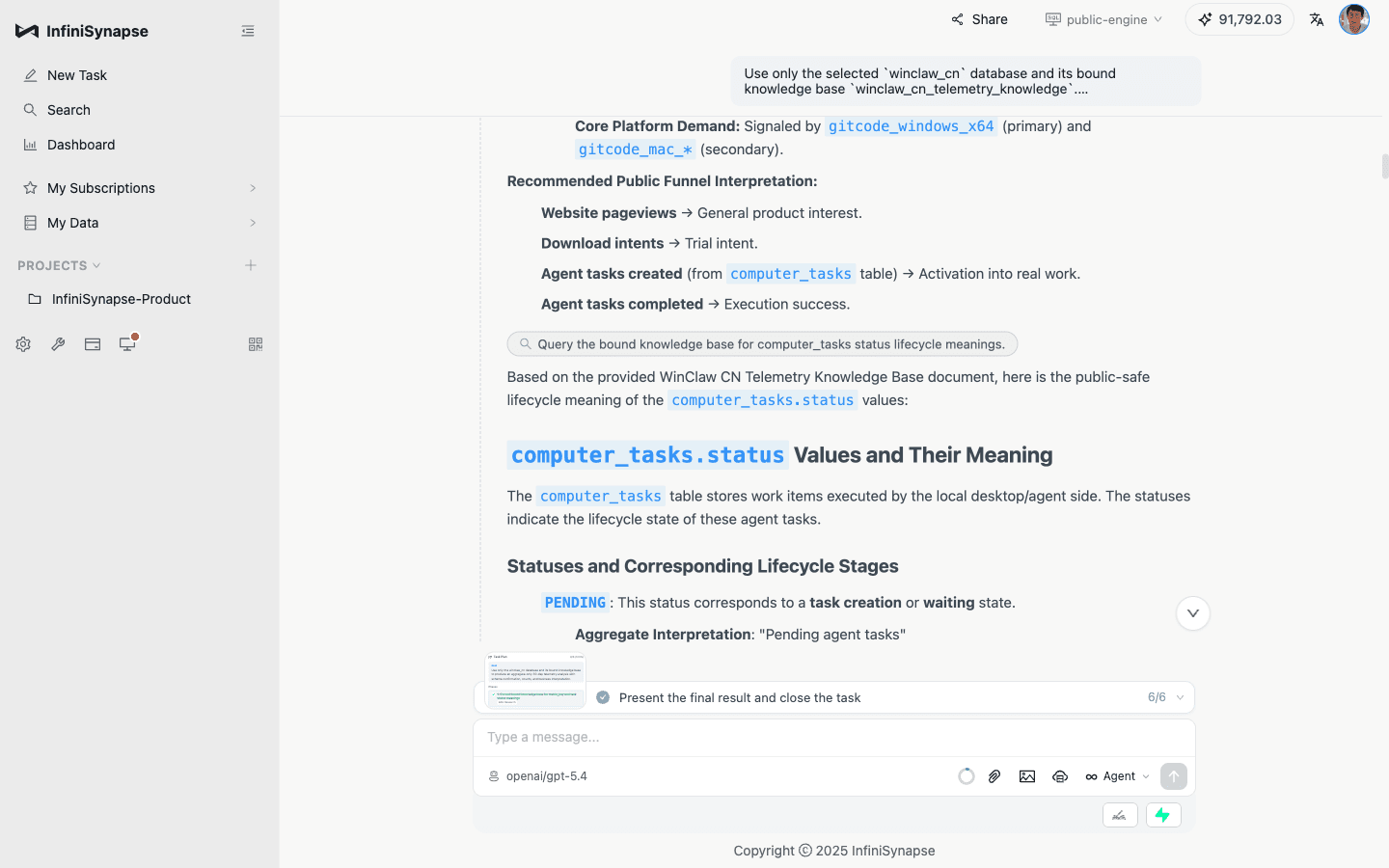
Finally, it asked how the public-safe funnel and demand clusters should be organized, retrieving the recommended funnel of website interest -> download intent -> agent tasks created -> agent tasks completed.
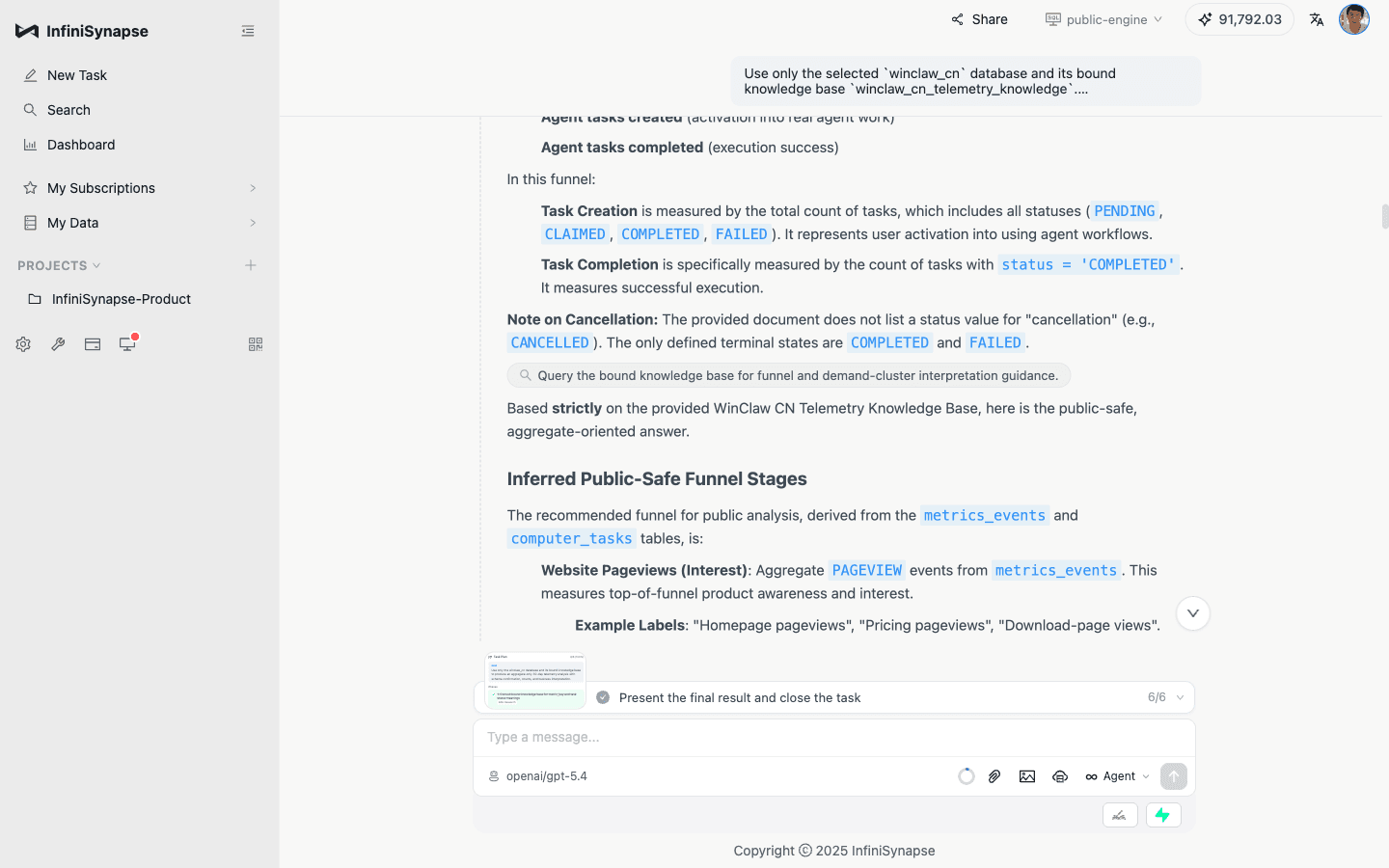
Only after that did the Agent inspect schema and run SQL.
This is the product behavior that matters most:
The knowledge base is not decoration. It becomes an Agent tool call inside the analysis workflow.
The Agent can ask the knowledge base for business meaning, then ask the database for measurable evidence.
The Result: From Counting Fields to Explaining the Business
The enhanced answer separated two layers clearly:
- Measured facts from aggregate SQL
- Knowledge-base interpretation from
winclaw_cn_telemetry_knowledge
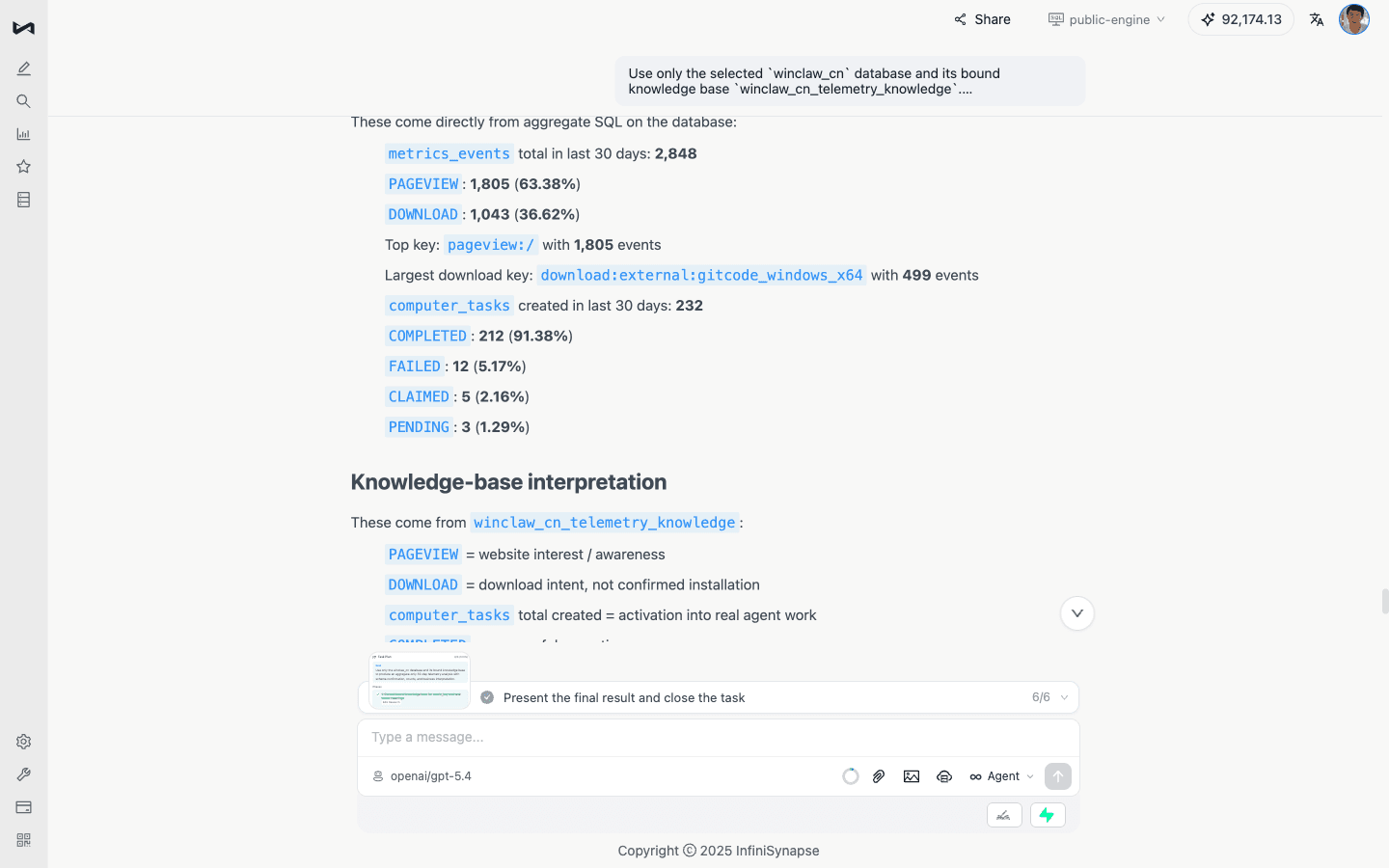
The measured facts included:
| Metric | Value |
|---|---|
metrics_events total in last 30 days | 2,848 |
PAGEVIEW | 1,805 (63.38%) |
DOWNLOAD | 1,043 (36.62%) |
Top key pageview:/ | 1,805 |
Largest download key download:external:gitcode_windows_x64 | 499 |
computer_tasks created in last 30 days | 232 |
COMPLETED | 212 (91.38%) |
FAILED | 12 (5.17%) |
CLAIMED | 5 (2.16%) |
PENDING | 3 (1.29%) |
The knowledge-base interpretation transformed those fields into business language:
| Database signal | Business meaning |
|---|---|
PAGEVIEW | website interest / awareness |
DOWNLOAD | download intent, not confirmed installation |
pageview:/ | homepage pageviews |
download:external:gitcode_windows_x64 | Windows x64 external download intent |
download:external:gitcode_mac_arm64 | macOS Apple Silicon external download intent |
download:tool:windows:x64:agent_wechat | WeChat agent tool download intent |
download:tool:windows:x64:agent-browser | Browser agent tool download intent |
download:tool:windows:x64:agent_excel | Excel agent tool download intent |
download:tool:windows:x64:agent_word | Word agent tool download intent |
download:tool:windows:x64:agent_ppt | PowerPoint agent tool download intent |
download:tool:windows:x64:agent_infini | InfiniSynapse integration tool download intent |
The difference is subtle but decisive.
Before binding, the Agent could count download:tool:windows:x64:agent_excel.
After binding, the Agent could explain that this is part of office workflow automation demand.
That is the moment a Data Agent stops being merely an autonomous data-gathering and summarizing Agent and starts becoming a business analyst.
It Can See Demand Clusters, Not Just Keys
Once the Agent had both measured facts and business definitions, it could identify demand clusters:
- core platform demand
- messaging automation
- browser automation
- office / document workflow automation
- scheduling automation
- InfiniSynapse integration
- chat / collaboration-adjacent tooling
- utility / local workflow automation
The final answer summarized the business story clearly:
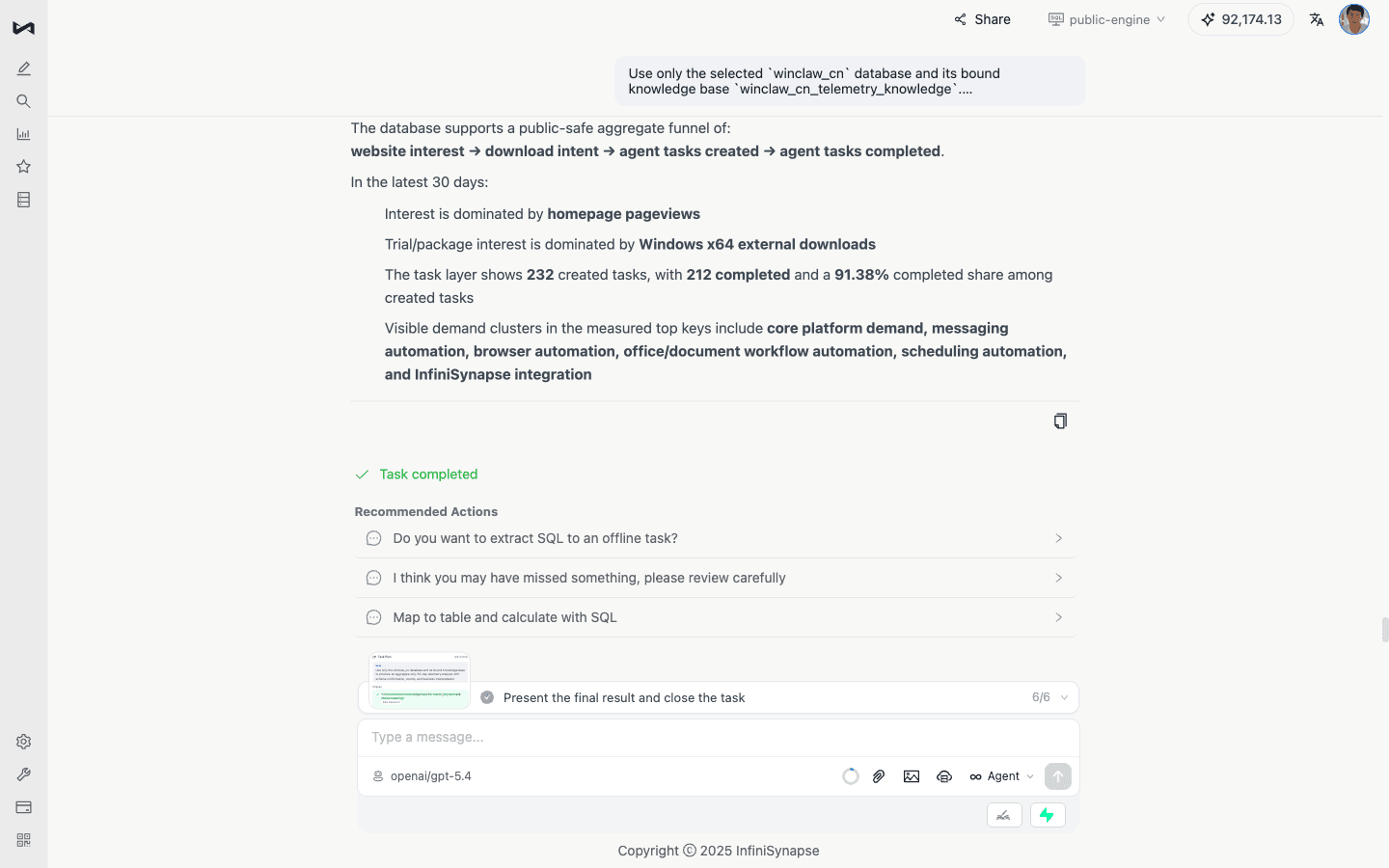
The public-safe funnel became:
website interest -> download intent -> agent tasks created -> agent tasks completed
And the business narrative became:
- interest is dominated by homepage pageviews
- trial/package interest is dominated by Windows x64 external downloads
- the task layer shows 232 created tasks, with 212 completed
- the completed share among created tasks is 91.38%
- visible demand clusters include core platform demand, messaging automation, browser automation, office/document workflow automation, scheduling automation, and InfiniSynapse integration
This is no longer just a query result. It is an explainable business reading of the data.
Why This Matters
Agentic Data Agents can already decompose questions, choose tools, query data, and produce reports.
But that is not the endpoint.
The real product challenge is deeper:
- Can the Agent know which facts are measurable?
- Can it understand what the metrics mean?
- Can it avoid unsafe row-level data?
- Can it separate database evidence from business interpretation?
- Can the knowledge base return accurate and stable business definitions when the Agent calls it?
- Can it ask for the right knowledge at the right time?
InfiniSynapse's database + knowledge base binding addresses exactly this gap.
It gives every connected database a semantic companion. The Agent can query the database for facts and call the bound knowledge base for meaning.
That design turns a database from a raw source into an Agent-ready business system.
The Takeaway
InfiniSynapse pioneered database and knowledge base binding for Data Agents.
With a fourth-generation, high-precision knowledge base exposed as an Agent tool, the Agent can ask for business knowledge while analyzing data, instead of guessing from table names or being misled by vague retrieval.
This is the shift:
Databases make facts computable. Knowledge bases make facts understandable. InfiniSynapse binds them together so Agents can produce trustworthy business analysis.