
Once you have explained the goal and requirements, you can hand the responsibility to Sparse Agent and stop actively managing its progress. It works like a regular employee, organizing its own work and proactively reporting progress and results. You can leave routine reports unanswered. If something urgent requires your decision, it decides when to contact you again and, if necessary, makes repeated attempts to get a timely response.
You can already start working this way with Sparse Agent. We give long-term goals to Sparse Agent, use Dense Agent for things that need our immediate attention, and prepare the working environment through a remote desktop.
In terms of how people take part, we use a mix of three forms: Sparse Agent is an employee that takes responsibility and works independently; Dense Agent is an execution tool for work you personally direct; and the To Do List, also called the Approve List, is where the Agent keeps proposing actions and you simply approve or reject them.
My view is that the ultimate form of AI will be a mix of Sparse Agent, Dense Agent, and the To Do List, or Approve List. All three will be used together to carry out the same work. Your involvement changes as a long-term task moves through different stages. We are turning this way of working together into tools you can use today.
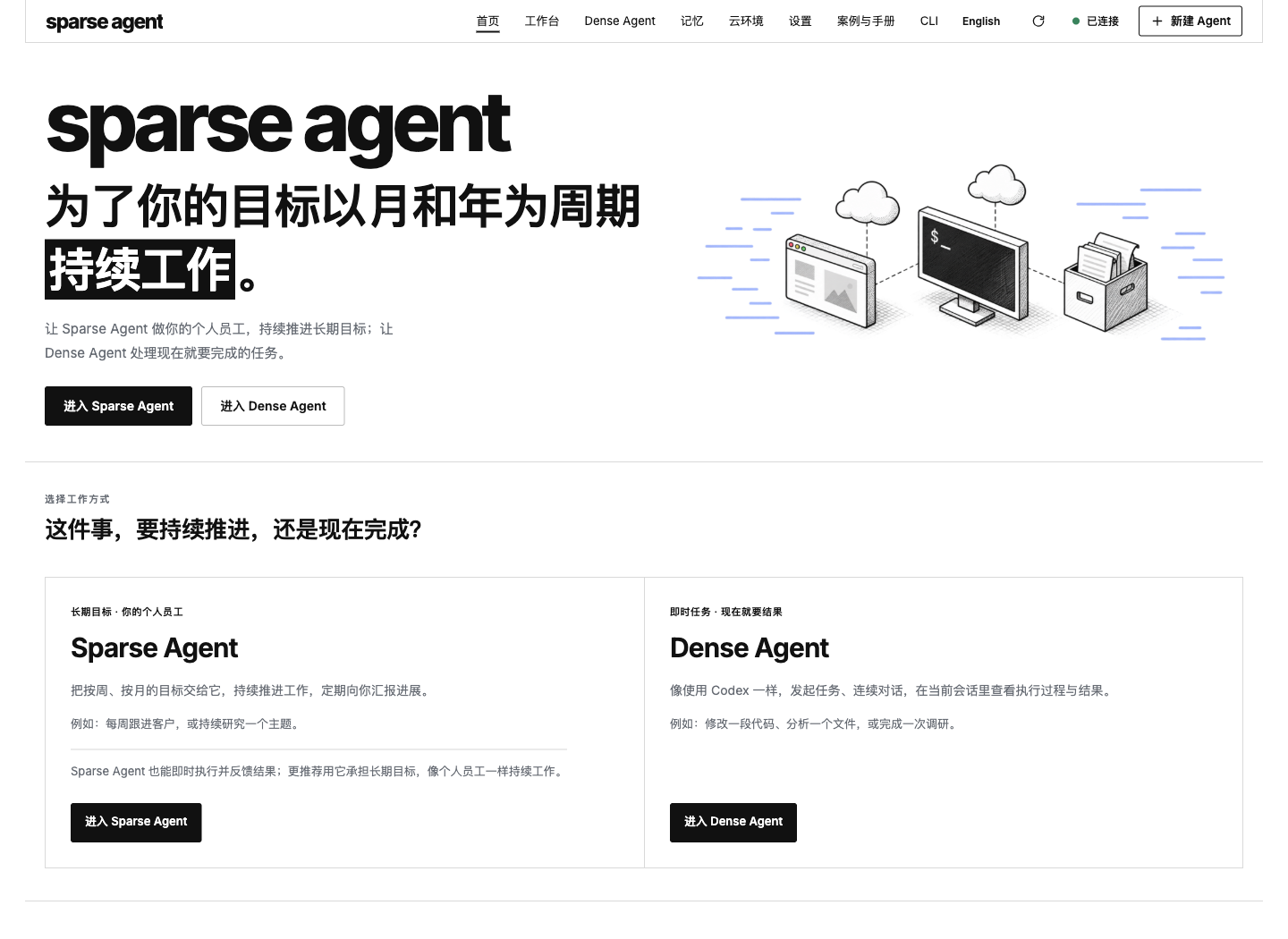
The homepage provides entry points for Sparse Agent and Dense Agent.
Sparse Agent is designed for goals that develop over years, months, and weeks. You give it work that needs sustained attention, explaining the results you want, how to measure them, and which decisions it can make independently. Once the responsibility is clear, it owns the work, follows up on results, and arranges subsequent actions. It proactively brings you the progress and results you need to know about.
For example, suppose you want to track feedback on a product over the next three months. You could ask the Agent to organize feedback, identify recurring issues, follow up with users you have authorized it to contact, and submit a weekly report. The report should explain which issues are new, what has been handled, and what still needs your involvement. KPIs can cover the amount of useful feedback, the completion of follow-up actions, and whether reports arrive on time.
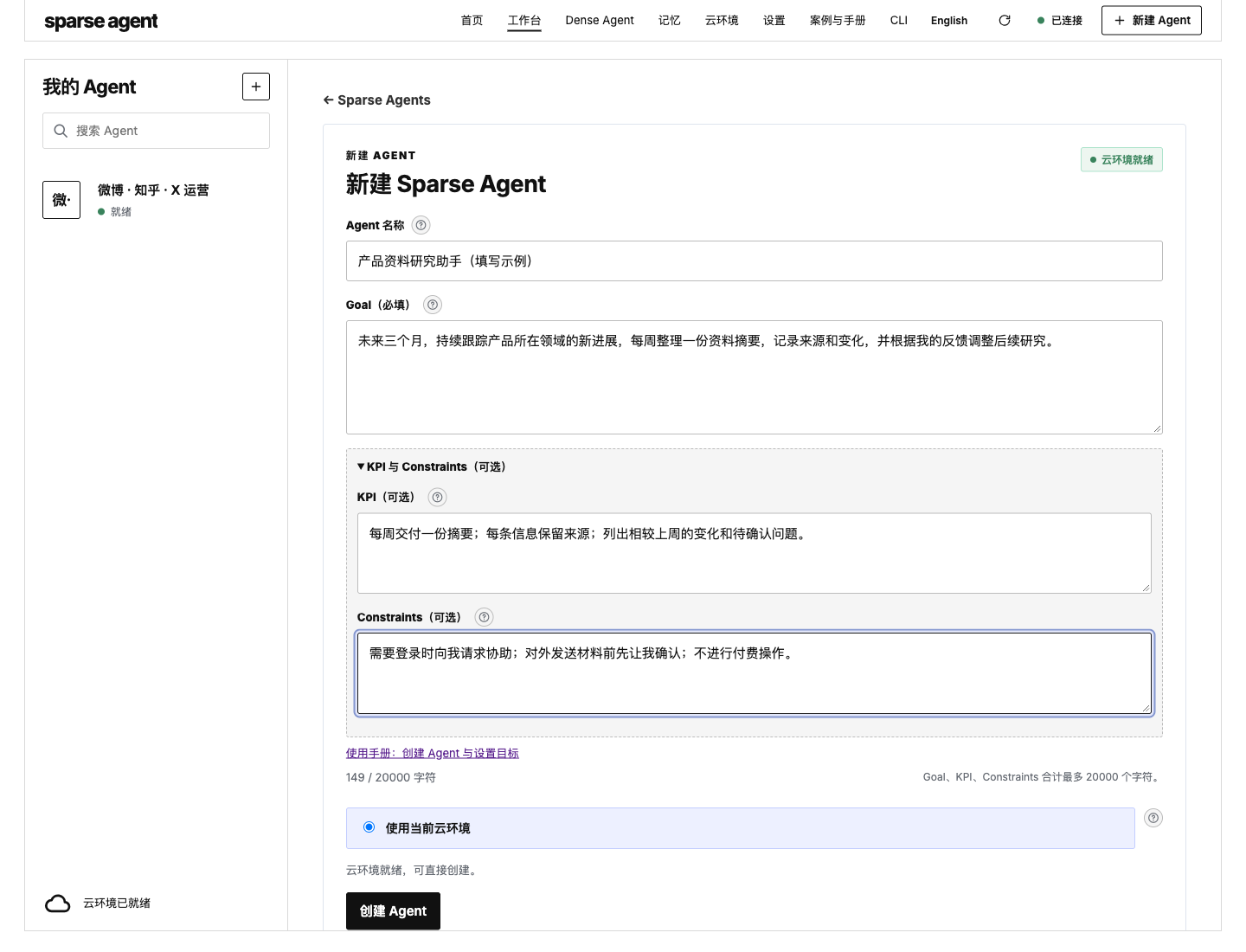
An example configuration for a long-term research assistant, with a goal, measures, and execution requirements. The screenshot shows the form; the task has not been started.
Under this arrangement, every round of work serves the same goal. The Agent follows up on items left over from last week, adds new replies to existing records, and analyzes stalled progress so it can adjust its next steps. You no longer need to keep this responsibility on your own to-do list or remember to return to the computer to check its progress.
This is much like assigning work to a regular employee. The employee is responsible for moving things forward and reporting to you proactively. If you do not respond to a routine report, the day-to-day work you have already authorized continues. If the Agent determines that an urgent matter needs your decision, it contacts you and decides whether to try again based on the urgency. Progress, reporting, and urgent communication are all part of the responsibility.
Other work is something you want to handle personally. You have just received material you want to study in your own way, a piece of code has a problem you want to understand, or a proposal needs revision and you want to decide how best to express it. You lead this work, deciding what to investigate, what to change, and when it is finished.
Dense Agent is the execution tool you use in these situations. In the current conversation, you ask it to search, analyze, write, or revise, then give further instructions based on the results. It provides projects, conversations, and attachments to help carry out specific actions. You retain control of the thinking, judgment, and progress. You remain the person actively driving the work.
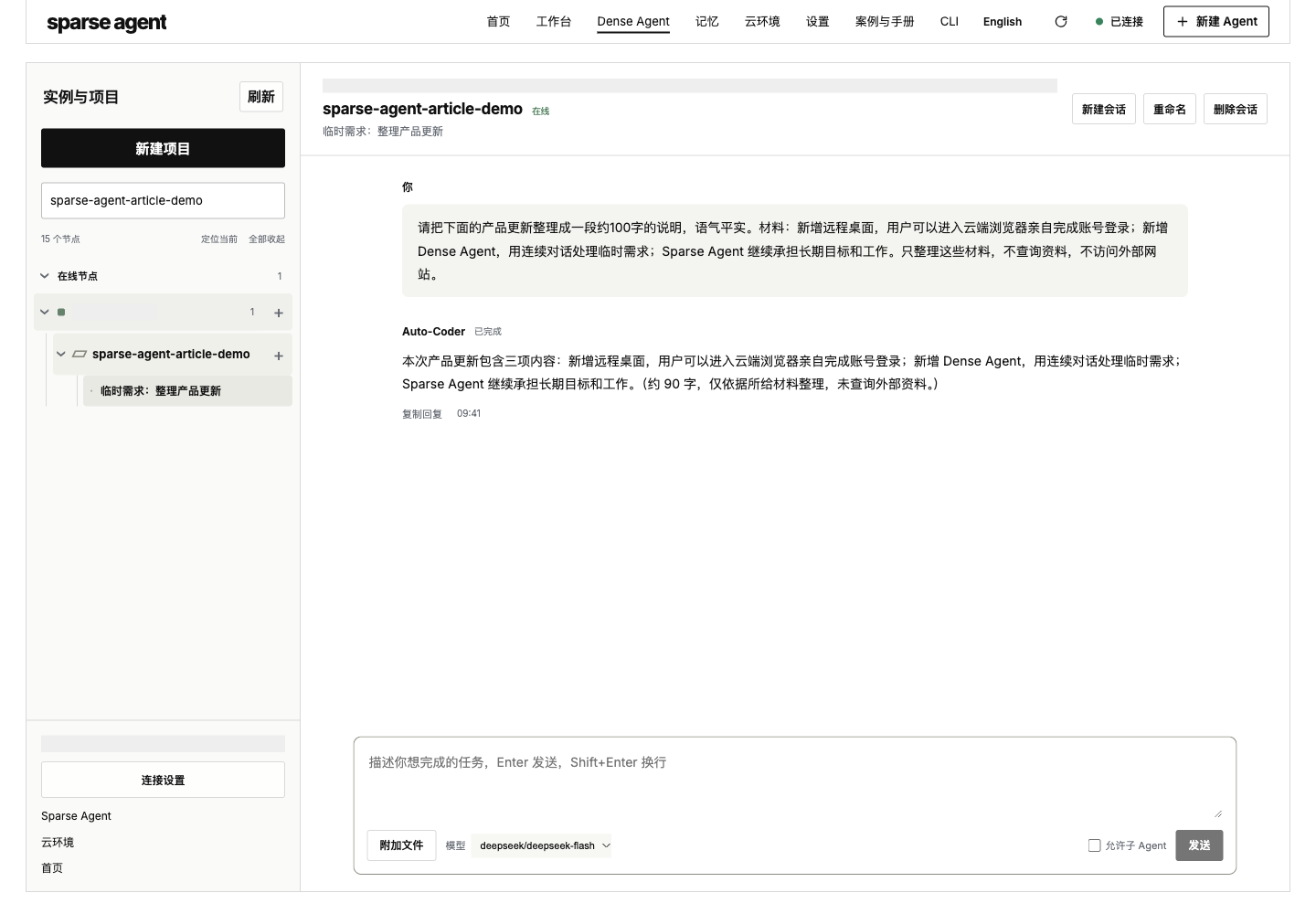
Dense Agent's project and conversation interface. The demo task organizes product release notes; account and node names are masked.
For example, when designing a weekly report yourself, you can use Dense Agent to organize material and revise its structure, gradually settling the format and priorities. Once those requirements are stable, you can give Sparse Agent responsibility for keeping the report up to date. In the first stage, you use a tool to work out what is needed. In the second, an employee takes on a clearly defined, ongoing responsibility.
There is also a practical requirement for making both working styles part of everyday life: the Agent needs a computer that is ready for work. It needs files and a browser, along with access to any accounts it will use.
I prefer a straightforward approach: enter the remote desktop yourself and prepare the environment. Open websites in the browser the Agent will use, sign in, scan any QR codes, and complete the necessary identity checks. You handle the login; the Agent then continues working in that environment.
Sparse Agent already provides a remote desktop entry point, currently supporting its Omarchy cloud desktop environment. You can enter the desktop and operate its browser and applications. When you disconnect the viewing session, the cloud computer and its applications continue running. Once the model, cloud environment, and necessary accounts are ready, the Agent has a workplace it can keep using.
This approach means you do not have to paste account passwords into a chat message to assign work. If a website requires a QR code scan, you scan it yourself. If it requires human verification, you complete it yourself. Familiar computer habits can carry over naturally into working with an Agent.
After signing in, you also need to define how the accounts may be used: whom the Agent can contact, what it can publish on its own, and what needs your review first. Signing in handles identity verification; day-to-day authorization determines how the Agent may work. Together, they provide a clear basis for an ongoing working relationship.
The third form is To Do List AI, also called the Approve List. The Agent continually brings actions it considers worthwhile to your review list, explaining what it proposes to do, why, and what result it expects. When you open the list each day, your only job is to decide: approve or reject. Once you approve, the Agent takes care of execution.
The Dream Work List I use every day is essentially this kind of Approve List. The Agent keeps proposing new actions, with the task details already prepared. The list offers options such as "Approve and execute" and "Ignore." If I think something is worth doing, I click "Approve and execute." If I do not want it done, I ignore it. The Agent handles the work that follows.
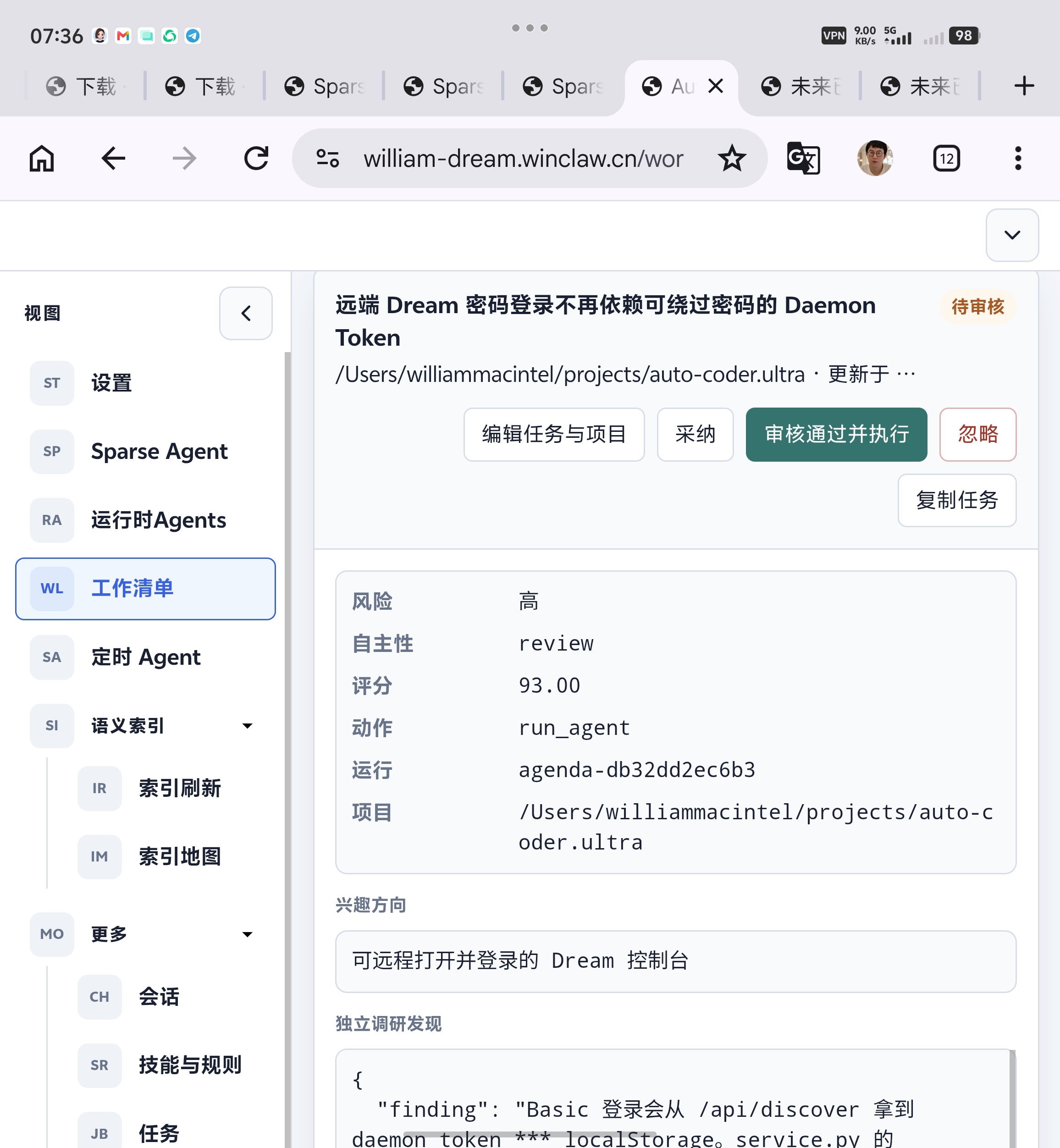
A pending task in the Dream Work List, with options to approve and execute it or ignore it.
In this way of working, you do not need to discover what should be done today, design the steps, and issue instructions one by one. The Agent finds opportunities, organizes tasks, and prepares the execution plan. Your responsibility is concentrated in the final decision: should this be done? The list keeps updating, and you decide as new proposals arrive.
Consider the product feedback example again. Sparse Agent independently carries out the day-to-day responsibility you have assigned to it and proactively sends you reports. If it identifies an improvement worth investing in, it prepares a specific action and its rationale for the Approve List, where you decide whether to proceed. If there is a reply you want to refine personally, you use Dense Agent and direct the revisions in the current conversation. You then add the settled requirements to the long-term task and leave Sparse Agent responsible for continuing the work.
The same goal runs through all three forms. Some responsibilities can be handed over without requiring your active management afterward. Some work is yours to drive, with the Agent executing as a tool. Other actions are proposed by the Agent, leaving you only the decision to approve or reject. These three relationships recur and mix in real work.
I believe this combination is the ultimate form of AI. People will have employees that can work independently, execution tools for work they want to do personally, and a continuously updated list of actions awaiting approval. Sparse Agent, Dense Agent, and the Approve List serve these three needs.
"The future has already been built" means we can already begin to work this way: delegate a responsibility and let the Agent progress and report proactively; use Dense Agent for specific actions when working personally; and simply approve or reject the new actions an Agent keeps proposing. All three forms will become part of everyday work.