title: "Give InfiniSynapse an Image, We Return a Computable SQL Table" date: 2026-05-07 description: "InfiniSynapse doesn't just chat about images — it maps visual data into computable structured tables, then executes all analysis via SQL. Complex statistics, multi-image comparison, and cross-report YoY/QoQ analysis are all within reach." tags: ["InfiniSynapse", "SQL", "Data Analysis", "AI Agent"] author: "WinClaw"
Preface: This article is based on a browser screenshot session of a target task page. The automated session did not access private task details behind login, so the actual screenshots primarily show public-facing views — the landing page, login gate, and data market. The article focuses on articulating InfiniSynapse's core methodology: turning image data into computable tables, then handing all computation to SQL.
The Core Thesis — We Don't Just Chat About Images, We Turn Them Into Tables
Many people encountering an image recognition tool for the first time assume it's just "chatting about images" — upload a screenshot, ask a few questions, get a text answer back.
But InfiniSynapse does something fundamentally different.
When you upload an image — a financial report screenshot, a sales dashboard, an operational data view — we don't just have a vision model describe what it sees.
We do something more foundational: we map the data in that image into a genuinely computable structured table.
Then, all computation is handed to SQL.
That is why InfiniSynapse delivers results that are highly accurate, reproducible, and auditable.
What We Captured from This Task Page
When visiting the task link, the first thing we see is the platform's brand navigation:

This is InfiniSynapse's unified entry interface, providing core functions such as task management, data marketplace, and team collaboration.
When trying to enter a specific task, the system prompts for login:

This is standard access control — private tasks are only visible to authorized users.
Clicking login brings up the login form:

Once logged in, users can enter the data marketplace to browse and subscribe to various data services:
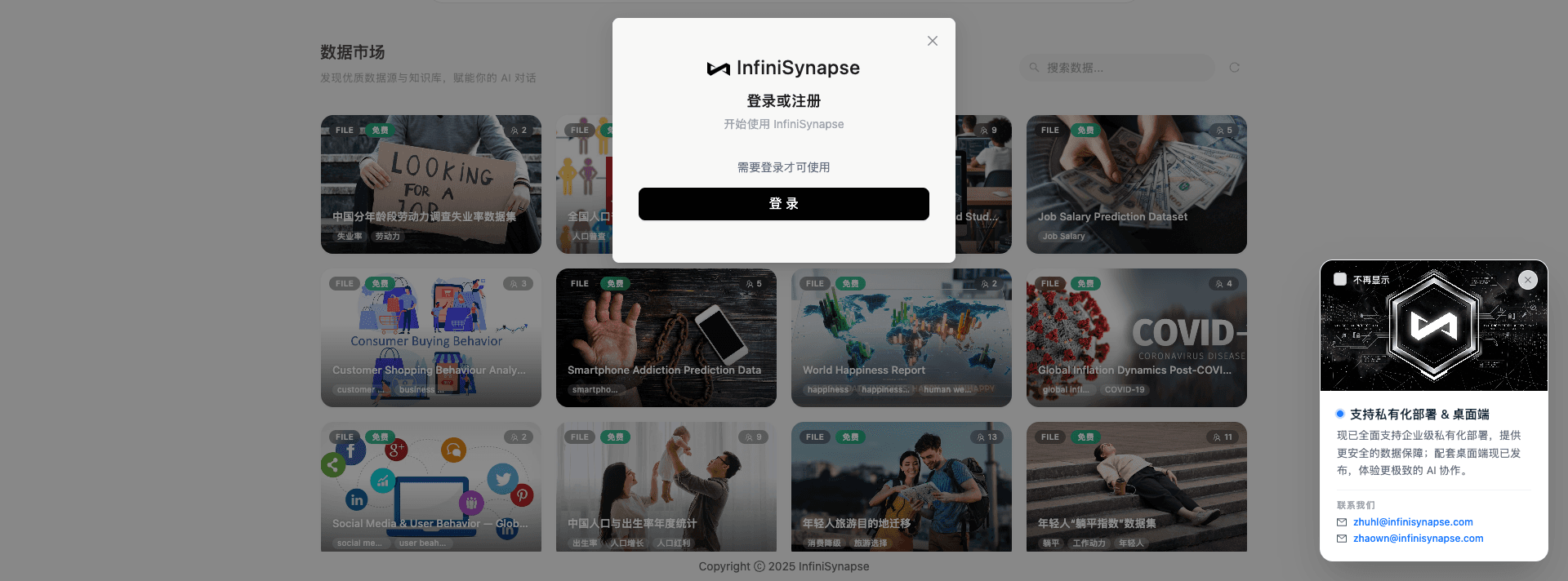
Here is the overall page view:

Although this automated session did not go past the login gate into specific task content, these public interfaces are already sufficient to understand InfiniSynapse's product shape. Now, let's dive into its most central technical philosophy: image to table, then to SQL.
What Happens When an Image Enters the System
When an image is uploaded to InfiniSynapse, it goes through a complete structured transformation pipeline:
The Complete Image-to-Table Pipeline:
- Upload Image — Financial reports, dashboards, operational data screenshots enter the system
- Visual Parsing + OCR — Beyond recognizing text, the system identifies table structure: row-column relationships, merged cells, header hierarchies
- Table Candidate Detection — A single image may contain multiple independent tables; the system auto-splits and labels them
- Schema Normalization — The most critical step: transforming something that "looks like a table" into a database-grade table:
- Column name standardization
- Data type inference (numbers, dates, currency, percentages)
- Unit unification
- Missing value handling
- SQL Data Table — At this point, image data becomes a first-class citizen — queryable, joinable, aggregatable, window-function-ready
- SQL Computation Engine — Every analytical need is ultimately translated into standard SQL; this is the bedrock of accuracy
- Output: Answers / Charts / Reports
Why Table-ization + SQL Is More Accurate
The following table illustrates the architectural difference:
| Dimension | Direct Image Q&A | Image → Table → SQL |
|---|---|---|
| Data Carrier | Visual features + text context | Structured data table |
| Computation | Model-generated reasoning | Standard SQL execution engine |
| Determinism | Same image, different answers possible | Same input = same output, fully reproducible |
| Auditability | Hard to trace answer provenance | SQL statements are reviewable, breakpoint-verifiable |
| Complex Computation | Depends on model context reasoning | Full SQL semantics, arbitrary complexity |
| Error Type | Model reasoning errors, hard to locate | Usually data extraction issues, targeted fix possible |
This is not a competition of model capabilities — it's a difference in architectural choice.
Take unstructured images, first convert them into familiar, reliable relational data tables — battle-tested by industry for decades — then use SQL to answer questions. That is the foundation of InfiniSynapse's accuracy.
Complex Statistics — SQL Does More Than SUM
Once data becomes a table, what you can do goes far beyond simple questions like "what's the total."
As an example, suppose we extracted the following data table from a sales report image (illustrative):
sales_data schema:
| region | product_line | month | revenue | target |
|---|---|---|---|---|
| East | A-Series | 2024-01 | 1,250,000 | 1,200,000 |
| North | A-Series | 2024-01 | 980,000 | 1,100,000 |
| ... | ... | ... | ... | ... |
Here are some typical SQL computation scenarios:
1. Group Aggregation + Contribution Rate
-- Calculate revenue by region and each region's contribution to total
SELECT
    region,
    SUM(revenue) AS regional_revenue,
    ROUND(SUM(revenue) * 100.0 / (SELECT SUM(revenue) FROM sales_data), 2) AS contribution_pct
FROM sales_data
GROUP BY region
ORDER BY regional_revenue DESC;
2. Window Function: Month-over-Month Growth
-- Calculate month-over-month growth rate per product line
SELECT
    product_line,
    month,
    revenue,
    LAG(revenue) OVER (PARTITION BY product_line ORDER BY month) AS prev_month_revenue,
    ROUND((revenue - LAG(revenue) OVER (PARTITION BY product_line ORDER BY month)) * 100.0
          / NULLIF(LAG(revenue) OVER (PARTITION BY product_line ORDER BY month), 0), 2) AS mom_growth_pct
FROM sales_data
ORDER BY product_line, month;
3. Top N + Variance Analysis
-- Find the top 5 region-product_line combinations by attainment rate, with volatility
WITH monthly_performance AS (
    SELECT
        region,
        product_line,
        AVG(revenue / target * 100) AS avg_attainment_pct,
        STDDEV(revenue / target) AS attainment_volatility
    FROM sales_data
    GROUP BY region, product_line
)
SELECT *
FROM monthly_performance
ORDER BY avg_attainment_pct DESC
LIMIT 5;

These are just the tip of the iceberg. Once data is properly table-ized, the complexity of questions you can answer is limited only by your analytical thinking — not by model capability.
Multi-Image Dimensional Comparison
Many analytical scenarios involve not one image, but comparing two — e.g., "this quarter vs. last quarter," "budget vs. actual," "version A vs. version B."
InfiniSynapse supports uploading multiple images simultaneously, structuring each independently, then joining them for comparison.
Key Steps Before Comparison
- Dimension Alignment — Confirm that the dimension columns in both tables can be matched (e.g., both have "region," "product_line")
- Metric Alignment — Confirm that metric names and definitions are consistent
- Unit Normalization — Automatically handle currency units, time units, magnitude (thousands/millions/billions)
- Missing Dimension Handling — Decide how to treat dimensions present in one image but absent in the other
Comparison SQL Example
Suppose we extracted q1_sales and q2_sales from two images:
-- Compare quarterly revenue by region
SELECT
    COALESCE(q1.region, q2.region) AS region,
    q1.total_revenue AS Q1_revenue,
    q2.total_revenue AS Q2_revenue,
    q2.total_revenue - q1.total_revenue AS delta,
    ROUND((q2.total_revenue - q1.total_revenue) * 100.0 / NULLIF(q1.total_revenue, 0), 2) AS growth_pct
FROM (
    SELECT region, SUM(revenue) AS total_revenue FROM q1_sales GROUP BY region
) q1
FULL OUTER JOIN (
    SELECT region, SUM(revenue) AS total_revenue FROM q2_sales GROUP BY region
) q2 ON q1.region = q2.region
ORDER BY growth_pct DESC NULLS LAST;
This kind of precise dimension-aligned computation is difficult to achieve reliably in a pure visual-dialogue mode.
Multi-Report Financial Analysis — From Many Small Tables to Cross-Report YoY/QoQ
This is one of the scenarios enterprise users care about most.
A single standard financial report PDF may contain dozens or even hundreds of small tables — income statement, balance sheet, cash flow statement, business segment data, regional data, footnote tables, and more.
If you have reports from consecutive quarters or years, InfiniSynapse can unify all these fragmented small tables into structured data tables and then perform cross-report time-series analysis.
Multi-Report Integration Pipeline:
- Report 1 — Income statement, balance sheet, cash flow statement, segment data
- Report 2 — Income statement, balance sheet, cash flow statement, segment data
- Report 3 — Income statement, balance sheet, cash flow statement, segment data
- Unified Schema Mapping — All tables aligned to a single data model
- Structured Data Warehouse — All fragmented tables consolidated into a queryable whole
- YoY / QoQ / Trend Analysis — Time-series analysis across reporting periods
Cross-Report YoY Analysis SQL Example
Assuming we extracted and consolidated data from multiple reports into a financials table:
-- Calculate year-over-year growth rates for key financial metrics
SELECT
    reporting_period,
    revenue,
    LAG(revenue, 4) OVER (ORDER BY reporting_period) AS prior_year_revenue,
    ROUND((revenue - LAG(revenue, 4) OVER (ORDER BY reporting_period)) * 100.0
          / NULLIF(LAG(revenue, 4) OVER (ORDER BY reporting_period), 0), 2) AS revenue_yoy_growth_pct,

    net_profit,
    LAG(net_profit, 4) OVER (ORDER BY reporting_period) AS prior_year_net_profit,
    ROUND((net_profit - LAG(net_profit, 4) OVER (ORDER BY reporting_period)) * 100.0
          / NULLIF(LAG(net_profit, 4) OVER (ORDER BY reporting_period), 0), 2) AS net_profit_yoy_growth_pct,

    ROUND(net_profit * 100.0 / NULLIF(revenue, 0), 2) AS net_margin_pct
FROM financials
ORDER BY reporting_period;
This is why financial analysts, investors, and finance teams love InfiniSynapse — you no longer need to manually copy-paste data from hundreds of PDF pages.
Upload all reports, let the system automatically turn every small table into a queryable data warehouse, then answer any time-series question with SQL.
What This Means for Enterprise Data Analysis
Once you understand the "Image → Table → SQL" architecture, InfiniSynapse's true value for enterprise data analysis becomes clear:
1. Bridging the Last Mile from Unstructured to Structured
In enterprises, 80% of data is scattered across PDF reports, screenshots, scanned documents, and embedded Excel tables. This data is "visible but unusable" — you can open and look at it, but you can't directly compute with it.
InfiniSynapse is the converter for that last mile.
2. Auditability of Analytical Results
SQL is white-box. Every computation result can be traced back to its source data and calculation logic — critical for industries with high compliance requirements.
3. Seamless Integration with Your Existing Data Stack
SQL is the universal language of data. The structured data output by InfiniSynapse plugs directly into your BI tools, data warehouses, and analytics platforms. No need to replace any existing infrastructure.
4. Liberation of Analytical Thinking
When data extraction and table-ization are no longer the bottleneck, analysts can focus their energy on "asking the right questions" and "interpreting insights" — rather than spending 80% of their time on data cleaning.
How to Experience InfiniSynapse
InfiniSynapse is available in three deployment forms to suit different scales and needs:
| Form | Best For |
|---|---|
| SaaS | Quick start, instant access — ideal for individuals and small-to-medium teams |
| Desktop | Local execution, data stays on-premises — ideal for sensitive data scenarios |
| Enterprise Private Deployment | Full functionality, customized integration — ideal for large enterprises |
We also provide Command Tools that enable the Agent ecosystem to directly invoke InfiniSynapse capabilities. Download a binary from:
👉 https://www.infinisynapse.cn/tools
Put it in your PATH, and you're ready to go.
Whether you use InfiniSynapse manually or integrate it into automated Agent workflows, our core promise remains the same:
Give us an image, and we return a computable table.
Closing Thoughts
Today's AI applications often pursue the experience of "looking intelligent."
InfiniSynapse chooses a simpler but more fundamental path: transforming unstructured images into the structured data infrastructure that industry has relied on for decades — battle-tested and proven.
This path may not look "flashy," but it delivers genuinely reliable analytical results.
Because in enterprise data analysis, what you need most is not surprise — it's trust.
Not "this answer seems right," but "I can make decisions based on this answer."
That is InfiniSynapse.
Try it yourself.