Running an account, following a field, and advancing a long-term project all require someone to remember the goal and keep the work moving from one round to the next. That is what we are building with Sparse Agent: a personal assistant that works toward long-term goals, or a digital employee.
A personal assistant that takes long-term responsibility
This is the kind of employee we want to work with: give it something that needs sustained effort, explain the goal and requirements, and let it take responsibility for planning the work, observing the results, and adjusting its approach. A goal can span months, a year, or even several years. You do not need to assign the same work again every day; it keeps following up based on current progress.
A digital employee should also report to the user regularly: what it has completed, how far it is from the goal, and how it plans to proceed. The user can provide materials, give feedback, and correct the direction. Following up proactively, reporting regularly, and accepting feedback are all part of this long-term responsibility.
Define the employee with a goal, KPI, and constraints
This is how we differ from personal agents whose work is organized primarily around scheduled tasks and event triggers. Schedules and events describe when work should begin. Sparse Agent starts with a long-term responsibility and plans subsequent actions around the desired result.
We define a digital employee with Goal, KPI, and Constraints. The Goal specifies what it should accomplish, for whom, and for how long. The KPI describes how progress and results should be measured. Constraints establish the boundaries of the work, including which actions it may take independently, which content needs the user's approval first, and when it should request assistance.
Once these requirements are clear, the Agent can turn the goal into ongoing work. After completing a round, it reviews the current results and decides what to do next and when to resume. If the goal remains unfinished, it schedules another round, continuing until the task is complete or the user decides to adjust or pause the work.
Months or years refer to the period of responsibility for the goal. Continuing through that period requires an available model and cloud environment, with authorization for the accounts the work needs. Once the user delegates the responsibility, the Agent handles routine follow-up while reports and feedback keep the user informed.
We also provide this employee with a computer where it can actually work. It uses Omarchy, the complete Linux operating system initiated by DHH and designed for Agent work, with a browser, terminal, and software environment that can be extended as tasks require. The Agent can research, process files, and run tools there, expanding its working capabilities as needed.
This computer is a virtual machine in the user's own DigitalOcean account. The user can view and manage the host, enter the environment over SSH, inspect files, and decide whether to keep or delete it. Data and working files entrusted to the digital employee have a clear owner, and the user retains a way to manage those assets.
Cloud Memory lets different Agents reuse experience
We also provide Sparse Agent Memory, a cloud service. Within the same account and the scope authorized by the user, different Agents can reuse shared working preferences, project conventions, and practical experience. Useful information accumulated by one Agent can inform the work of others later, while each Agent's private memory remains subject to access controls.
For example, an operations Agent may confirm that product introductions should explain practical uses before listing features. Once that preference is saved as shared memory, a writing Agent taking on related work can query and use it. Corrections from the user and confirmed project decisions can also carry into later tasks, reducing repeated explanations and trial and error.
When we say the system becomes smarter with use, we mean this accumulation of experience: useful methods are saved, outdated requirements are updated, and later work applies the records in the current context. Goals, KPIs, and constraints tell the Agent what it is responsible for. Cloud Memory lets it and other authorized Agents use the experience already accumulated.
What work is a good fit for Sparse Agent?
Some work calls for sustained operations, some tasks involve long waits, and some projects require repeated improvements to the same problem. Work with a clear goal, results that can be checked, and a continuing need for follow-up is a good fit for this approach.
A year of social media operations
You can give an operations Agent a one-year goal: keep running your product's accounts on Weibo, Zhihu, or X so that people interested in the field understand the product better. The KPI might be verifiable content reach or another account metric you want to improve. Agree on the target, reporting period, and calculation method first, so that progress can be checked later.
Once it has the product materials, existing content, and your working preferences, it can choose topics, try different ways of presenting them, and adjust the posting schedule within the agreed scope. Which content performs well, which topics need more explanation, and how far it is from the current KPI can all inform the next round of work. You do not need to tell it what to post every day. It turns the goal into ongoing operations, reports as agreed, and adjusts in response to your feedback.
Our earlier social media operations case used monthly verifiable reach as its KPI, with daily reports tracking cumulative progress, the remaining gap, and the next actions. A year is a period of responsibility you can set; the results need to be checked as the work continues.
An Apple developer account task spanning two weeks
Another kind of task has a clear finish line but involves many waits and exchanges with other people. One task I previously assigned to Sparse Agent was to handle an Apple developer account and complete developer signing for the PythonMiao desktop application.
The work involved registration and renewal, support tickets, communication with Apple Support, payment confirmation, and then certificates, signing, and notarization. If the account was not activated, it had to keep investigating. If Support had not replied, it had to preserve the progress and arrange follow-up. When it needed me to log in, confirm my identity, or authorize a payment, it asked proactively and reminded me to supply what the next step required.
The project's case record runs from the assignment on July 16 to completion of signing and notarization on July 29, about 13 days in total. The completion criteria were a usable account and membership, followed by successful signing, notarization, and distribution checks. Much of the elapsed time was spent waiting. The Agent kept tracking the status and provided the agreed progress reports and plans for the next steps.
After delegating the task, the user leaves routine coordination and follow-up to the Agent. Logins, identity confirmation, and payment authorization that require the user still remain with the user. The Agent should explain what is missing, why it is needed, and what it will do afterward. The user does not have to chase every step; the Agent reminds them when their participation is needed.
Three months of website performance improvement
A development team can also give an Agent a performance improvement goal lasting three months. First identify the website or application to improve, then agree on metrics such as page loading time, response time for key APIs, and error rates, along with the baseline, targets, and measurement method.
During that period, it can monitor the running system, use the data to find opportunities for improvement, reproduce problems, modify the code, and compare the results before and after each change. After a release, it continues observing the actual behavior: whether the problem is resolved, whether other functionality is affected, and what should be addressed next. Each round of changes works toward the same performance goal.
The constraints for this task can also be explicit: submit changes for human review, and release them after approval. The Agent handles monitoring, analysis, preparing changes, and tracking the results; people retain the review and release decisions. For those three months, it keeps its attention on this performance work while progress reports keep the user informed.
These examples cover ongoing operations, a specific task spanning many days, and a sustained improvement project. The Goal describes what should be accomplished and to what standard. The KPI helps check current progress, and constraints establish the scope in which the Agent may proceed independently. Continuing with account operations, we can turn that responsibility into a concrete goal.
Start with a long-term goal
For example, to run a Weibo or Twitter account, you could give it this goal:
Over the next year, keep running my account so that people interested in this field can better understand our product. Choose topics based on real product progress, review how the content performs regularly, and adjust the posting frequency based on feedback. Report progress to me every week.
This is an example you can refine further. You can specify the intended readers, how to judge the results, which content it may publish directly, and which content it should show you first. A clearer goal makes the collaboration easier to review and adjust.
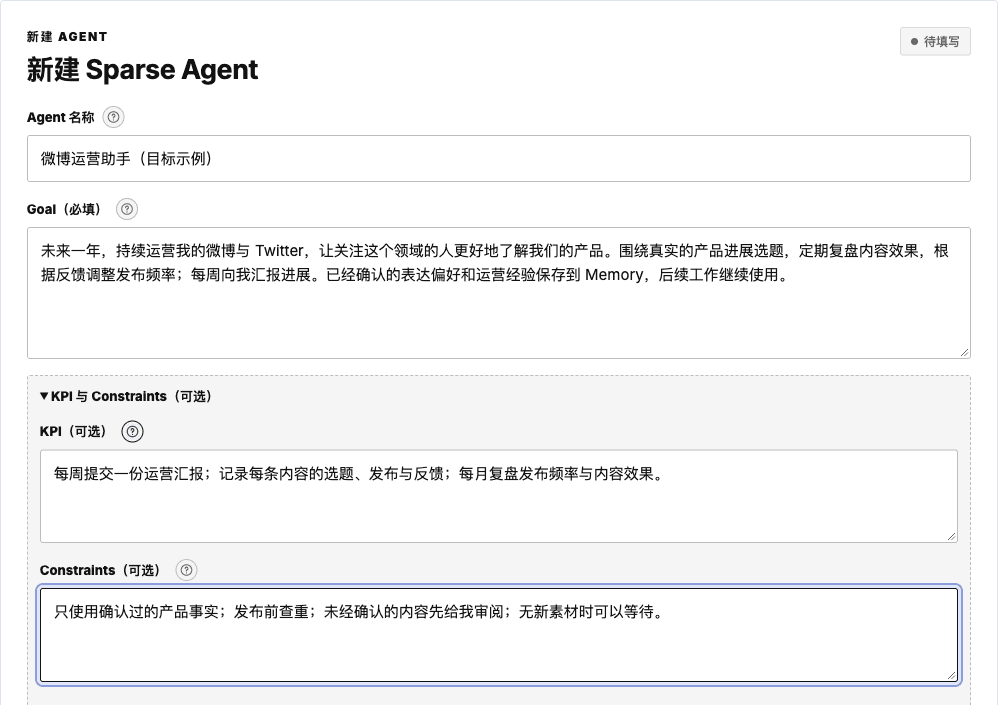
Enter the Goal, KPI, and execution constraints in the workbench. The Weibo account goal shown here is an example; no Agent has been created.
Work gradually unfolds around this goal: first understand the account and its existing content, then prepare topics and materials, and check the response after publishing. If a type of content does not receive the expected response, keep reviewing the topic, wording, and publication time. If an approach is worth keeping, use it in later attempts.
Posting frequency can also be something to work out over time. Begin with the agreed schedule, gather feedback for a while, and then decide whether it needs to change. These decisions need to be considered alongside the goal, the quality of the materials, and the actual results.
Finish this round and know when to start again
An assistant that works over the long term needs to know how to organize its time.
Suppose it has finished choosing a topic and preparing the content in the morning, but the next post is best published in the evening. If there is nothing else to handle in between, it can rest and resume when it is time to work again. New information, additional requirements from you, or something that needs advance preparation can also change its plans.
At the end of each round of work, Sparse Agent records the current progress and schedules the time and task for the next round. When it resumes, it considers the existing records and the latest circumstances before deciding what to do next. As long as the goal remains unfinished, there is more work to follow.
Scheduled tasks are useful for fixed actions, and event triggers are useful for clearly defined changes. Sparse Agent places greater emphasis on letting the goal and current progress determine the next step, including adjustments to the pace of work. The time and any events that have occurred are part of what it considers when planning.
This also helps manage token consumption. While resting, the model does not need to keep generating content to maintain a working state; it is called when judgment and execution are needed. Working as needed can reduce consumption during waiting periods. Actual usage depends on the selected model, task complexity, and workload.
Add information whenever you want, and keep the lessons for later
Long-term collaboration inevitably involves change. Your product gains a feature that you want the next round of content to highlight. You read a draft and find an expression that does not fit your style. An approach you used before encounters new circumstances and needs adjustment. You can send all of this directly to Sparse Agent.
Once cloud Memory is connected, requirements, judgments, and practical lessons worth keeping can be saved. The Agent can query and use them when relevant tasks come up later. For example, if you want product introductions to explain practical uses before listing features, you can explicitly ask it to remember that and refer to it in the next draft.
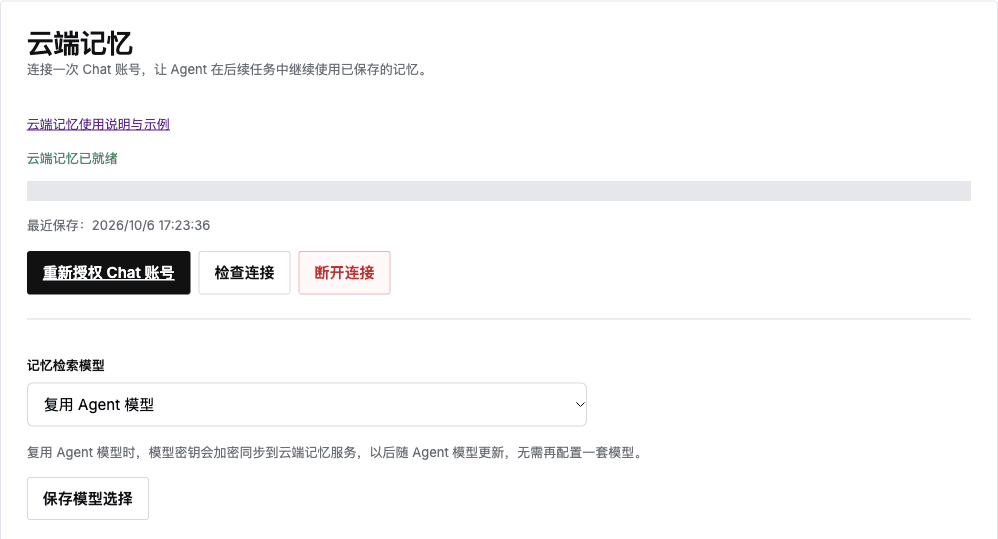
Sparse Agent's Settings → Cloud Memory screen. The connection is ready, and the connected account has been masked.
Corrections can accumulate in the same way. If a statement in a piece of content is inaccurate, provide the correct information and the conditions under which it applies, and update the relevant memory. The next round of work then has new information to consult. Through repeated collaboration, we hope the assistant becomes more familiar with your requirements and better understands which methods suit the current task.
Memory provides long-term records that can be queried and updated. In practice, you can ask the Agent to explain what it found and how it plans to use it, then check the results to see whether the correction took effect.
Send a message to begin working together
You do not need to connect every third-party tool, such as email and calendars, before starting with Sparse Agent. Once the basic model and cloud environment configuration is complete and a goal is defined, you can message it directly in the workbench to provide materials, check progress, or assign an immediate task.
Log in and authorize the accounts needed for the particular work. For example, to publish on Weibo or Twitter, you need to log in to your account in the browser used by the Agent and agree on the scope of publishing. You can send temporary materials directly by message; to change the long-term requirements, edit the Goal / KPI in the workbench.
We are also working on integrations with instant messaging tools such as Telegram, so that you can communicate with the assistant through the chat tools you use every day. This part is still in development; we will share more later.
Try it with something you want to keep working on
We are opening Sparse Agent for an invitation-based trial. If you are interested, send me a private message or leave the keyword “助手” (“assistant”) through our WeChat Official Account. Tell me what you would like it to keep working on, and I will send you an invitation code and the entry point.
Website: https://sparse-agent.com/
When joining for the first time, follow the page instructions to use an invitation code, then sign in with your own Auto-Coder Chat account. The current trial requires model and cloud service configuration. Monthly and annual durations refer to the goal period; continuing toward those goals also requires arranging the subsequent runtime environment and saving results before an environment expires.
We want to build a digital assistant that can become a long-term partner: it remembers the goal, works carefully when there is something to do, rests when waiting makes sense, and adjusts when it finds a problem. Bring a concrete goal to try it out, and tell me where the collaboration feels awkward.
User guide: https://sparse-agent.com/cases/goal-kpi-constraints.html
Because server resources are limited, access is by invitation. If you are interested, email allvefantasy@gmail.com to apply.