Since September 2026, Personal Agents have been emerging as a more recognizable product category. OpenAI released Dots, Meta introduced Muse, and Cognition added Memory and Dreaming to Devin. They share a direction: helping AI remember requirements, continue working after a conversation ends, and return to the user when needed.
This article first explores the work a personal assistant needs to handle, then introduces Sparse Agent, the product we are building. We want it to take on a long-term responsibility: advance work around the user's goal and KPI, report regularly, accept feedback, and proactively request help when participation is needed.
What work should a personal assistant take on?
Many things can be completed in one conversation: researching a question, revising a passage, or organizing a file. Other work spans days. Customer support has not replied. A colleague still needs to provide information. Published content needs time to gather a response. Solving one problem leads to another round of improvement. The user needs someone to remember the current progress and keep arranging what comes next.
A personal assistant handles this work that remains relevant to a person over time. It needs to know what the user is doing, what result they want, and which requirements have already been agreed. It also needs tools and a working environment where it can use a browser, handle files, and access applications. While waiting, it should preserve progress and resume at an appropriate time.
This collaboration also needs clear communication. The assistant should explain what it has completed, where it is blocked, and what it plans to do next. When a login, identity confirmation, payment, or personal decision is required, it should make an explicit request. New information and feedback from the user should inform subsequent work.
Connecting these parts makes AI closer to an assistant you can work with over time. A conversational interface is a starting point. Goals, memory, a working environment, and the way people collaborate with it all need to follow.
The different emphases of Dots, Muse, and Devin
OpenAI's Dots brings ongoing collaboration into existing workflows. According to the official introduction on September 29, a dot has its own cloud computer and can use a browser and connected applications to keep projects moving. Users can reach it through ChatGPT, Slack, or Teams; it can also report proactively, ask questions, or request a decision. Specialist dots for organizations are configured with an identity, credentials, and system access for particular responsibilities. This approach emphasizes connecting an assistant to the working environments people and teams already use. OpenAI's official introduction
Meta's Muse starts with specific tasks in everyday life. In its official introduction on September 8, Meta described uses including sending emails, arranging travel, completing forms, and making plans and coordinating time and resources around a larger goal. Muse works on its own cloud computer, and users can communicate with it through the app or WhatsApp. It can continue handling tasks after the app closes and contact the user when circumstances change or approval is needed. This approach focuses on how people can delegate everyday matters. Meta's official introduction
Devin's Memory and Dreaming focus on carrying experience forward. The official documentation explains that Memory saves user preferences, corrections, and project experience in records that can be used across sessions. Dreaming organizes these records in the background, merges duplicates, removes outdated information, and adds useful lessons. For ongoing development work, remembering how a previous problem was solved and how the user wants testing and reporting handled can reduce repeated explanations. Devin's official documentation
These products have different starting points and emphases, and all are exploring how to keep advancing goals. When evaluating a personal assistant, look at the actual collaboration: can it take on work spanning multiple days, understand the next step, apply agreed requirements, and communicate when the user needs to participate?
Sparse Agent: define a worker through goals, KPIs, and constraints
Sparse Agent also starts with ongoing collaboration. You can give it a responsibility such as running an account, following a project, or improving a website, and let it advance the work through successive rounds. The goal period can be several months, a year, or longer. Reports and feedback let users follow progress without assigning the same work again every day.
We define that responsibility through Goal, KPI, and Constraints. The Goal states whom it works for, the desired result, and the duration. The KPI explains how progress and results will be assessed. Constraints establish which actions it can complete independently, what needs review first, and when it should request assistance.
Scheduled tasks and events can specify when a round of work starts. Sparse Agent also plans subsequent work around the long-term goal, current progress, and actual results: what should follow this round, when should it check again, who needs to provide something, and which methods are worth trying further?
A digital worker should also report consistently. Users need to see completed work, the remaining gap to the goal, current problems, and the next plan. When the user provides feedback, the Agent needs to incorporate those requirements into later work and continue taking responsibility for the assignment.
Three types of work it can take on
Some work requires ongoing operations. Some tasks involve repeated waiting. Other projects require successive improvements around a set of metrics. The following three scenarios show how this goal-driven collaboration can work.
A year of social media operations
You can give an operations Agent a one-year responsibility: keep running the product's accounts on Weibo, Zhihu, or X so that people interested in the field understand the product better. Provide product materials, existing content, and working preferences, then agree on the KPI, publishing scope, and reporting schedule. It now has a basis for ongoing work.
The KPI might be monthly verifiable public reach or an account metric relevant to the current operations goal. The target, reporting period, and calculation method should be clear. The amount of published content reflects the workload; reach and reader responses help assess whether the topics and presentation are producing the intended effect.
Within the agreed scope, the Agent can choose topics, try different approaches, and adjust the posting schedule. When the product gains a capability, it can use the new materials in future content. If a type of topic receives a weak response, it can keep examining the audience, presentation, and publication time. Users can point out content that needs adjustment, and the Agent applies those requirements to the next round.
Our earlier social media operations case used monthly verifiable reach as its KPI. Daily reports recorded cumulative progress, the remaining gap, and upcoming work. A year is a period of responsibility you can set; results need to be checked as operations continue. Reaching one month's KPI still leaves the next stage of operations to carry out.
An Apple developer account task spanning two weeks
Another type of work has a clear finish line but involves many waits and exchanges. One task I previously gave an Agent was to handle the Apple developer account and complete developer signing for the PythonMiao desktop application. The task was assigned on July 16, 2026, along with daily progress reports covering the day's progress, the next day's plan, and the estimated time remaining.
As the work unfolded, it involved registration and renewal, account activation, support tickets, communication with Apple Support, payment confirmation, and then certificates, signing, and notarization. If the account was not activated, the Agent kept investigating. If Support had not replied, it saved progress and arranged follow-up. When the user needed to log in, confirm their identity, or authorize payment, it explained what was missing and reminded the user to help.
After the user completed the necessary steps, the Agent continued. It kept track of the blocked step, what had already been tried, and whose reply was pending. The user could delegate routine coordination and follow-up, then participate when a specific question or request arrived.
According to the project's case record, this task was completed on July 29, spanning about 13 days. The final checks covered a usable developer account and membership, along with successful Developer ID signing, Apple notarization, and distribution verification for the software. Much of the elapsed time was spent waiting, but the task still needed follow-up until those results were confirmed. Once the agreed acceptance criteria were met, the specific task could be closed.
Three months of website performance improvement
A development team can also delegate a sustained improvement responsibility to an Agent. For example, it can focus on improving a website's performance over the next three months. Before starting, identify the key pages or APIs, agree on metrics such as page load time, API response time, and error rate, and establish the current baseline, desired improvements, and measurement methods.
During this period, the Agent can keep checking the website's operation, use data to find opportunities for improvement, reproduce problems, prepare code changes, and compare results before and after optimization. Following a release, it should keep observing the actual behavior, check whether the problem was resolved and whether other functions were affected, and arrange the next round of work.
One constraint can be stated clearly: people review changes first, and release them after approval. The Agent handles monitoring, analysis, preparing reviewable changes, and tracking results; people retain the review and release decisions. Three months is a working period that can be set for this scenario. Progress reports show the current metrics, completed changes, and upcoming work.
These three types of work end differently: operations are an ongoing role assessed in stages; an Apple account task ends after acceptance; performance work involves sustained improvements during an agreed period. All require someone to preserve progress, assess changes, and take responsibility for what comes next.
Arrange the next round when each round ends
For account operations, you might begin with a Goal like this:
For the next year, keep running our product accounts so that people interested in this field understand the product better. Choose topics based on real product developments, regularly review content results, and adjust the posting schedule using feedback. Report progress to me every week.
Then add the KPI's definition and target, along with which content can be published directly and which needs the user's approval first. Clear goals make subsequent collaboration easier to assess and adjust.
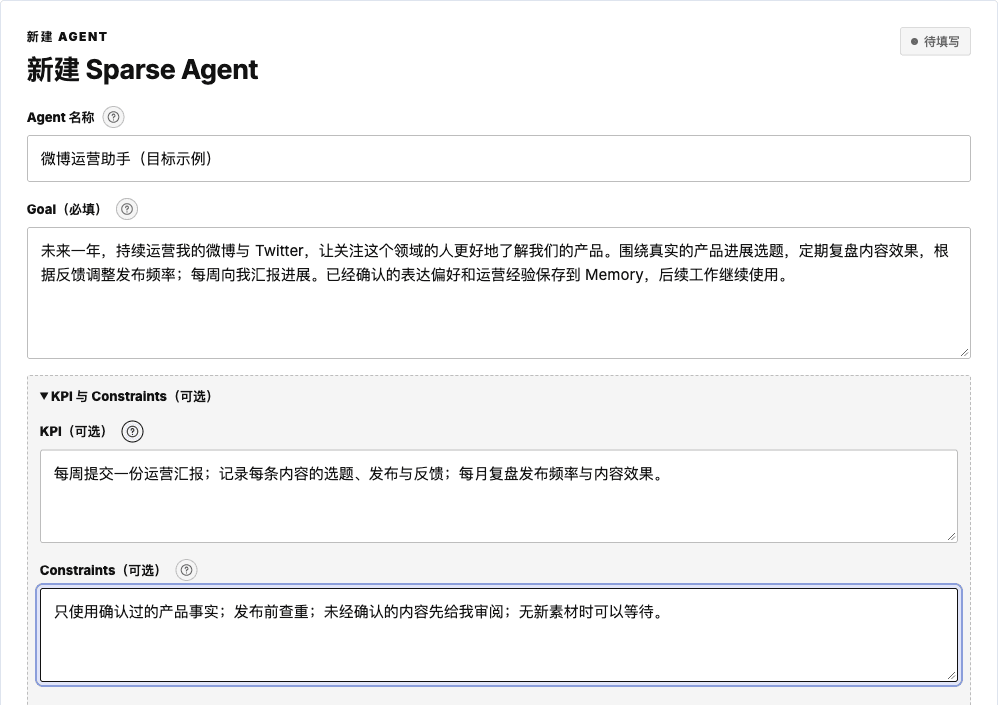
The Sparse Agent assignment form. The Weibo operations goal shown is an example; no Agent has been created.
Work gradually unfolds around that goal: understand the account and existing content, prepare topics and materials, observe responses after publication, and adjust the next round. The schedule also needs to fit the situation. If preparations are finished in the morning, the content is suited to an evening release, and nothing else is pending, it can wait. New materials or requirements from the user can change subsequent plans.
At the end of each round, Sparse Agent saves current progress and schedules the next work session and task. When it resumes, it uses existing records and the latest situation to decide what to do next. As long as the responsibility continues, the work can keep moving.
Working when needed can also help control model usage. Waiting does not require continuous model generation; the model is called when judgment and execution are needed. Actual token usage still depends on the chosen model, task complexity, and workload.
A cloud computer in your own account
An Agent needs an environment where it can use a browser, terminal, and files to carry out work. Sparse Agent uses a Linux cloud computer running Omarchy. Started by DHH, Omarchy provides a complete desktop and tool environment where the Agent can research, handle files, run tools, and add software as the task requires.
This computer runs in the user's own DigitalOcean account. The user can view and manage the host, enter the working environment through SSH, inspect working files, and decide whether to retain or delete it. Data and results handled by the digital worker have a clear storage location and management interface.
New cloud environments currently have no time limit by default. An automatic deletion period of 1–168 hours can also be set during creation. Long-term responsibilities require arrangements for the model, cloud host, and account authorization so that subsequent work has what it needs to continue. Cloud costs are billed through the user's own cloud provider account. When finishing, save the results and confirm that the environment has been deleted. Shutting it down alone does not stop cloud billing. Model and cloud environment settings guide
Memory helps later work use existing experience
During ongoing collaboration, users add materials and correct requirements. They might want product descriptions to explain practical uses before listing features, need a phrase corrected, or want to reuse a solution already found for a problem. Useful information like this should still be available in the next round of work.
We built Sparse Agent Memory as an independent cloud service for working preferences, project agreements, confirmed decisions, and reusable methods. Users can ask an Agent to remember a requirement, then retrieve and apply it later. When an agreement changes, the relevant memory can be updated with its new conditions of use.
Within an authorized memory project, different Agents can reuse shared materials and experience. For example, product wording agreed during operations can inform later work by a writing Agent. Sharing needs a defined scope. The Sparse workbench currently keeps each Agent's memory separate; connecting to the same service does not mean they automatically read one another's private content.
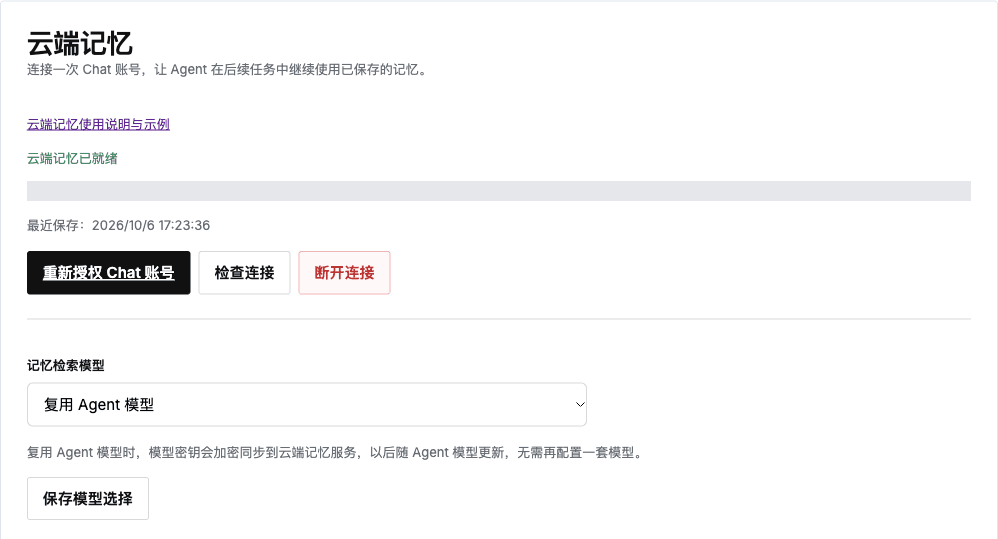
The Sparse Agent Settings → Cloud Memory screen. The connection is ready, and the account has been redacted.
When we say it becomes smarter through use, we mean accumulated experience from collaboration: useful methods are saved, outdated requirements are updated, and subsequent work applies them to the current situation. Users can also search, inspect, and export their memory through the Memory website. Important deliverable files still need to be saved separately; the memory service keeps information that can be used again. Cloud memory guide
Send messages, keep communicating, and receive reports
You do not need to connect every third-party application before starting. After setting up the model and cloud environment and defining the goal, you can message the Agent in the workbench to provide materials, check progress, or assign an immediate task.
Log in and authorize accounts as the work requires them. To operate Weibo or X, log in to your account in the Agent's browser and agree on the publishing scope. To receive reports by email or Telegram, the Agent can help with configuration. Once login and testing are complete, agree on the notification contents and schedule.
Temporary materials and current tasks can be sent as messages. To change the long-term responsibility, edit Goal, KPI, and Constraints in the workbench. Users can pause work, add new judgments, and then let it continue.
Arranging necessary help is also part of a digital worker's responsibility. When logins, identity confirmation, payment authorization, or code releases require a person, the Agent should explain what is missing, why it is needed, and how work will continue afterward. The user should not have to follow every step personally. The Agent should keep following up and remind the user when participation is needed.
Start with one task that needs ongoing follow-up
For a first attempt, choose work with a clear scope and results that are easy to check. Explain the responsibility, how progress will be assessed, and which actions can be completed independently. Agree on reporting and how assistance will be requested. Use a specific task to assess whether the collaboration works, then gradually expand the responsibility.
Sparse Agent currently uses an invitation system. If you are interested, message me or leave “助手” in the WeChat account's inbox and tell me what work you want it to keep advancing. I will provide an invitation code and access details. You can also apply by email at allwefantasy@gmail.com.
Website: sparse-agent.com. Follow the page's invitation-code instructions when first joining, then sign in with your own Auto-Coder Chat account. Use your own provider accounts for the model and cloud services, and connect cloud Memory as needed.
Handbook: Goal, KPI, and working constraints. Further reading: Three Types of Work That Fit Sparse Agent.
The digital worker we want to build remembers its responsibility and keeps the work moving. It preserves progress when waiting is appropriate and proactively contacts the user when participation is needed. Goals, KPIs, a working environment, and memory all need to support this continuing responsibility in practice.