
Data governance in an enterprise usually involves aligning business meanings, database records, and the methods used in analysis. The same “sales revenue” figure will produce different results depending on whether it is calculated from signed contracts, shipments, or payments received. A metric's definition specifies the scope, time period, and rules used to calculate it. Agreeing on those definitions and ensuring that data is used accordingly has long been a shared responsibility of business leaders and data teams.
The traditional approach usually begins with building a data warehouse, processing and organizing data from separate business systems into structures suitable for analysis. This work relies on three groups: engineering and data warehouse and modeling staff organize and process the underlying data; business experts determine metric definitions; and analysts use SQL, a database query language, to retrieve data, calculate figures, and perform analysis. Understanding a data warehouse often requires bringing all three groups together to explain why tables were designed a particular way, what fields mean, and how a business question should be answered.
With InfiniSynapse, these roles change substantially. Business users can retrieve data directly. Analysts spend more time helping the system learn the business, reviewing results, and preserving their experience. Business experts leave knowledge behind through everyday use. Work that previously centered on building a data warehouse shifts toward keeping the system stable. Looking at each person's daily work helps explain this change.
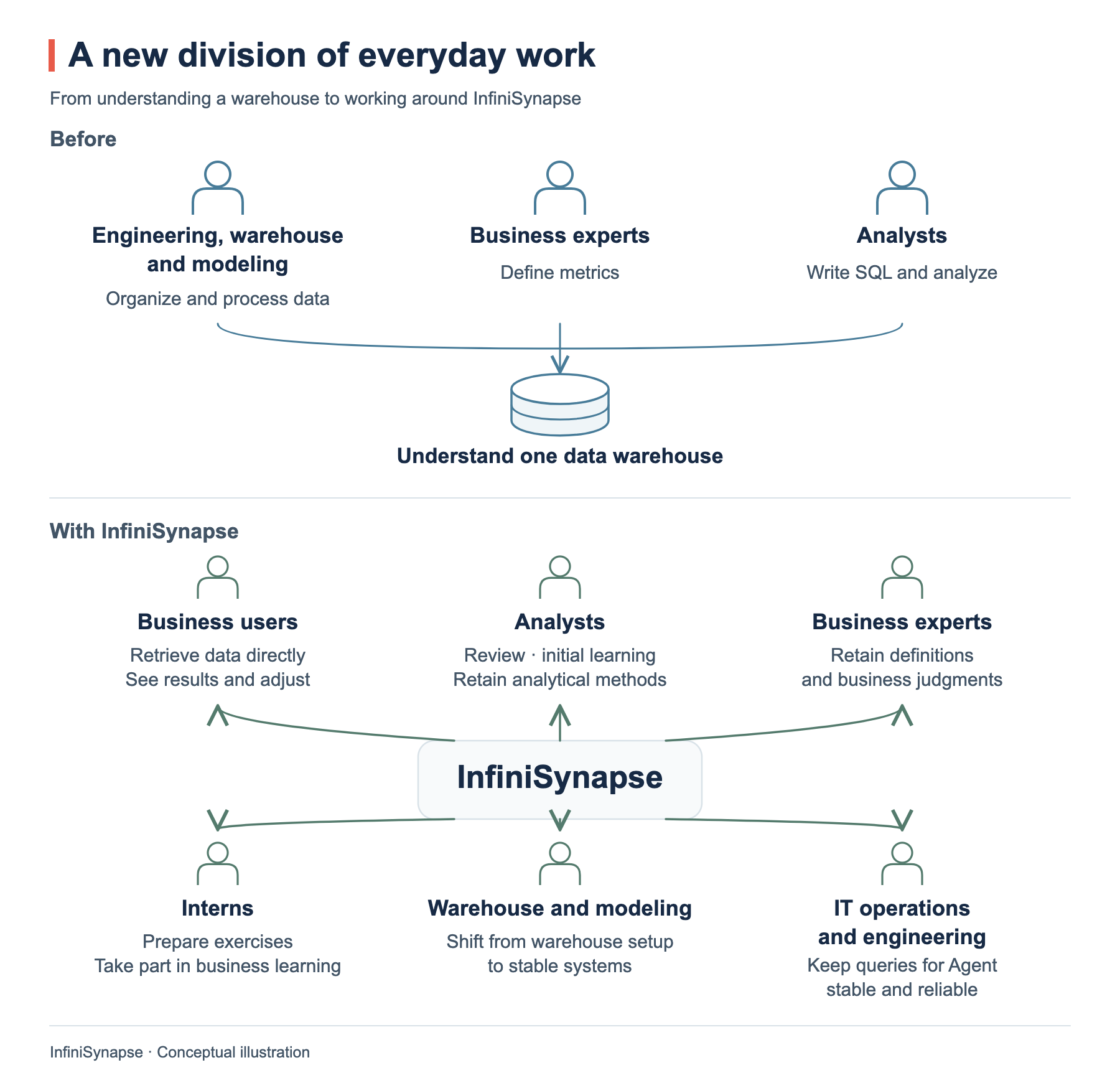
Division of work illustration: the three groups involved in understanding a warehouse appear above the six roles working around InfiniSynapse.
Business users: see the results, then clarify the question
Previously, a business user who wanted to understand changes in sales would usually explain the request to an analyst, then wait while the analyst found the tables, wrote queries, and checked the results. If the user subsequently wanted a different breakdown, or discovered a problem with the original reporting scope, another round of communication would follow.
The difficulty is that business users often cannot say precisely what they need at the outset. Someone might begin by asking, “How are sales this month?” Only after seeing the results do they realize that they need a breakdown by region or channel, or that canceled orders should be excluded. The request takes shape as the user examines the data. Requiring every condition to be specified in the first question can leave the analysis waiting on further explanation.
With InfiniSynapse, business users can retrieve data directly, without relying on an analyst to handle every query, and see the results immediately. They can look at monthly sales, examine a particular region, and ask further questions when something looks unusual. If a reporting condition is unsuitable, they can adjust it there and then. Removing repeated queues and handoffs greatly reduces waiting and makes it easier to follow the results into deeper questions.
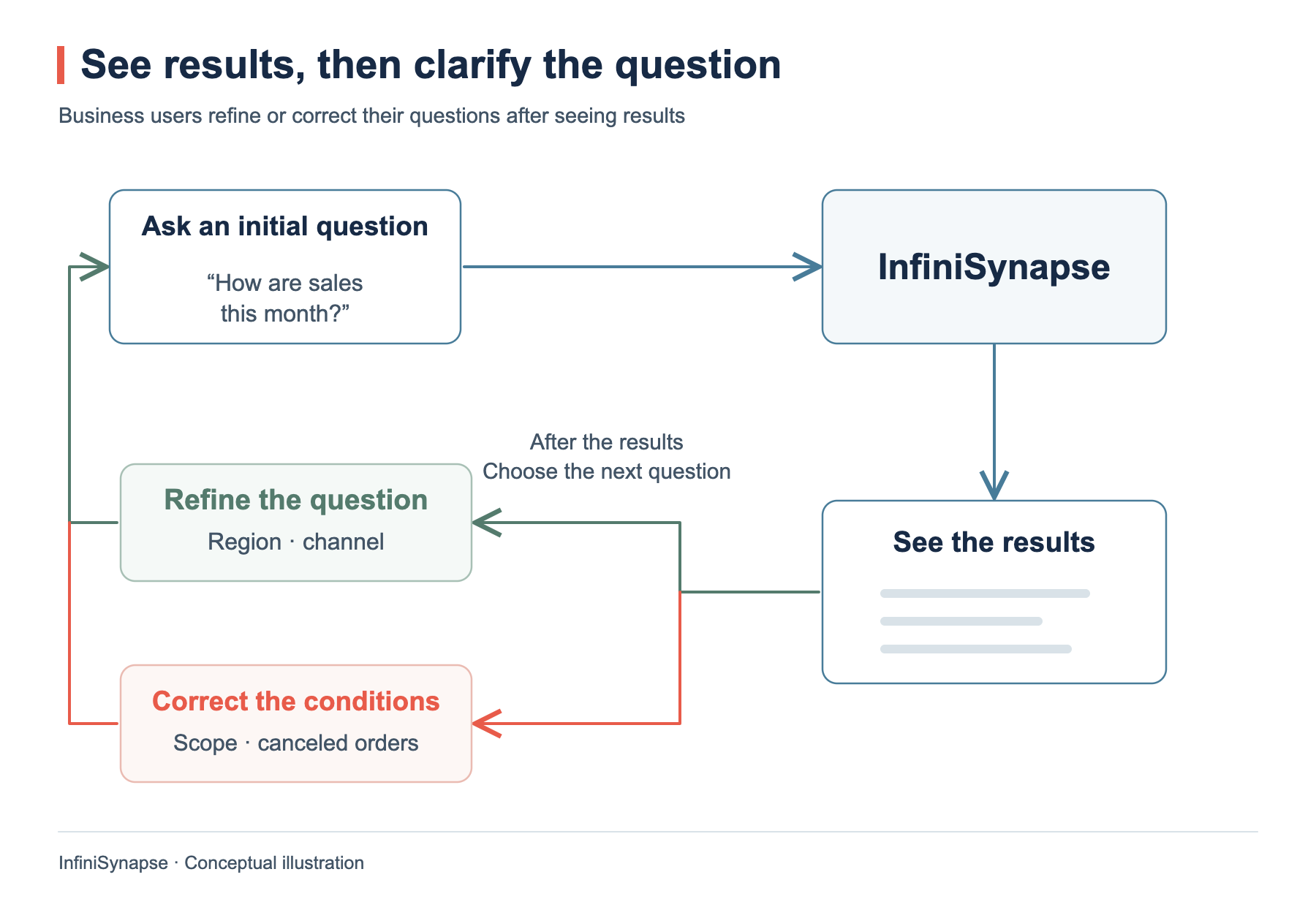
Questioning loop illustration: after seeing results, business users follow either the refinement or correction branch to ask again.
The system's accuracy can also be set according to business needs. For example, a business user might say, “I want an accuracy of 39%,” and InfiniSynapse can provide that capability. Accuracy here means the proportion of correctly answered questions within an agreed set of business questions. The business scope, what counts as a correct answer, and how acceptance will be assessed need to be specified together, followed by checks that the system meets the requested standard. Timely results and a clear understanding of the standard those results meet give business users a basis for using and trusting the system.
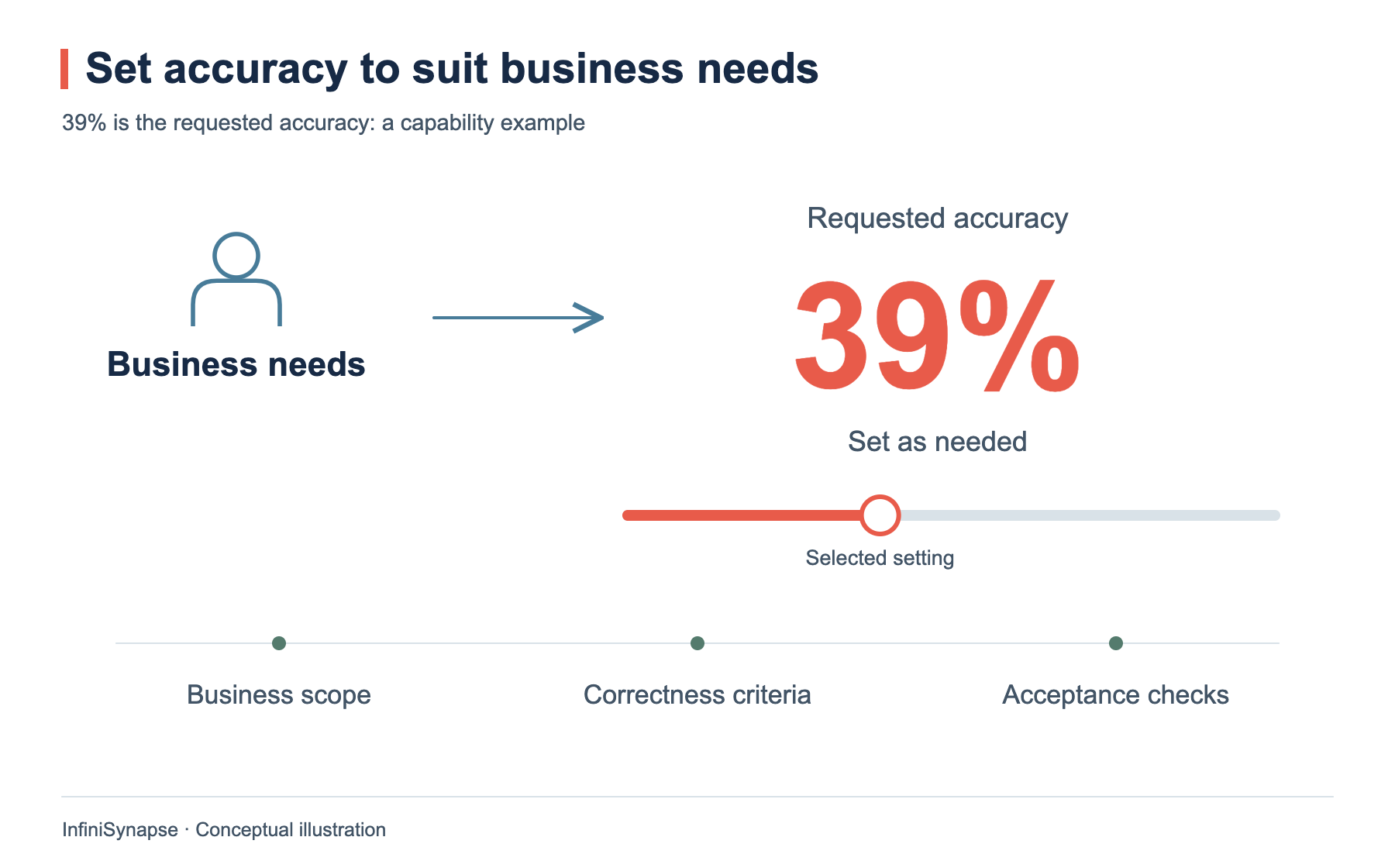
Accuracy setting illustration: the control is set to 39%, with business scope, correctness criteria, and acceptance checks below.
Business users therefore gain another daily responsibility: examining results, deciding where more detail is needed, and bringing business questions back into the analysis promptly. Their understanding can feed directly into the next question, allowing the analysis to continue alongside their business judgment.
Analysts: review and initial learning become the main work
When business users can retrieve data themselves, analysts spend less time repeatedly writing queries, producing reports, and explaining similar questions. Their main attention shifts to review and cold start, maintaining InfiniSynapse's ability to learn the business automatically. Cold start here means helping the system acquire an initial set of reliable business knowledge and analytical methods when it first encounters a business area.
Consider monthly sales again. An analyst can select questions and reliable answers from existing reports and business applications, specify the time period, business scope, and filters, and let the system try to reproduce the answers. When results differ, the analyst needs to identify the reason: whether refunds were deducted, canceled orders were excluded, or regions were assigned by customer location or the store where a sale was made. Once the cause is understood, the correct approach can become part of subsequent learning.
Everyday review also involves specific tasks. InfiniSynapse's enterprise edition already supports human review of changes to table and field meanings, metric definitions, and analytical cases. Analysts can examine the old and new descriptions proposed by the system, decide whether to accept them, or point out what needs revision. Someone is therefore responsible for checking whether knowledge acquired during analysis is suitable for continued use, and mistaken interpretations can be corrected.
Analysts also need to preserve deeper business understanding and analytical methodology: how to break down a class of questions, make comparisons, and investigate causes. When sales decline, which dimensions should be examined first? Which metrics need to be considered together? What circumstances call for further checks? These practices can be saved with analytical cases. When someone later asks about a different month or phrases a question differently, the system can reuse the applicable approach. A problem an analyst has worked through can then help with many subsequent questions.
Business experts: retain business definitions through use
Previously, business experts often explained the business and confirmed metrics during a concentrated period at the start of a project. Analysts and technical staff would then put those explanations into documents, queries, or models. When the business changed, experts had to explain it again, sometimes repeating the same rule across many projects.
Business experts become more important with InfiniSynapse. Analysis continually encounters questions that require their judgment: what status makes an order complete, from which period a new expense should be deducted, or why sales and finance define revenue differently. These judgments determine whether a result makes sense in the business.
Experts can do this work while examining results and correcting metric definitions. For example, during a discussion of monthly sales, an expert may explain that the sales department looks at the value of completed transactions, while finance also considers payments actually received. The system then has business definitions that need to be distinguished. Once the relevant knowledge has been confirmed and reviewed, it remains available, allowing later analyses to use the appropriate calculation rules and reducing repeated explanations.
What is retained is the calculation rule and the conditions under which it applies. Saving a sales figure for one month does not explain how to retrieve the data next month. Understanding how a figure is calculated and which questions it applies to makes reuse possible. The explanations and corrections business experts contribute each time they use the system can become knowledge for later analysis. Deeper participation gives the system a better chance of keeping its understanding aligned with changes in the business.
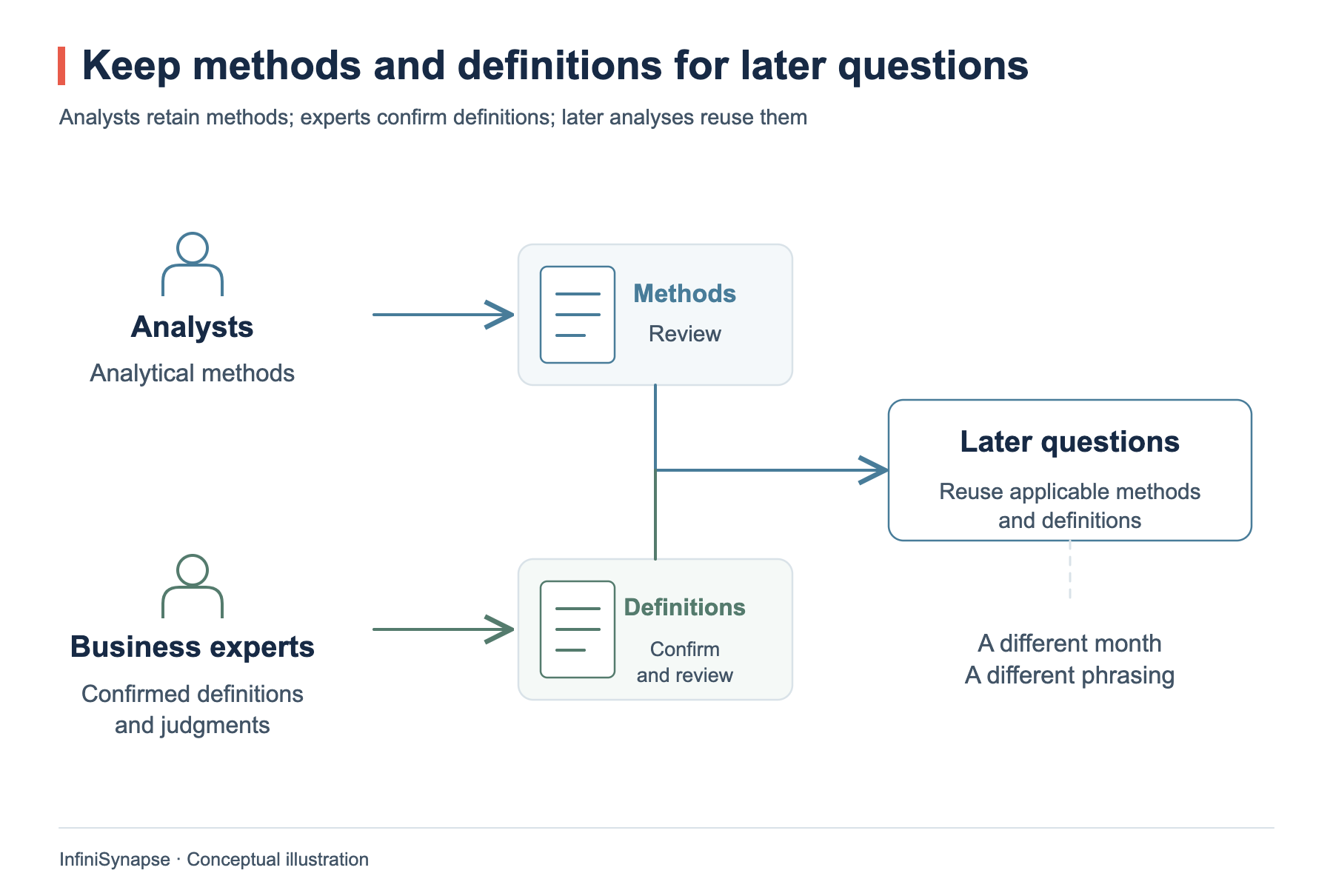
Knowledge reuse illustration: reviewed methods from analysts and confirmed business definitions connect to later questions.
Interns: participate in business learning by preparing exercises
In the traditional division of work, interns may be able to organize reports and check numbers while still finding it difficult to explain the underlying databases and the full analytical logic independently. Turning that material into knowledge a system can use requires further work from experts, analysts, and technical teams.
InfiniSynapse gives them an easier way to participate. A few interns can prepare exercises from existing reports, business applications, or confirmed questions and answers, recording each question, its answer, and the relevant reporting conditions, then let the system work through the exercises. Ambiguous questions and mismatched answers can be referred to analysts and business experts for checking.
For example, an exercise asking, “What are this month's net sales in a particular region?” needs to specify the region, period, and treatment of refunds. To reproduce the answer, the system needs to gradually establish where orders and refunds are stored, how the relevant databases and tables relate, what the fields mean in business terms, and how net sales should be calculated. With a few interns helping prepare exercises and the system working through them, business logic, the business meanings and structures of the underlying databases and tables, and analytical methodology can gradually be learned.
Interns prepare clear questions and answers; the system handles exploration and knowledge organization while working through the exercises; and professionals take responsibility for key judgments and review. This division lets existing business work support initial learning and allows more people to participate in preparation. Once the system has learned how to handle a class of questions, it has a basis for answering new ones with different periods, regions, or conditions.
Data warehouse and modeling staff: the focus shifts to system stability
Traditionally, data warehouse and modeling staff organize scattered data into structures suitable for analysis, handle relationships between tables, and document the meanings of databases, tables, and fields. A new analytical requirement may call for additional data processing, changes to a model, and maintenance of the accompanying descriptions. A great deal of this work sits behind the reports business users eventually see.
In InfiniSynapse's approach, data warehouse and modeling staff move away from the sequence of first building a warehouse and then manually describing fields. They no longer carry out that entire set of upfront construction and preparation tasks. Through exercises, analysis, and corrections, the system gradually learns table structures, business meanings, and analytical methods, with people confirming and reviewing key points. Knowledge that previously had to be assembled in advance can accumulate through actual questions.
These staff members spend more of their time ensuring system stability. As business questions change, data needs to remain available for queries so that learned methods can be used repeatedly and subsequent analyses can continue.
IT operations and engineering: provide reliable query services to Agent
Previously, engineers were heavily involved in data retrieval, processing, and warehouse construction, while operations staff kept the related databases, jobs, and services running. With InfiniSynapse, IT operations and engineering also move away from first building a warehouse and manually describing tables and fields, devoting more effort to keeping the system stable.
The way queries are used also changes. DataEngine is the data engine within InfiniSynapse that handles queries; Agent is a program that requests results from that engine on a person's behalf. After a business user asks a question directly, Agent requests data as the analysis requires and continues processing the results. Follow-up questions after the user sees a result may lead to several queries within the same analysis. As usage grows, DataEngine handles an increasing volume of queries.
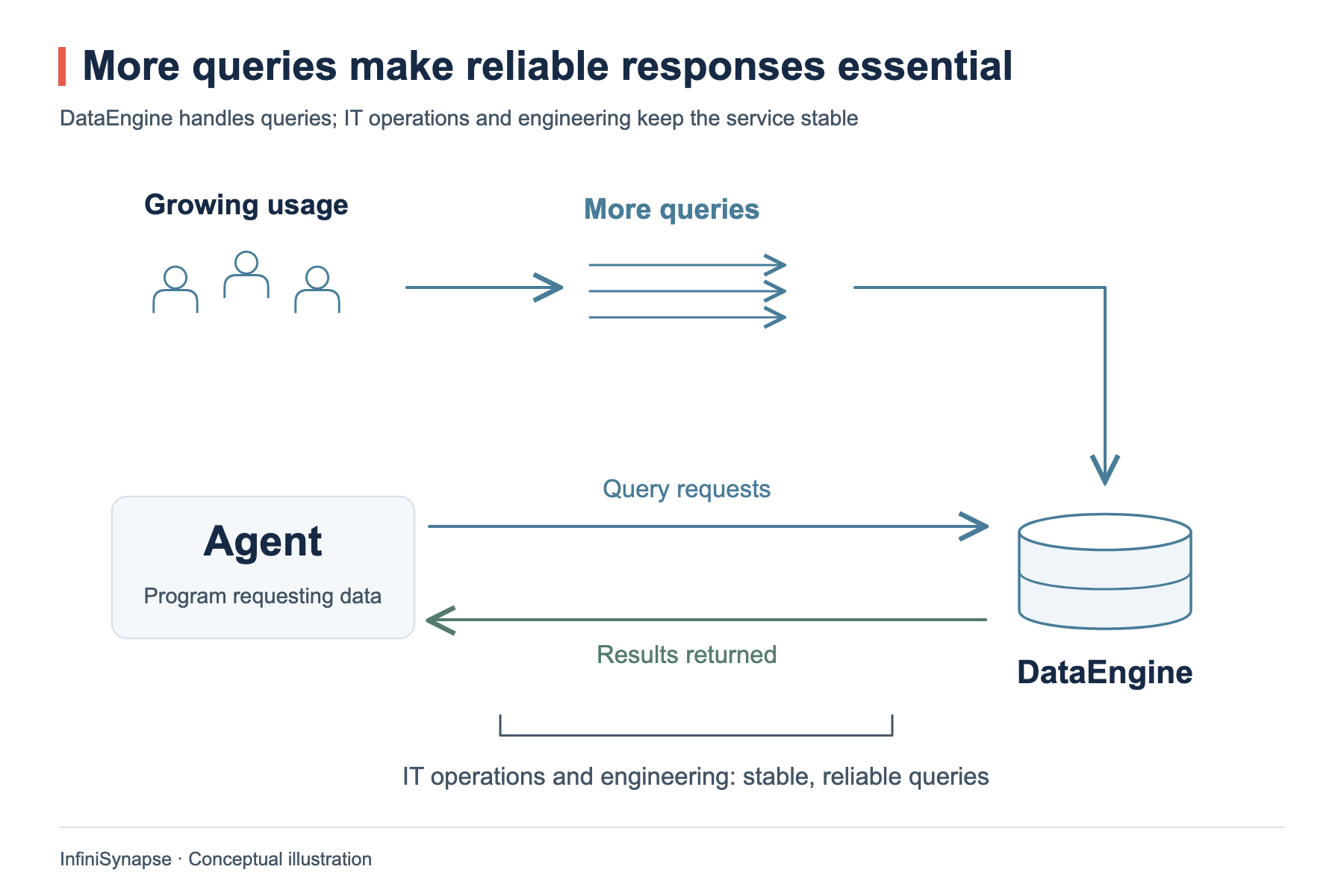
Query service illustration: growing usage brings more queries; Agent requests data, DataEngine returns results, and IT operations and engineering maintain the service.
For IT operations and engineering, providing Agent with stable, reliable query services therefore becomes more important. The system's ability to keep responding as query volume rises, and to recover promptly from faults, affects whether business users can continue their analysis. Methods approved by analysts and definitions confirmed by business experts both require actual query execution to produce fresh results. The stability of the underlying services becomes a foundation for this division of work.
Business users work directly with data, analysts maintain learning and review, business experts keep contributing judgments, interns help prepare exercises, and warehouse, modeling, and IT teams keep the system stable. Together, these responsibilities form a new daily working relationship. Sustaining data governance increasingly depends on the repeated use of business experience and the continued reliable execution of queries.